Why the Ribbed CPAP Tubing Is the Therapy Pressure Delivery Boundary and the Kink Prevention Component of the CPAP System Simultaneously
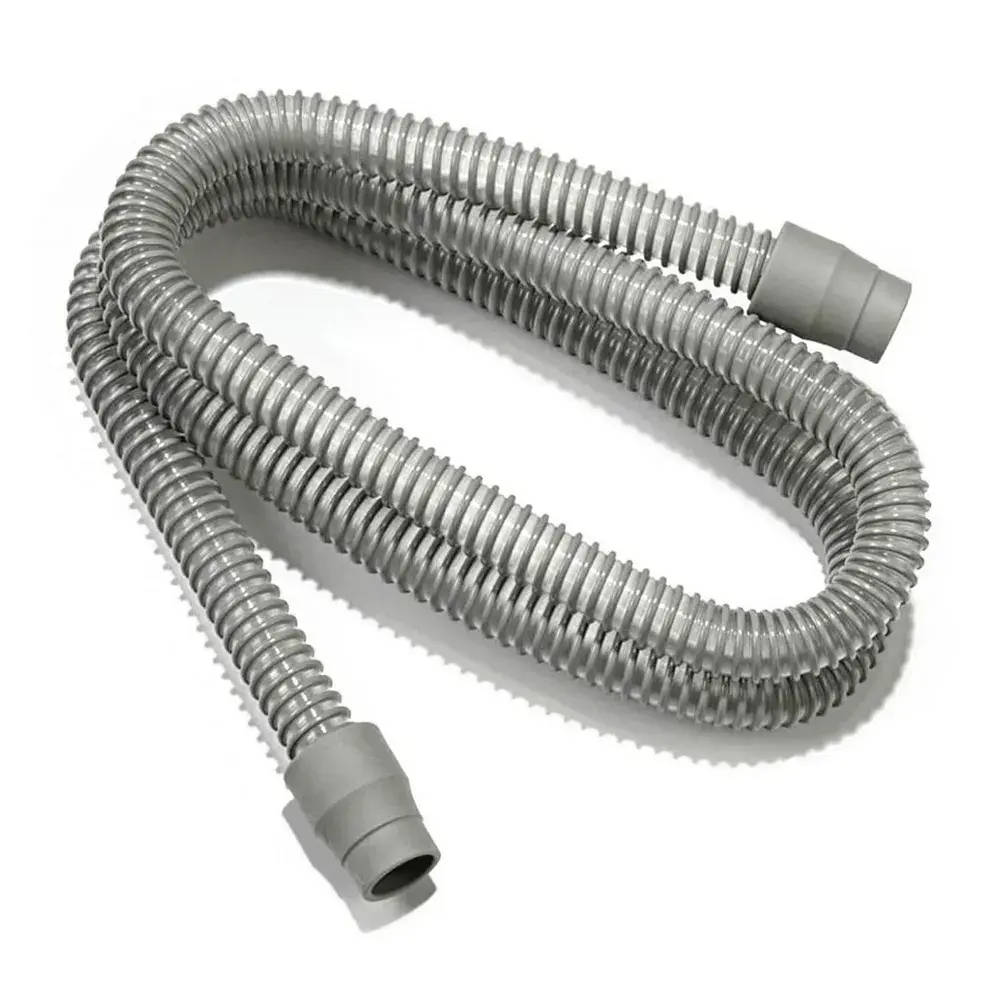
The ResMed 6-foot ribbed standard CPAP tubing serves two structurally distinct functions that are both essential to reliable and comfortable CPAP therapy, and that a single tubing component must satisfy simultaneously. The first function is therapy pressure delivery: the CPAP tube is the pressurised airway through which the machine's therapy output — the precisely controlled pressure waveform at the prescribed level between 4 and 20 cmH₂O — is carried from the machine's output port to the mask interface at the patient's face. This pressure must arrive at the mask within the tolerance the device's pressure compensation algorithm is calibrated for, which means the tube's internal diameter, length, and wall compliance must collectively produce a resistance and compliance characteristic that the CPAP machine's output compensation accounts for correctly. The 19 mm internal diameter of the ResMed ribbed tube is the industry-standard bore specification for CPAP therapy tubing — large enough to maintain the airflow velocity and pressure drop characteristics that CPAP machines operating at therapy pressures of 4–20 cmH₂O are calibrated to deliver through standard-specification tubing, without the elevated resistance of a narrower tube or the increased compliance losses of a wider, thinner-walled tube. The 22 mm cuff connectors at both tube ends interface with the 22 mm standard port geometry used by ResMed, Philips Respironics, Fisher & Paykel, DeVilbiss, and most other CPAP machine manufacturers, making the tube a functional cross-brand replacement without adapter requirements.
The second function the ribbed tubing must satisfy simultaneously is kink prevention — maintaining unobstructed airflow continuity through the tube during the full range of positional changes, tube routing configurations, and contact with bed surfaces that occur during overnight CPAP use. A CPAP tube that kinks during sleep creates a partial or complete flow obstruction at the kink point that reduces the delivery pressure at the mask below the therapeutic level — and does so intermittently, in correlation with the patient's sleep position changes, creating therapy pressure interruptions that may not be detected by the device's mask pressure monitoring but that reduce the efficacy of the therapy at the moments they occur. The ribbed exterior construction of the ResMed standard tube addresses this kink risk through a corrugated wall geometry that distributes the bending stress of tube flexion across the series of ribbed ridges rather than concentrating it at a single tube wall section, as a smooth-walled tube would. When a smooth-walled tube is bent sharply — at a pillow edge, under the patient's body weight, or at a tight loop over a bed rail — the outer wall of the bend is placed in tension and the inner wall in compression, and if the bend angle exceeds the tube wall's elastic limit, the wall buckles inward to produce the kink. The ribbed tube's corrugated structure allows each rib section to compress or extend independently under the same bending force, distributing the total bend angle across the multiple rib intervals rather than localising it at one wall section, and preventing the buckling that single-point bend concentration produces.
The 6-foot length of the ResMed standard tube addresses the machine placement flexibility requirement of home CPAP therapy, where the CPAP machine may be placed on a bedside table, nightstand, or floor at varying distances from the patient's head position. The 6-foot length provides sufficient reach from machines positioned on the floor beside the bed, on a nightstand at the same level as the pillow, or on a surface at a slightly elevated position — without creating an excess loop of slack tubing that gathers beside the pillow and produces drag forces on the mask as the patient moves through it. Six feet is the standard length specification for home CPAP tubing across most CPAP manufacturers because it represents the practical centre of the machine placement distance range in a typical bedroom, providing adequate reach for both close and mid-distance placements without the handling challenges of a significantly longer tube.
The non-heated specification of the ResMed standard tube places it in the standard configuration for use with CPAP machines that do not have integrated heated humidifiers requiring a heated tube, or for use with machines that have an integrated humidifier in environments where condensation rainout is not a concern requiring heated tube management. Patients whose primary therapy comfort concern is humidification consistency in cool room environments, and who experience condensation water droplet accumulation in the tube during winter use, would benefit from a heated tube compatible with their specific machine model. The standard non-heated ribbed tube is the appropriate replacement for patients whose therapy setup does not include heated humidification, or who use their CPAP in ambient conditions that do not produce condensation in standard unheated tubing.
KEY FEATURES
- Ribbed corrugated exterior — ribbed wall geometry distributes bending stress across multiple rib intervals rather than concentrating it at a single wall section, preventing the tube wall buckling that produces kinking in smooth-walled tubes under the same bend angles
- 19 mm internal diameter — standard CPAP therapy tube bore specification, maintaining the airflow velocity and pressure drop characteristics that CPAP machine pressure compensation algorithms are calibrated for across the 4–20 cmH₂O therapy pressure range
- Universal 22 mm cuff connectors — both-end standard 22 mm interface compatible with ResMed, Philips Respironics, Fisher & Paykel, DeVilbiss, and most other CPAP and BiPAP machines without brand-specific adapters
- 6-foot length — standard home CPAP therapy length covering the practical range of bedside machine placement distances without tube tension on the mask at far placements or excess slack loop at closer placements
- Non-heated standard configuration — appropriate replacement for setups without heated humidification requirements, or for ambient temperature conditions that do not produce condensation rainout in standard unheated tubing
BENEFITS
- Ribbed structure prevents therapy pressure interruptions from kinking — corrugated wall geometry maintains tube patency through the range of bend angles encountered during sleep position changes, pillow contact, and bed-surface tube routing that would kink a smooth-walled tube
- Standard 19 mm bore maintains therapy pressure delivery accuracy — tube resistance specification consistent with CPAP machine pressure compensation calibration, ensuring machine output pressure corresponds to mask delivery pressure within the device's therapy tolerance
- Universal 22 mm connectors cover most CPAP and BiPAP brands — single tube purchase compatible across the range of machines without brand-specific tube sourcing, supporting use as a cross-platform replacement in multi-device households and clinical settings
- 6-foot length supports flexible machine placement — standard length accommodates the normal range of bedside surface placement distances without requiring tube extension or creating excess slack management during sleep
- Ribbed design maintains flexibility across a wide bend range — tube remains supple and manageable during the routing adjustments patients make at bedtime, without the stiffness that some kink-resistant tube constructions introduce
TYPICAL APPLICATIONS
✓ Scheduled CPAP tube replacement — replacement at the recommended interval (typically every 3–6 months) as part of routine CPAP maintenance, with the ribbed construction and 22 mm connectors providing a direct specification match for most ResMed machine setups
✓ Cross-brand tube replacement — universal 22 mm cuffs allow use as a replacement tube for Philips Respironics DreamStation, Fisher & Paykel, and DeVilbiss machines in addition to ResMed devices, covering the full range of standard 22 mm-interface CPAP machines
✓ Active sleepers with tube kinking history — ribbed corrugated construction for patients who have experienced airflow interruptions or mask pressure drops caused by tube kinking at pillow edges, under body weight, or at tight tube routing angles during sleep
✓ Non-humidified or standard humidifier setups — standard non-heated tube for patients using CPAP without humidification, or with a humidifier in conditions that do not produce condensation rainout requiring a heated tube solution
✓ Backup or spare tube — additional standard tube for travel or emergency replacement, with the universal 22 mm cuffs ensuring compatibility with any standard CPAP machine the patient may use the spare tube with

 780 409-1509
 Get directions