
Slideshow Items

  • Catheters
  • continence-ostomy/catheters
  • Continence & Ostomy
  • continence-ostomy
OSS-Ostomy Essentials

  |  

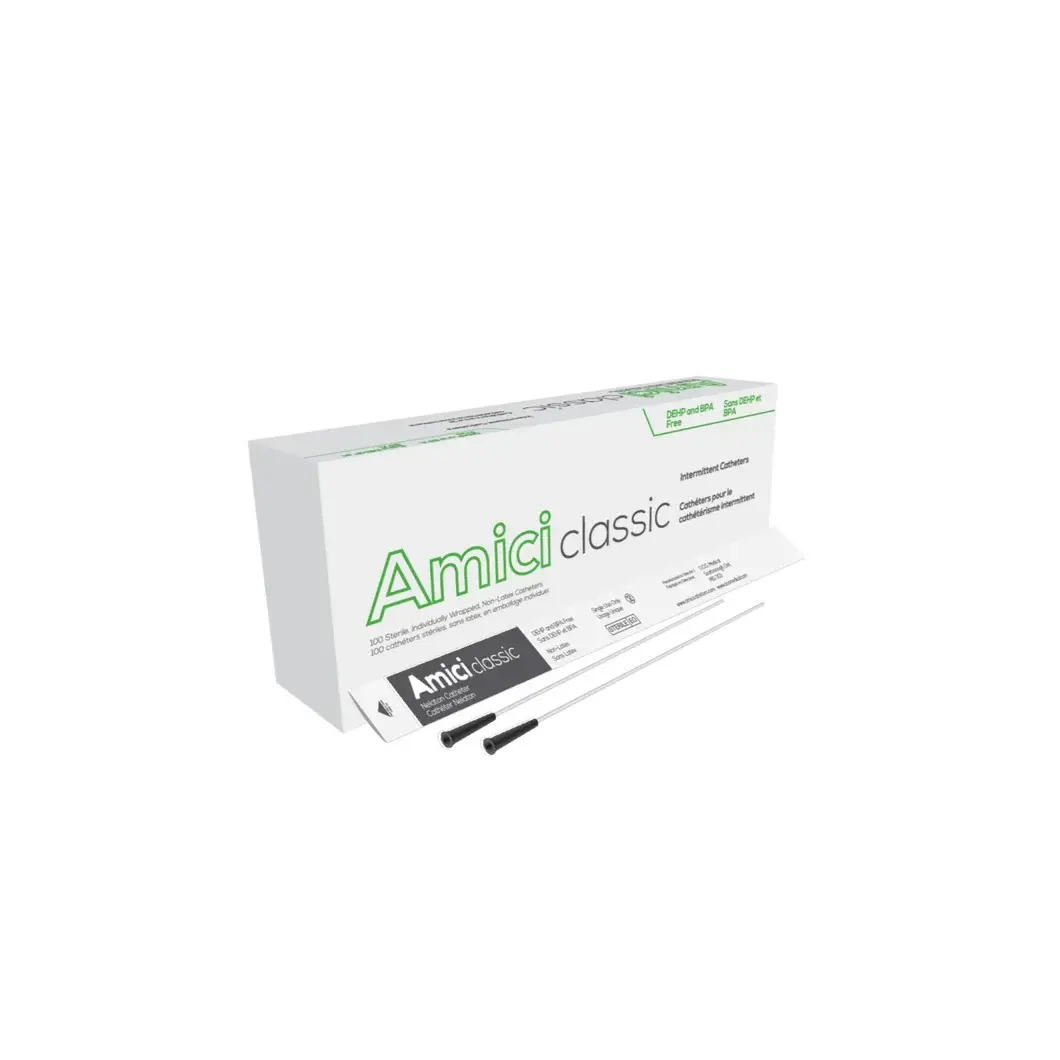
Amici Classic Male Intermittent Catheters 16in 10FR

C$1.00
In stock online
In store: Check availability

Available in store

SKU: 3910

16-inch male intermittent catheter with 10FR diameter for comfortable drainage. Medical-grade PVC with polished eyelets reduces friction. Straight tip. Latex-free, sterile single-use. For clean intermittent catheterization. Individual pack.

    • The Amici Classic male intermittent catheter represents an accessible, cost-effective solution for clean intermittent catheterization (CIC), providing reliable urinary drainage for patients with urinary retention, neurogenic bladder, post-surgical complications, or other conditions preventing normal bladder emptying. The 16-inch length is specifically designed for male urethral anatomy, accommodating the longer male urethra (approximately 18-20cm from meatus to bladder) while providing sufficient external length for handling and control during insertion.

      The 10 French (10FR) diameter—equivalent to approximately 3.3mm outer diameter—represents a slim, low-resistance catheter option particularly suitable for adolescents, young adults, patients with urethral strictures or sensitivity, and individuals new to catheterization who may benefit from starting with a smaller diameter before progressing to larger sizes. While 12-14FR is considered the standard adult male catheter size, the 10FR option fills a critical clinical niche for patients who cannot tolerate standard sizing due to anatomical constraints, previous urethral trauma, post-surgical narrowing, or comfort preferences.

      The medical-grade PVC (polyvinyl chloride) construction provides a balance of flexibility and structural integrity—soft enough to navigate the natural curves of the male urethra without causing trauma, yet firm enough to advance smoothly without kinking or collapsing during insertion. The polished drainage eyelets (typically 2 lateral openings near the catheter tip) are specifically engineered with smooth, rounded edges to minimize mucosal irritation during insertion and withdrawal, reducing the micro-trauma that can lead to urethral strictures, bleeding, or infection over time.

      The straight tip design—as opposed to coudé (curved) tips—is appropriate for the majority of male catheterization situations where the prostatic urethra and bladder neck are not significantly obstructed. Straight tips offer easier insertion technique for self-catheterization users and are less likely to cause bladder wall trauma from incorrect positioning, making them the recommended starting point for most CIC patients.

      The sterile single-use packaging is essential for infection control in intermittent catheterization. Unlike indwelling catheters (Foley catheters) that remain in place continuously, intermittent catheters are inserted 4-6 times daily, making infection prevention through proper sterile technique and single-use products a critical clinical priority. Catheter-associated urinary tract infections (CAUTIs) represent one of the most common healthcare-associated infections, and proper CIC technique with sterile, single-use catheters reduces CAUTI risk by 80-90% compared to reusable or improperly sterilized catheters.


      Key Features & Benefits

      16-Inch Length - Male Urethral Anatomy Specific

      ✓ Designed for male urethra length (18-20cm urethral passage)
      ✓ Provides adequate external length for handling (8-10cm remains outside body)
      ✓ Allows secure grip during insertion without risk of catheter slipping too far
      ✓ Accommodates various body sizes (standard length works for 95%+ of adult males)
      ✓ Longer than female catheters (6-8") but shorter than coudé specialty catheters (18"+)

      10 French (10FR) Slim Diameter

      ✓ 3.3mm outer diameter (smaller than standard 12-14FR adult catheters)
      ✓ Ideal for adolescents, young adults, and smaller-framed individuals
      ✓ Reduced insertion resistance (important for urethral strictures, sensitivity)
      ✓ Gentler on urethral mucosa (less stretching, less micro-trauma)
      ✓ Appropriate for patients new to CIC (start smaller, progress to larger if needed)
      ✓ Essential for post-surgical patients (urethral healing, post-TURP, post-urethroplasty)

      Medical-Grade PVC Construction

      ✓ Flexible yet firm (navigates urethral curves without kinking)
      ✓ Smooth surface reduces friction during insertion
      ✓ Biocompatible material (minimal tissue reaction)
      ✓ Clear tubing allows visual confirmation of urine flow
      ✓ Cost-effective compared to hydrophilic-coated catheters ($0.50-2 vs. $3-8)
      ✓ Suitable for frequent daily use (4-6× daily = 120-180 catheters monthly)

      Polished Drainage Eyelets

      ✓ Smooth, rounded edges (reduce mucosal irritation)
      ✓ Typically 2 lateral eyelets near tip (optimal drainage without bladder wall trauma)
      ✓ Prevents "grabbing" or catching on urethral tissue during withdrawal
      ✓ Reduces long-term complications (urethral strictures, scarring, bleeding)
      ✓ Critical for users performing 1,000+ catheterizations annually (reduces cumulative trauma)

      Straight Tip Design

      ✓ Appropriate for 80-85% of male CIC patients (most don't need coudé curve)
      ✓ Easier insertion technique vs. coudé (fewer steps, less skill required)
      ✓ Lower risk of bladder wall trauma (coudé can perforate if incorrectly positioned)
      ✓ Recommended starting point for new CIC patients (master straight before trying coudé)
      ✓ Suitable for neurogenic bladder, urinary retention, incomplete emptying

      Sterile Single-Use Packaging

      ✓ Individual sterile packaging (reduces CAUTI risk by 80-90%)
      ✓ No cleaning/sterilization required between uses (vs. reusable catheters)
      ✓ Eliminates bacterial colonization from inadequate cleaning
      ✓ Meets healthcare infection control standards (hospitals, nursing homes, home care)
      ✓ Convenient for travel, work, public restrooms (dispose after use)

      Latex-Free Composition

      ✓ Suitable for latex-allergic patients (5-10% of population)
      ✓ Reduces allergic reaction risk (contact dermatitis, anaphylaxis in severe cases)
      ✓ Essential for patients with spina bifida (70-80% have latex allergy)
      ✓ Hospital-safe (many facilities have latex-free policies)

      Clear Tubing for Visual Confirmation

      ✓ See urine flow immediately (confirms proper bladder entry)
      ✓ Monitor urine characteristics (color, clarity, blood presence)
      ✓ Ensures complete drainage (see when flow stops = bladder empty)
      ✓ Educational tool (helps new users learn proper technique)


      Clinical Applications

      Primary Applications:

      Neurogenic Bladder (Spinal Cord Injury, Spina Bifida, Multiple Sclerosis)
      Neurological damage disrupts bladder control signals, causing urinary retention (incomplete emptying) or incontinence. CIC is the gold standard treatment, performed 4-6 times daily to empty the bladder completely, prevent kidney damage from high bladder pressures, and reduce UTI risk. The 10FR size is particularly common in pediatric spina bifida patients and adolescents with spinal cord injuries who require lifelong CIC.

      Post-Surgical Urinary Retention
      Following pelvic surgeries (prostate, bladder, colorectal), temporary urinary retention is common due to anesthesia effects, post-op swelling, or surgical trauma to pelvic nerves. CIC may be required for days to weeks until normal function returns. The 10FR diameter is ideal post-operatively when urethral edema or surgical narrowing makes larger catheters uncomfortable or impossible to pass.

      Benign Prostatic Hyperplasia (BPH) - Incomplete Emptying
      Enlarged prostate compresses the urethra, causing incomplete bladder emptying, urinary retention, and overflow incontinence. Patients who cannot tolerate or refuse surgery, or who are awaiting surgery, may use CIC to manage retention. The 10FR size may be necessary if the prostatic urethra is severely narrowed, though many BPH patients eventually require larger catheters or coudé tips to navigate the enlarged prostate.

      Urethral Strictures
      Scar tissue narrowing the urethra (from trauma, infection, catheterization, or surgery) can prevent normal urination. The 10FR slim diameter is specifically indicated for mild-to-moderate strictures where larger catheters cannot pass. CIC with appropriately sized catheters can help maintain urethral patency between stricture dilations or surgeries.

      Diabetic Bladder Dysfunction
      Long-standing diabetes damages bladder nerves, causing impaired sensation and weak detrusor muscle contraction, leading to incomplete emptying and chronic retention. CIC prevents urinary stasis, reduces UTI risk, and protects kidney function. The 10FR size accommodates patients with diabetic neuropathy-related urethral sensitivity.

      Post-Transurethral Resection of Prostate (TURP)
      Following TURP surgery, the prostatic urethra is healing and temporarily narrowed. CIC with smaller catheters (10FR) allows drainage while avoiding trauma to healing tissue. Patients typically progress to larger sizes (12-14FR) as healing completes over 6-12 weeks.

      Medications Causing Urinary Retention
      Anticholinergic medications (for Parkinson's, overactive bladder, depression), opioids, antihistamines, and decongestants can cause acute or chronic urinary retention as side effects. Patients who cannot discontinue medications may require CIC. The 10FR size is appropriate for temporary use or long-term management if the causative medication is medically necessary.

      Spinal Stenosis or Cauda Equina Syndrome
      Spinal cord or nerve root compression can cause neurogenic bladder with retention. CIC prevents kidney damage and UTIs while awaiting definitive treatment (surgery, medications). The 10FR size accommodates patients with partial nerve damage causing urethral hypersensitivity.

      Specific Patient Populations:

      Adolescent Males (12-18 Years)
      Transitioning from pediatric catheter sizes (6-8FR) to adult sizes; 10FR bridges this gap appropriately

      Young Adults with Spinal Cord Injury
      Lifelong CIC requirement; 10FR suitable for initial post-injury period, may upsize later

      Spina Bifida Patients
      Neurogenic bladder from birth; many use 10FR throughout adolescence and young adulthood

      Elderly with BPH and Comorbidities
      Not surgical candidates; 10FR manageable for self-catheterization with arthritis, tremor

      Post-Urethroplasty Patients
      Urethral reconstruction surgery requires smaller catheters during healing (6-12 weeks)

      Patients with Limited Dexterity
      Parkinson's, stroke, arthritis—smaller catheter = easier insertion despite hand tremor

      Home Care Patients (Non-Institutional)
      Self-catheterization 4-6× daily; 10FR balance of drainage efficiency and comfort

      Rehabilitation Facility Patients
      Learning CIC technique post-SCI; start with 10FR, progress to 12-14FR as skill improves


      Technical Specifications

      Product Details:

      • Brand: Amici Classic
      • Type: Male Intermittent Catheter (Straight Tip)
      • Length: 16 inches (40.6 cm)
      • French Size: 10FR (French)
      • Outer Diameter: 3.33mm (10FR ÷ 3 = outer diameter in mm)
      • Material: Medical-Grade PVC (Polyvinyl Chloride)
      • Tip Design: Straight (Non-Coudé)
      • Eyelets: 2 Lateral Polished Drainage Eyelets
      • Sterility: Sterile, Single-Use Disposable
      • Latex Content: Latex-Free
      • Packaging: Individual Sterile Peel-Pack

      French Size System Explained:

      • French (FR) = Circumference in millimeters ÷ π ≈ Circumference in mm / 3.14
      • 10FR = 10mm circumference = 3.18-3.33mm outer diameter
      • Comparison: 10FR < 12FR (4mm) < 14FR (4.67mm) < 16FR (5.33mm)
      • Clinical Selection: Larger FR = faster drainage but more urethral stretching; smaller FR = slower drainage but gentler on tissue

      Material Properties:

      • PVC Benefits: Smooth surface, flexible, cost-effective, clear visibility
      • PVC vs. Hydrophilic: PVC requires lubricant; hydrophilic catheters self-lubricate when wet (more expensive)
      • PVC vs. Silicone: PVC stiffer (easier insertion); silicone softer (better for long-term indwelling, not intermittent)
      • Biocompatibility: Medical-grade PVC tested for cytotoxicity, sensitization, irritation per ISO 10993

      Catheter Anatomy:

      • Insertion Tip: Straight, closed end with polished surface
      • Drainage Eyelets: 2 lateral openings, 5-10mm from tip, opposite sides
      • Catheter Shaft: Hollow tube, uniform diameter, flexible but firm
      • Funnel End: Wider opening for urine collection (connects to collection container or toilet)
      • Total Length: 16 inches (approximately 6-8 inches remains external after full insertion)

      Eyelet Design:

      • Number: Typically 2 (some catheters have 3-4)
      • Location: Lateral (side) positions, not end-of-catheter
      • Purpose: Drain bladder without catheter tip touching bladder wall (prevents trauma)
      • Smooth Edges: Polished, rounded (reduces mucosal catching during withdrawal)

      Sterilization & Shelf Life:

      • Sterilization Method: Ethylene Oxide (EtO) gas or gamma irradiation
      • Sterility Assurance: Individual peel-pack maintains sterility until opened
      • Shelf Life: 3-5 years from manufacturing date (check package expiration)
      • Storage: Cool, dry place; avoid direct sunlight and extreme temperatures

      Regulatory Compliance:

      • FDA Classification: Class II Medical Device (510(k) clearance required)
      • ISO Standards: ISO 10555 (Single-use intravascular catheters—standards apply to urinary catheters by extension)
      • Biocompatibility: Tested per ISO 10993 (biological evaluation of medical devices)
      • Quality System: Manufactured under ISO 13485 (medical devices quality management)

      Packaging Specifications:

      • Individual Unit: One catheter per sterile peel-pack
      • Box Quantity: Typically sold in boxes of 25, 50, or 100 catheters
      • Case Quantity: Usually 4-10 boxes per case (100-1,000 catheters)
      • Labeling: French size, length, lot number, expiration date on each package

      Usage Instructions

      Pre-Catheterization Preparation

      1. Gather All Supplies:

      • Amici Classic 10FR catheter (verify correct size and sterile packaging intact)
      • Water-based lubricant (K-Y Jelly, Surgilube, or sterile single-use packets)
      • Antiseptic wipes or soap and water for cleaning
      • Urine collection container (if not catheterizing directly into toilet)
      • Clean towel or paper towels
      • Disposal bag for used catheter

      2. Hand Hygiene (CRITICAL for Infection Prevention):

      • Wash hands thoroughly with soap and warm water for 20-30 seconds
      • Clean under fingernails and between fingers
      • Dry hands with clean towel
      • If soap/water unavailable: use alcohol-based hand sanitizer (60%+ alcohol)
      • Hand hygiene is THE MOST IMPORTANT step in preventing CAUTIs

      3. Genital Cleansing:

      • Uncircumcised: Retract foreskin completely, clean glans with antiseptic wipe or soap/water
      • Circumcised: Clean glans and urethral meatus with antiseptic wipe or soap/water
      • Wipe from meatus outward in circular motion (center to periphery)
      • Use fresh wipe for each pass (don't reuse same area of wipe)
      • Dry with clean towel or allow to air-dry

      4. Position Yourself Comfortably:

      • Sitting: On toilet or chair with legs slightly apart
      • Standing: At toilet or urinal (some users prefer standing once experienced)
      • Lying: Semi-recumbent in bed (for patients with mobility limitations)
      • Ensure good lighting and privacy

      5. Open Catheter Package:

      • Peel open sterile package carefully
      • Do NOT touch the catheter shaft or tip (maintain sterility)
      • If catheter falls or touches non-sterile surface: discard and use new one
      • Handle only the funnel end (external drainage end)

      Catheter Insertion Technique

      1. Apply Lubricant (ESSENTIAL for Comfort and Safety):

      • Apply generous amount of water-based lubricant to catheter tip and first 6-8 inches
      • Cover entire length that will enter urethra
      • More lubricant = easier insertion, less friction, less trauma
      • Never insert dry catheter (causes mucosal damage, bleeding, pain)

      2. Penis Positioning:

      • Hold penis perpendicular to body (90-degree angle, pointing straight up)
      • This straightens urethral pathway and facilitates catheter passage
      • Uncircumcised: Keep foreskin retracted during insertion
      • Use non-dominant hand to hold penis; dominant hand inserts catheter

      3. Catheter Insertion:

      • Hold catheter funnel end with dominant hand (never touch the shaft that will enter urethra)
      • Gently insert lubricated tip into urethral meatus
      • Advance slowly and steadily—do NOT force
      • Natural Resistance Points:
        • External sphincter (~4-6 inches): Take deep breath, relax pelvic floor, gentle pressure advances catheter
        • Prostatic urethra (~6-8 inches): May feel snug, continue gentle steady pressure
      • Advance until urine begins to flow (approximately 8-10 inches inserted for most adult males)
      • Insert 1-2 inches further after urine starts (ensures catheter is fully in bladder, not just at bladder neck)

      4. Urine Drainage:

      • Allow bladder to empty completely (typically 200-500mL for adults)
      • Do NOT pinch or kink catheter during drainage
      • If urine flow stops before expected: reposition catheter slightly (rotate or advance 0.5 inch)
      • Wait for complete drainage—bladder should empty completely (reduces UTI risk from residual urine)
      • Drainage typically takes 1-3 minutes depending on bladder volume

      5. Catheter Removal:

      • When urine flow stops completely, pinch catheter to prevent dripping
      • Slowly withdraw catheter while maintaining gentle pinch
      • If resistance felt during withdrawal: STOP, relax, try again (don't force)
      • Uncircumcised: Return foreskin to normal position IMMEDIATELY after removal (prevents paraphimosis)
      • Discard catheter in disposal bag or trash (never reuse)

      Post-Catheterization Care

      1. Genital Cleansing:

      • Wipe urethral meatus and glans with clean tissue or antiseptic wipe
      • Dry thoroughly
      • Uncircumcised: Ensure foreskin is returned to normal position

      2. Hand Hygiene:

      • Wash hands again after catheterization
      • Even though you wore gloves or maintained sterile technique, always wash hands post-procedure

      3. Document (If Required):

      • Some patients must track volume drained (fluid restriction monitoring, kidney disease)
      • Note volume, color, clarity, any blood or unusual findings
      • Report concerning findings to healthcare provider

      4. Catheter Disposal:

      • Place used catheter in disposal bag, seal, discard in household trash
      • Do NOT flush catheter (will clog plumbing)
      • In healthcare facilities: dispose in biohazard waste

      Catheterization Frequency

      Typical CIC Schedule:

      • 4-6 times daily: Standard frequency (every 4-6 hours during waking hours)
      • Upon waking, mid-morning, lunch, mid-afternoon, evening, before bed: Common schedule
      • Individualized: Healthcare provider determines optimal frequency based on bladder capacity, kidney function, lifestyle

      Volume-Based Frequency:

      • Ideal: Empty bladder before it reaches maximum capacity (usually 400-500mL in adults)
      • If draining >500mL regularly: increase catheterization frequency
      • If draining <200mL regularly: may decrease frequency (consult provider first)

      Signs You Need to Catheterize:

      • Feeling of bladder fullness
      • Lower abdominal discomfort
      • Difficulty starting urination or weak stream
      • If unable to void normally for 6-8 hours
      • Note: Many neurogenic bladder patients lack sensation—must follow time-based schedule
    • No reviews yet

      Add yours

    Testimonials from Google

    See all reviews

    Your cart — 0

    You cart is currently empty

    Login

    By using our website, you agree to the use of cookies. These cookies help us understand how customers arrive at and use our site and help us make improvements. Hide this message More on cookies »