Why Bariatric-Rated Commodes for Safe, Dignified Toileting
Standard commodes with narrow seats and lower weight capacities (typically 250-350 lb) pose serious safety risks for bariatric users—including tipping, frame collapse, seat breakage, and user injury. These inadequate solutions also compromise dignity, forcing larger users to attempt toileting on equipment that feels unstable and uncomfortable. Bariatric commodes address these critical needs through reinforced construction, extra-wide seating surfaces, and higher weight ratings that provide the stability and confidence required for safe transfers and use. The 24-inch wide seat platform accommodates larger body frames comfortably without the pinching, discomfort, or instability of standard seats, while the 650 lb weight capacity ensures structural integrity under real-world conditions. Adjustable height legs allow proper positioning relative to beds or toilets, reducing fall risk during transfers—particularly important for bariatric users who may have mobility limitations, joint pain, or balance challenges. This combination of strength, space, and adjustability makes bariatric commodes essential for safe, dignified toileting in home care, assisted living, rehabilitation, and hospital settings where standard equipment simply cannot meet the needs of larger users.
Key Features
- 650 lb Weight Capacity – heavy-duty construction supports bariatric users safely and reliably
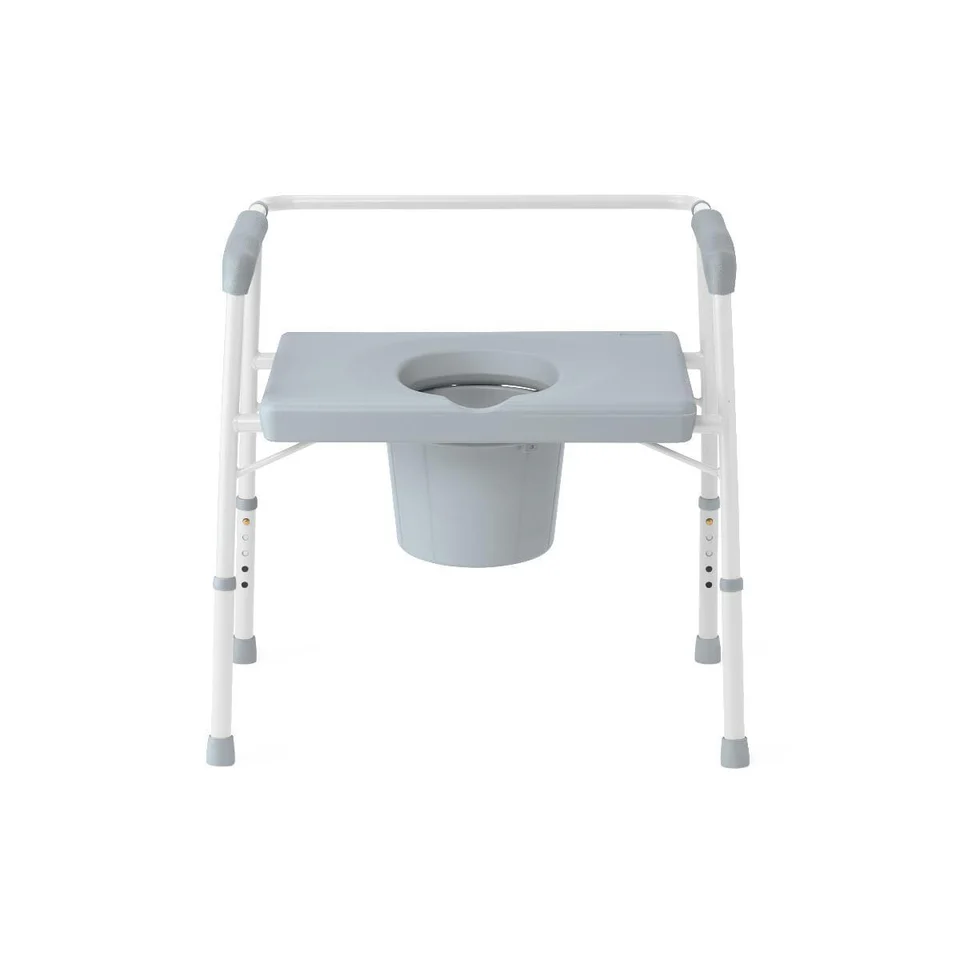
- Extra-Wide 24" Seat Platform – spacious seating surface accommodates larger body frames comfortably
- Reinforced Steel Frame – welded steel construction with powder-coated finish ensures durability and stability under heavy loads
- Adjustable Height Legs – customize seat height in one-inch increments to match bed height or toilet positioning
- Padded Armrests – comfortable plastic armrests provide support during transfers and use
- 9.3-Quart Capacity Bucket – large removable bucket with lid for bedside toileting (approximately 8.8 liters)
- Non-Marring Rubber Tips – protect flooring and prevent sliding for stable positioning
- Splash Guard – integrated design helps contain waste and maintain hygiene
- Tool-Free Assembly – simple setup without specialized tools (basic wrench may be needed for some adjustments)
- Over-Toilet Capability – frame design allows positioning over standard toilets when bucket is removed
Benefits
- Ensures User Safety – 650 lb capacity and reinforced frame eliminate risk of collapse or tipping during use
- Provides Comfortable Fit – 24-inch wide seat accommodates larger users without pinching, discomfort, or instability
- Reduces Fall Risk – adjustable height and sturdy armrests support safe transfers between bed, wheelchair, or standing position
- Preserves Dignity – properly-sized equipment allows confident, independent toileting without fear of equipment failure
- Supports Independence – enables bariatric users to toilet with minimal assistance when safely positioned
- Offers Versatile Positioning – use bedside with bucket or position over toilet for flushing convenience
- Protects Caregivers – stable equipment reduces physical strain and injury risk during assisted transfers
- Simplifies Hygiene – large bucket with lid contains odors; removable for easy emptying and cleaning
- Prevents Floor Damage – non-marring rubber tips protect hardwood, tile, and vinyl flooring
- Provides Long-Term Durability – heavy-duty construction withstands daily use in home care and institutional settings
- Enhances Quality of Life – reliable, comfortable toileting solution improves daily dignity and confidence
Clinical Applications
✓ Bariatric patients requiring bedside toileting due to mobility limitations or post-surgical restrictions
✓ Users with weight exceeding standard commode capacity (typically 250-350 lb)
✓ Post-operative patients (orthopedic, bariatric surgery) needing elevated, stable toileting surface
✓ Individuals with joint pain, arthritis, or limited mobility who need armrest support for transfers
✓ Patients requiring nighttime toileting access without long-distance ambulation to bathroom
✓ Home care settings where bathroom access is difficult or impossible for larger users
✓ Rehabilitation facilities supporting bariatric patients during mobility recovery
✓ Long-term care and assisted living facilities serving diverse body types and weight ranges
✓ Hospital rooms and skilled nursing facilities requiring bariatric-appropriate equipment
✓ Users needing adjustable-height toileting to match bed height for safe transfers
✓ Situations where over-toilet positioning provides convenient flushing alternative to bucket emptying
Usage & Application
Pre-Use Assessment
- Confirm commode weight capacity (650 lb) meets or exceeds user's weight
- Assess user's mobility level and transfer ability (independent, minimal assist, maximum assist)
- Evaluate space availability for commode placement (beside bed, over toilet, in bathroom)
- Determine optimal seat height based on user's bed height, wheelchair seat height, or standing transfer needs
- Review caregiver's ability to assist with transfers and commode maintenance
- Identify any special positioning needs (proximity to call button, nightstand, walker)
Assembly and Setup
- Unpack Components – remove commode frame, seat platform, bucket, lid, armrests, and hardware from packaging. Verify all parts are included per instruction manual.
- Inspect Frame – check steel frame for damage, sharp edges, or defects. Ensure all welds are solid and powder coating is intact.
- Attach Seat Platform – secure the 24-inch wide seat platform to the frame using provided hardware. Tighten bolts firmly but avoid over-tightening that could strip threads.
- Install Armrests – attach padded armrests to designated mounting points on each side of frame. Ensure armrests are level and securely fastened.
- Adjust Leg Height – set all four legs to desired height using adjustment mechanisms (typically push-button or threaded adjustments). Ensure all legs are adjusted to SAME height for level, stable seating.
- Verify Rubber Tips – confirm non-marring rubber tips are installed on all four legs and are in good condition (not cracked or missing).
- Insert Bucket – place 9.3-quart bucket into frame opening beneath seat. Ensure bucket sits securely and doesn't wobble.
- Test Stability – before user attempts to sit, press down firmly on seat and armrests from multiple angles to verify frame is stable and doesn't wobble or tip.
Height Adjustment Guidelines
- For Bedside Use: Adjust seat height to match mattress height (typically 18-24 inches from floor). User should be able to transfer laterally from bed to commode with minimal vertical movement.
- For Over-Toilet Use: Adjust seat height to position commode frame securely over toilet bowl, with seat platform slightly above toilet rim. Ensure frame legs straddle toilet bowl without interfering with bowl shape.
- For Standing Transfers: Set seat height so user's hips are slightly higher than knees when seated (typically 17-21 inches from floor). This facilitates easier standing and sitting.
- For Wheelchair Transfers: Match commode seat height to wheelchair seat height (typically 19-20 inches) for safe lateral transfers.
- One-Inch Increments: Most bariatric commodes adjust in one-inch increments. Fine-tune height for user comfort and safety.
- Level Check: After adjusting, place commode on floor and verify all legs contact floor evenly. Place hand on seat and press from multiple angles—commode should not rock or wobble.
Positioning and Placement
- Bedside Positioning: Place commode within easy reach of bed (typically 12-18 inches from mattress edge). Angle commode 30-45 degrees toward bed for easier transfer access. Ensure path is clear of obstacles.
- Over-Toilet Positioning: Center frame over toilet bowl with legs straddling bowl. Remove bucket. Adjust height so seat platform is stable and doesn't shift. Ensure splash guard (if equipped) doesn't interfere with male users.
- Floor Surface: Position on flat, level flooring. Avoid uneven surfaces, thick carpeting, or sloped floors that compromise stability.
- Lighting: Ensure adequate lighting for nighttime use (nightlight or motion-sensor light recommended).
- Accessibility: Position within reach of call button, phone, or assistance device. Keep toilet paper and personal care items within easy reach.
Safe Transfer Techniques
Bed-to-Commode Transfer (Lateral Transfer):
- Prepare: Lock wheelchair (if used), ensure commode is stable and positioned correctly beside bed.
- User Positioning: User sits on edge of bed with feet flat on floor, knees aligned with commode seat.
- Stand or Pivot: User stands (if able) or pivots while remaining seated, using armrests for support. Caregiver provides support at waist or under arms as needed.
- Lower to Seat: User lowers onto commode seat slowly while holding armrests. Caregiver guides and supports descent.
- Verify Position: Ensure user is centered on seat platform and stable before caregiver releases support.
Standing Transfer:
- Approach: User approaches commode from front, using walker or cane if needed.
- Turn and Grasp: User backs up to commode until backs of legs touch seat, then grasps both armrests.
- Lower Slowly: User bends knees and lowers to seated position while holding armrests for support. Caregiver provides support as needed.
- Center Position: User adjusts position to center on seat platform.
Wheelchair Transfer:
- Position Wheelchair: Angle wheelchair 30-45 degrees to commode. Lock wheelchair brakes.
- Remove Armrest: If wheelchair has removable or swing-away armrest, remove or swing out of the way on transfer side.
- Stand-Pivot or Sliding Board: User either stands and pivots, or uses sliding transfer board to move from wheelchair to commode. Caregiver assists as needed.
- Reposition: Once seated on commode, user adjusts position for stability and comfort.
Transfer Safety Tips:
- Never rush transfers—take time to position correctly and move slowly
- Always lock wheelchair brakes before transfers
- Ensure commode is stable and positioned correctly before beginning transfer
- Use gait belt on user for caregiver control and support during assisted transfers
- Keep user's feet flat on floor during transfer for better balance
- If user begins to fall, guide them safely to floor rather than attempting to catch—protect head and body
- Practice transfers with physical therapist or healthcare provider before unsupervised use
During Use
- Verify Stability: Before user fully commits weight to commode, ensure frame is stable and not wobbling.
- Armrest Support: User should use armrests for support and balance during toileting, especially when leaning or reaching.
- Dignity and Privacy: Provide privacy during use (close door, use privacy screens if in shared room).
- Call for Assistance: User should call for help when ready to transfer back to bed or wheelchair. Never attempt to stand without support if stability is questionable.
- Monitor Time: For users with limited endurance, don't prolong sitting time unnecessarily—complete toileting and transfer back promptly.
Cleaning and Maintenance
After Each Use:
- Empty Bucket: Remove bucket from frame. Empty contents into toilet. Do not overfill bucket (empty when 2/3 full to prevent spills).
- Rinse Bucket: Rinse bucket with warm water. Add disinfectant or cleaner per facility/home protocol.
- Disinfect Bucket: Spray or wipe bucket interior and exterior with disinfectant. Allow to sit per product instructions (typically 1-10 minutes).
- Dry Bucket: Wipe bucket dry with paper towels or allow to air dry before returning to frame.
- Replace Lid: Place lid on clean, dry bucket and return to frame.
- Wipe Seat and Armrests: Use disinfectant wipes or spray to clean seat platform and armrests. Pay attention to crevices and underside of seat.
- Clean Frame: Wipe down frame legs and support bars with disinfectant if soiled.
Daily Maintenance:
- Inspect frame for cracks, bends, or loose connections
- Check leg adjustment mechanisms are secure and legs are at equal height
- Verify rubber tips are intact and not worn or missing
- Ensure bucket has no cracks or damage
- Check armrest attachment points for tightness
Weekly Deep Cleaning:
- Remove bucket and thoroughly clean frame, seat, and all components with hospital-grade disinfectant
- Inspect splash guard (if equipped) and clean thoroughly
- Check all bolts and fasteners—tighten if loose
- Inspect rubber tips for wear and replace if cracked or compressed
Odor Control:
- Empty bucket promptly after each use
- Use odor-eliminating sprays or powders in bucket
- Add small amount of water with disinfectant to bucket bottom to reduce odor between uses
- Ensure lid fits tightly on bucket
- Ventilate room well
Replacement Schedule:
- Replace rubber tips annually or when worn
- Replace bucket if cracked or damaged
- Replace entire commode if frame shows structural damage, excessive rust, or instability
Troubleshooting
Commode Wobbles or Feels Unstable:
- Verify all four legs are adjusted to same height—use level or measuring tape to check
- Ensure rubber tips are installed on all legs and are not worn unevenly
- Check floor surface is level—if floor slopes, adjust leg heights to compensate
- Inspect frame welds and connections for cracks or damage
- Tighten all bolts and fasteners—check armrest connections and seat platform attachment
- If wobbling persists despite adjustments, discontinue use and contact supplier for replacement
Seat Height Doesn't Match Bed or Toilet:
- Re-measure bed height or toilet rim height from floor
- Adjust legs in one-inch increments until proper height is achieved
- For over-toilet use, legs may need to be at slightly different heights to accommodate toilet bowl shape
- If commode cannot adjust high enough or low enough, contact supplier about alternative models with different height ranges
User Has Difficulty with Transfers:
- Consult physical therapist for transfer training and technique improvement
- Consider using transfer aids (gait belt, sliding board, stand-assist lift)
- Verify seat height is optimal for user's transfer method
- Ensure armrests are at comfortable height and position for grasping
- If user cannot safely transfer even with assistance, consider alternative toileting solutions (bedpan, lift-equipped commode)
Bucket Leaks or Overflows:
- Empty bucket more frequently—don't wait until full
- Check bucket for cracks or damage—replace if compromised
- Ensure bucket is seated properly in frame opening
- Don't exceed bucket capacity (9.3 quarts)
- If bucket repeatedly leaks at seams, contact supplier for replacement
Seat Platform Too Narrow or Uncomfortable:
- Verify commode is 24-inch wide model designed for bariatric use
- Check user's weight is within 650 lb capacity
- Consider adding padded seat cover for additional comfort (ensure cover is rated for bariatric use and doesn't interfere with splash guard)
- If 24-inch seat is insufficient, contact supplier about extra-wide models (some manufacturers offer 26" or 28" options)
Armrests Are Uncomfortable or Too High/Low:
- Some models allow armrest height adjustment—check instruction manual
- Armrests can often be removed temporarily if they interfere with transfers (replace after user is seated)
- Add foam padding to armrests for additional comfort
- If armrests are unsuitable, consult with supplier about alternative armrest styles or heights
Frame Shows Rust or Corrosion:
- Wipe down frame regularly to prevent moisture buildup
- Avoid using harsh acidic cleaners that damage powder coating
- Touch up any chips or scratches in powder coating with rust-inhibiting paint
- If rust is extensive or structural, replace commode—rust compromises frame strength
Commode Tips During Transfer:
- This is a safety emergency—discontinue use immediately
- Verify user's weight is within 650 lb capacity
- Ensure floor surface is level and stable
- Check that all four legs contact floor evenly
- Verify rubber tips are in good condition and gripping floor
- Ensure user is centering weight properly during transfer (not leaning heavily to one side)
- Consider using wider-base model or commode with additional stabilization
- Have user evaluated by physical therapist for safer transfer techniques
Storage
- If storing commode between uses, clean and dry thoroughly first
- Store in dry location away from moisture (avoid damp basements)
- Keep assembled and ready for use, or disassemble legs for compact storage if needed
- Store bucket separately with lid on to prevent dust accumulation
- Inspect before each use period to ensure no damage occurred during storage
Weight Capacity Considerations
- Maximum User Weight: 650 lb (approximately 295 kg)
- Safety Margin: Do not exceed stated weight capacity—safety margin is built into rating
- Dynamic Loading: Understand that transfers and sitting down create temporary forces greater than static weight—stay well below maximum capacity if possible
- Weight Verification: If user's weight is close to capacity, verify current weight before use
- Re-Evaluation: If user's weight increases significantly, re-evaluate whether equipment is still appropriate
- Multiple Users: If commode serves multiple users in facility setting, ensure all users are within weight capacity
Professional Consultation
Consult healthcare provider, physical therapist, or durable medical equipment specialist if:
- User has difficulty with safe transfers despite proper technique
- User's weight exceeds or approaches 650 lb capacity
- User experiences pain or discomfort during commode use
- Commode shows signs of structural damage or instability
- User's mobility level changes significantly
- Alternative toileting solutions may be more appropriate
Technical Specifications
- Weight Capacity: 650 lb (approximately 295 kg)
- Seat Platform Width: Approximately 24 inches (61 cm)
- Seat Platform Depth: Approximately 18-20 inches (varies by model)
- Seat Height Range: Adjustable in one-inch increments (typical range 16-24 inches; verify specific model range)
- Frame Material: Welded steel construction with powder-coated finish (rust-resistant)
- Armrest Material: Padded plastic armrests with comfortable grip
- Bucket Capacity: 9.3 quarts (approximately 8.8 liters)
- Bucket Material: Durable plastic with integrated handle
- Included Accessories: Commode bucket with lid, non-marring rubber leg tips, splash guard (model-dependent)
- Leg Tips: Non-marring rubber tips protect flooring and prevent sliding
- Overall Dimensions: Approximately 26-28" wide x 22-24" deep x 32-38" high (assembled; varies by model and height adjustment)
- Product Weight: Approximately 25-35 lb (frame weight; varies by model)
- Assembly: Tool-free or minimal tools required (basic wrench may be needed)
- Over-Toilet Capability: Yes—can be positioned over standard residential toilets when bucket is removed
- Seat Opening: Approximately 10-12 inches (front to back) for toileting access
- Finish: Powder-coated steel (available in gray, white, or other colors depending on model)
- Warranty: Varies by manufacturer (typically 1-3 years limited warranty on frame; verify with supplier)
- Intended Use: Bariatric bedside commode for home care, assisted living, hospital, and rehabilitation settings
- Compliance: May meet FDA and ADA guidelines for durable medical equipment (verify specific model compliance)