
Slideshow Items

|
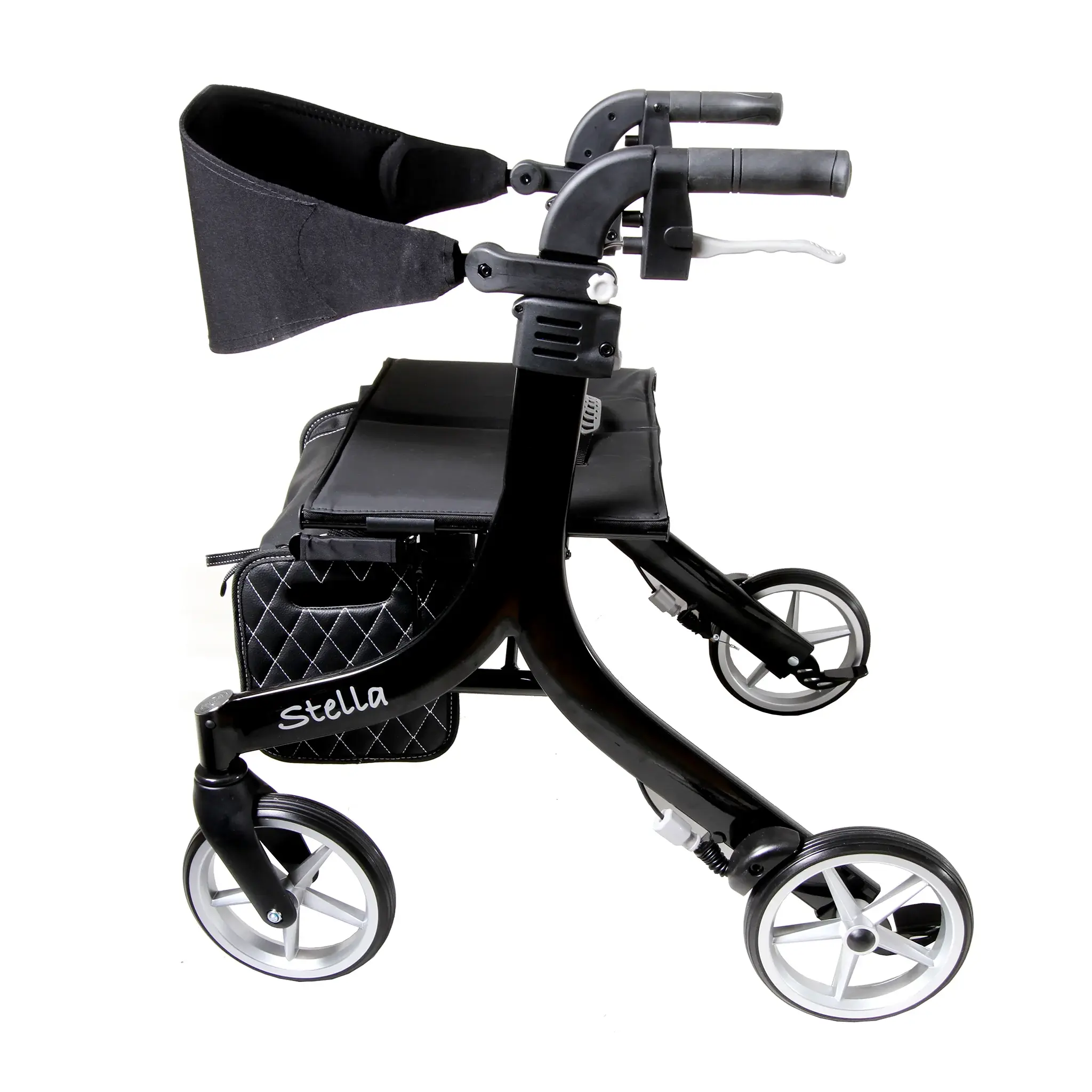
With 12-inch rear wheels and companion hand brakes delivers enhanced outdoor mobility and caregiver control while the folding back-release hinge and 20-pound weight enable vehicle loading for the 300-pound capacity companion-style transport chair.
Loading…
Standard transport wheelchairs typically feature 8-inch rear wheels optimized for indoor use, but 12-inch wheels provide significant performance advantages on uneven outdoor surfaces, sidewalk cracks, door thresholds, and gravel paths. The increased diameter enables smoother rolling over obstacles while reducing pushing effort for caregivers navigating varied terrain. Unlike self-propelling wheelchairs with 22-24 inch rear wheels, the 12-inch configuration maintains the compact, lightweight transport chair design while adding outdoor capability. This balanced approach serves users requiring caregiver assistance who frequently encounter mixed indoor-outdoor environments during daily activities, medical appointments, shopping, and social outings.
✓ Short-to-medium distance caregiver-assisted mobility ✓ Medical appointment transportation and clinic transfers ✓ Shopping centers and retail environment navigation ✓ Airport and travel facility mobility assistance ✓ Rehabilitation facility patient transport between therapy areas ✓ Hospital discharge transportation to vehicles ✓ Nursing home and assisted living resident transport ✓ Home health patient mobility for appointments and errands ✓ Temporary mobility needs during injury recovery requiring assistance ✓ Elderly individuals unable to self-propel standard wheelchairs ✓ Post-surgical patients requiring transport assistance ✓ Individuals with limited upper body strength or endurance ✓ Bariatric users up to 300 pounds requiring stable transport
Understanding Transport Chair Design: Transport wheelchairs differ fundamentally from self-propelling wheelchairs. The smaller rear wheels (12 inches versus 22-24 inches on standard wheelchairs) eliminate hand rims, making these chairs companion-dependent—users cannot propel themselves. This design prioritizes lightweight portability and caregiver ease over user independence. Ideal users include those who: lack upper body strength for self-propulsion, require assistance during mobility activities, use the chair primarily for transportation rather than extended sitting, or need a secondary lightweight chair for travel and vehicle transport.
Initial Setup and Inspection: Before first use, inspect all components: verify wheel locks engage firmly, test companion hand brakes for proper function, check footrest swing-away mechanisms operate smoothly, ensure backrest folding hinge locks securely in upright position, inspect seat belt for proper attachment and function, and verify all fasteners are tight. Adjust footrest height if needed to accommodate user leg length—feet should rest flat on footplates with knees at approximately 90-degree angles when seated.
User Transfer Techniques: Always engage both wheel locks before initiating transfers. Position the transport chair at appropriate angle to transfer origin (bed, standard chair, toilet, vehicle seat). Swing away both footrests to clear the transfer path and prevent shin impacts. For stand-pivot transfers: user stands, pivots to face away from transport chair, and lowers into seat while caregiver guides and supports. For sliding board transfers: position chair parallel to transfer surface, remove or swing away armrest if possible (fixed armrests require transfer over armrest), and use transfer board to bridge the gap.
Caregiver Pushing Techniques: Stand behind the transport chair, grasping the flared push handles with both hands. Push with steady, controlled force, avoiding sudden accelerations that could alarm or destabilize the user. Use proper body mechanics: keep back straight, engage leg and core muscles, and avoid excessive forward leaning. Communicate with the user before initiating movement, turns, or stops. The 12-inch rear wheels roll more easily over obstacles than standard 8-inch wheels, but caregivers should still approach curbs, thresholds, and uneven surfaces deliberately rather than at speed.
Companion Hand Brake Operation: The companion-activated hand brakes function similarly to bicycle brakes, operated by the caregiver from the push handle position. Squeeze the brake levers gradually to slow or stop the chair—avoid sudden aggressive braking that could pitch the user forward. Use brakes primarily when: descending ramps or inclines, controlling speed on smooth downhill surfaces, approaching stops or obstacles, or during user transfers on slight slopes. These brakes provide dynamic speed control that wheel locks cannot offer during active movement.
Wheel Lock Usage: Push-to-lock wheel locks must be engaged whenever the transport chair is stationary, particularly during: all transfers into or out of the chair, extended stationary periods (conversations, appointments, dining), stops on any incline regardless of grade, and anytime the caregiver steps away from the chair. Engage both locks by pushing the lever forward until it clicks into the locked position. Test lock effectiveness by attempting to push the chair—properly engaged locks should prevent wheel rotation completely.
Navigating Outdoor Terrain: The 12-inch rear wheels significantly improve outdoor performance compared to standard 8-inch transport chair wheels. Approach obstacles strategically: for curbs and steps, tilt the chair backward slightly to lift the front casters over the obstacle first, then push forward to roll the rear wheels over. For gravel or grass, maintain steady pushing momentum as these surfaces increase rolling resistance. Cross sidewalk cracks at an angle rather than perpendicular to reduce jarring. The enhanced wheel size doesn't eliminate terrain limitations—avoid steep grades, extremely rough surfaces, and soft ground (sand, deep mud) beyond the chair's design parameters.
Indoor Navigation and Tight Spaces: Despite the larger rear wheels, the transport chair maintains excellent indoor maneuverability through the combination of compact overall dimensions and responsive front casters. Navigate doorways by approaching straight-on, ensuring adequate clearance on both sides. Turn in tight spaces by lifting the front casters slightly (tilt back gently) while pivoting around the rear wheels. The 19-inch seat width provides adequate clearance through standard 32-36 inch doorways. Use caution in crowded environments to avoid the user's feet or footrests contacting obstacles.
Folding for Transport: To fold the transport chair for vehicle loading or storage: (1) Remove or flip up footrests if they interfere with folding. (2) Locate the back-release hinge mechanism (typically near the top of the backrest). (3) Engage the release (lever, button, or pull-strap depending on model) while pushing the backrest forward. (4) The backrest folds down toward the seat, creating a compact profile. (5) Lift the center of the seat fabric upward to initiate the frame fold—sides collapse inward. The fully folded chair achieves minimal dimensions suitable for vehicle trunks and closets.
Vehicle Loading Process: The 20-22 pound weight enables most caregivers to load the transport chair independently. Fold the chair completely as described above. Position the folded chair perpendicular to the vehicle trunk or cargo area. Use proper lifting mechanics: bend knees, keep back straight, grasp frame at stable points (avoid grabbing seat fabric), and lift with leg muscles. Place the folded chair in vehicle storage area, positioning to prevent shifting during transport. Some caregivers remove rear wheels using quick-release axles (if equipped) for even more compact storage.
Seat Belt Usage: The included seat belt should be worn by the user during all transport activities. Fasten the belt snugly but comfortably across the lap, similar to vehicle seat belts. The belt prevents users from sliding forward or standing unexpectedly during movement, reducing fall risk. Particularly important during ramp navigation, outdoor terrain, and any situation where chair stability might be challenged. Never use the seat belt as a restraint—it's a safety device for fall prevention, not behavioral management.
User Positioning and Comfort: Proper positioning enhances user comfort and safety during transport. The user should sit fully back in the seat with spine against the backrest, weight distributed evenly across both hips, and feet resting flat on footrests. Avoid allowing users to slouch forward or sit on the front edge of the seat, as these positions compromise stability and increase fall risk. The padded armrests provide upper extremity support and transfer assistance. For extended transport periods, check user comfort regularly and allow position changes or breaks as needed.
Footrest Management: The swing-away footrests facilitate safe transfers and storage. To swing away: release the locking mechanism (typically a lever or button), swing the footrest outward and to the side, and lock in the parked position if the mechanism includes a park position. During transport, ensure both footrests remain in the forward position with the user's feet properly supported on footplates. The heel loops prevent feet from sliding backward off the footplates during movement or on inclines.
Cleaning and Maintenance: Clean the nylon upholstery regularly with mild soap and water, wiping down with a damp cloth and allowing to air dry. The padded components can be spot-cleaned or surface-cleaned but generally aren't removable for machine washing. Clean the aluminum frame by wiping with a damp cloth—avoid harsh chemicals that could damage the powder-coated finish. Lubricate moving parts (folding joints, wheel bearings, footrest hinges) periodically with appropriate lubricant. Inspect tires for wear and maintain proper inflation if pneumatic (most 12-inch wheels use solid or foam-filled tires requiring no inflation).
Regular Safety Inspections: Perform routine inspections to ensure safe operation: check wheel lock function (both should engage firmly and hold the chair stationary), test companion hand brakes (should provide smooth, progressive stopping), verify backrest folding mechanism locks securely in both upright and folded positions, inspect footrests for secure attachment and proper swing-away function, examine seat belt for wear or damage, check for loose or missing fasteners, and inspect wheels for damage or excessive wear. Address any issues promptly before continued use.
Weight Capacity Compliance: The 300-pound capacity includes user body weight plus clothing and any items carried in the lap or on the chair. Exceeding capacity compromises structural integrity, accelerates wear, increases tip risk, and may void warranty. Distribute weight evenly and avoid hanging heavy bags on the backrest or push handles as this raises the center of gravity and increases tip risk. For users approaching capacity limits, verify the specific model's rating and consider bariatric transport chair options if needed.
When Professional Evaluation Is Needed: Seek occupational therapist or physical therapist evaluation if: the user requires extended sitting durations (transport chairs lack pressure-relieving seating), specialized positioning or support needs exist, the user has pressure injury risk requiring medical-grade cushioning, skin breakdown or discomfort occurs with current seating, or questions arise regarding appropriate wheelchair type for specific needs. Transport chairs serve a specific niche—short-to-medium duration caregiver-assisted mobility—and may not be appropriate for all users.
Carousel items
Testimonial items
Very welcoming and informative. We went in to rent a Walker for my mom to see if she would use it. They had no rentals left so he gave us a brand new one on rental. Highly recommend this company for all your ADL needs.
Tara Maye
The rating of this product is 5 out of 5
Fantastic service and experience, from delivery to pickup we could not have asked for anything more! We rented a hospital bed, and I do not believe you would get better service anywhere. Highly recommended!
Shawn Dillon
The rating of this product is 5 out of 5
Super friendly and very helpful! Delivered the wheelchair for me, special ordered other parts and took the time to show me how to install. I recommend!
Fiona Haines
The rating of this product is 5 out of 5
Can not thank the team at Med Supplies enough for their amazing service. We were in a tough spot till we got their help. Amazing service. Kind and respectful delivery. First class all the way. Thank you again.
Jon Beatty
The rating of this product is 5 out of 5
Ordered the chair on Sunday and it arrived Monday morning. Spoke to customer service to follow up on delivery times. It was already on my front door. Excellent and helpful staff. The product is sturdy and of good quality. Thank you for your help.
H D
The rating of this product is 5 out of 5
Excellent experience - website faithfully represented what was in stock (which hasn't always been my experience with other vendors sadly), and local shipping was really fast - ordered on the weekend, received it on Monday in my case. Thank you for being
Jason Hudson
The rating of this product is 5 out of 5
0/0
You cart is currently empty
780 409-1509
Get directions