Why Arm Trough Support System?
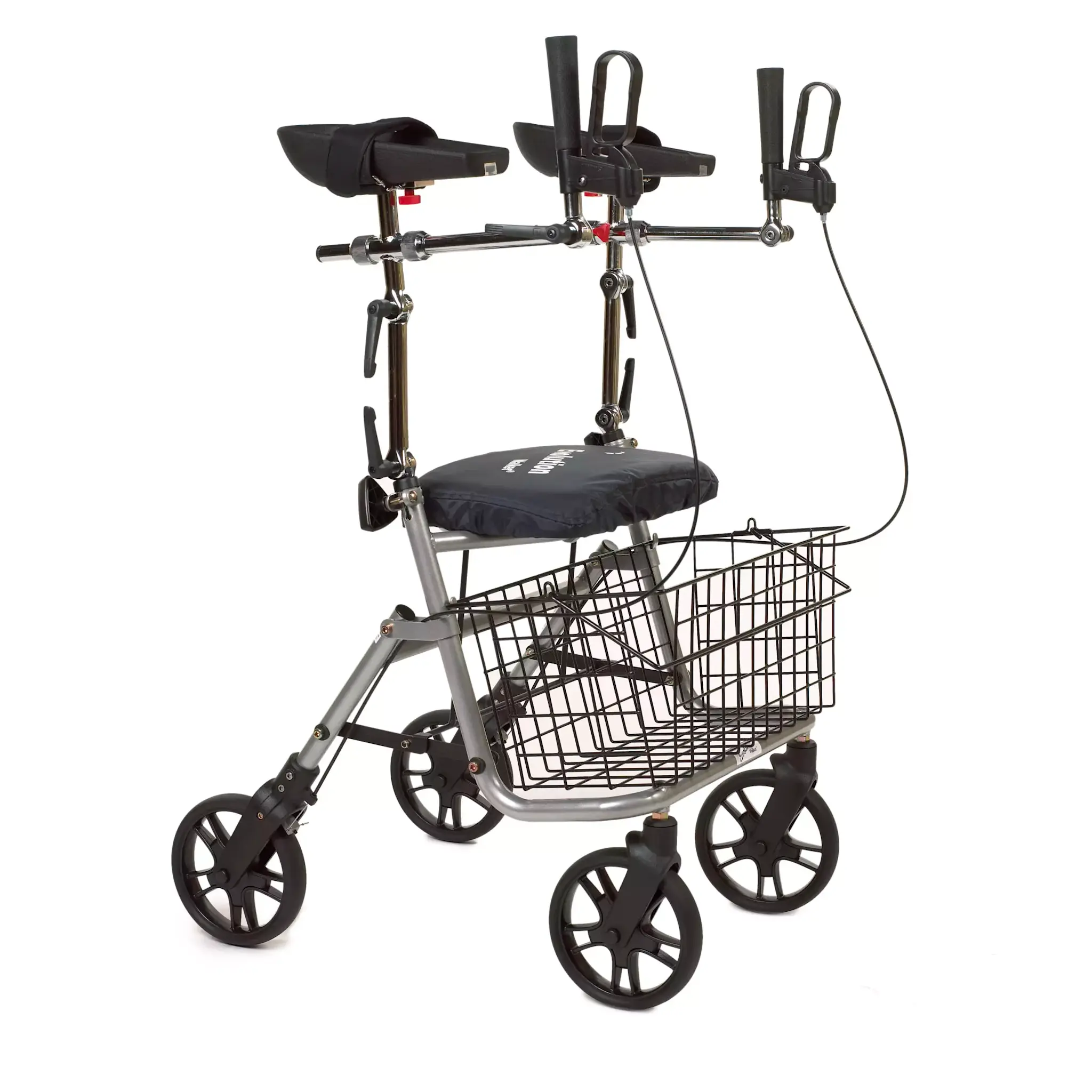
Arm trough support systems address a critical mobility gap for users whose upper extremity conditions prevent safe use of standard walker handle-grip designs that dominate conventional walker engineering. Traditional front-wheel walkers and rollators rely fundamentally on hand-grip interaction: users must grasp cylindrical handles with sufficient grip strength (typically 15-25 lbs force per hand) to control walker direction, provide partial weight-bearing support through arms during ambulation, and manage brake systems requiring sustained finger pressure. This hand-grip paradigm works adequately for users with intact upper extremity strength, coordination, and proprioception, but creates insurmountable barriers for multiple clinical populations. Hemiplegia from stroke leaves one arm with profound weakness, spasticity, or complete paralysis preventing any meaningful grip function—these users face impossible choice between attempting one-handed walker control (dangerously unstable) or abandoning walker use entirely despite lower extremity capability benefiting from walker support. Severe rheumatoid arthritis or osteoarthritis affecting hand joints creates excruciating pain during grip force application, effectively preventing sustained walker use despite lower extremity weakness warranting ambulatory assistance. Median or ulnar nerve injuries create specific grip deficits—median nerve damage prevents thumb opposition essential for secure cylindrical grip, while ulnar nerve damage eliminates hypothenar eminence strength needed for power grip. Brachial plexus injuries from trauma or surgical complications create varied upper extremity paralysis patterns potentially eliminating hand function while preserving proximal arm strength. Amputations or congenital limb differences affecting hands or fingers prevent conventional grip even when residual arm strength could support walker use. For all these populations, the fundamental design assumption underlying standard walkers—that users can and will maintain continuous bilateral hand grip—creates absolute exclusion from a mobility technology that could otherwise support their ambulation needs. The Evolution EVO Arm Trough System solves this problem by replacing the hand-grip interaction paradigm with forearm-support interaction: instead of grasping handles, users rest affected forearm(s) in padded trough-style supports that bear weight and provide control through forearm contact rather than hand grip. The trough cradles the forearm from just above the wrist to just below the elbow, distributing loading across 8-12 inches of forearm length rather than concentrating force in the 2-3 inch palm contact zone typical of grip designs. This distributed loading enables users with zero hand grip capability to safely control walkers, bear partial body weight through upper extremities, and maintain upright posture during ambulation. The five-point adjustment system addresses the reality that forearm length, arm angle preferences, and optimal support positioning vary dramatically between individuals and cannot be accommodated by fixed-geometry designs—adjustments accommodate height (raising or lowering trough relative to walker frame), tilt (angling trough anterior-posterior to match natural arm angle), width (moving trough medially or laterally relative to walker centerline), depth (adjusting trough forward-backward position), and rotation (changing trough orientation relative to vertical). The Evolution EVO-specific design ensures proper geometric fit with the walker's frame structure, folding mechanism, and optional accessories (slow-down brakes, mono-brake systems) without creating interference or compromising safety.
Key Features
- Left-Side Trough Configuration: Designed for left forearm support with mirror-image right-side version available separately for bilateral or opposite-side needs
- Five-Point Adjustment System: Independent control of height, tilt, width, depth, and rotation enabling precise personalized positioning
- Tool-Free Adjustment Mechanisms: Built-in hand-adjustable controls eliminate need for wrenches, screwdrivers, or specialized tools during fitting
- Evolution EVO Walker Compatibility: Engineered specifically for EVO Regular, EVO Wide, EVO Low, and EVO Low Wide models ensuring proper mounting and function
- 200-lb Per-Side Capacity: Structural engineering supports up to 200 lbs loading through single trough enabling significant weight-bearing assistance
- Padded Trough Surface: Cushioned contact surface distributes forearm pressure preventing discomfort during extended use periods
- Preserved Folding Function: Trough design accommodates EVO's folding mechanism without requiring removal or creating binding during folding operations
- Brake System Compatibility: Functions alongside slow-down drag brakes and mono-brake systems without interference or compromising brake operation
- Unilateral or Bilateral Use: Single trough supports asymmetric needs (one arm weakness) or pair of troughs (left + right) supports bilateral weakness
- Height Range Accommodation: Adjustment span approximately 34-50 inches accommodates varied user heights and arm length combinations
- Durable Construction: Materials withstand daily use over typical 3-5 year service life without structural degradation or adjustment mechanism failure
Benefits
- Enabled Walker Use for Non-Gripping Populations: Users with hemiplegia, severe arthritis, nerve injuries, or amputations can safely use walkers despite inability to grip handles
- Distributed Forearm Loading: 8-12 inch contact length reduces pressure per square inch 60-80% compared to palm-only grip contact, preventing pain and tissue damage
- Maintained Upright Posture: Proper forearm support enables users to stand erect rather than hunching forward compensating for inadequate upper body support
- Enhanced Balance and Stability: Secure forearm positioning provides proprioceptive feedback and stability superior to compromised or painful hand-grip alternatives
- Reduced Secondary Complications: Prevents shoulder, neck, and back strain from compensatory postures users adopt when struggling with inadequate grip-based support
- Customized Optimal Positioning: Five adjustment points enable precise fit accommodating individual anatomy, preferences, and clinical requirements
- Simplified Setup Process: Tool-free adjustments enable therapists, caregivers, or users to modify positioning without equipment or technical expertise
- Preserved Walker Functions: Normal folding, brake operation, and accessory compatibility maintain full walker capability alongside arm trough addition
- Supported Independence: Users who might otherwise require wheelchair dependence or continuous assistance can maintain ambulatory independence with appropriate support
- Accommodated Progressive Conditions: Adjustment capability supports changing needs as progressive conditions evolve or post-injury recovery progresses
- Cost-Effective Solution: Adding arm trough to existing compatible walker ($100-200) versus specialized custom equipment ($2,000-5,000) achieves 90-95% cost savings
Clinical Applications
✓ Post-stroke hemiplegia with arm weakness or paralysis preventing grip function in affected upper extremity
✓ Brachial plexus injuries creating varied upper extremity paralysis patterns affecting hand but preserving proximal arm strength
✓ Traumatic brain injury with hemiparesis affecting grip strength and coordination in one or both arms
✓ Cerebral palsy with spasticity or athetosis preventing consistent reliable hand grip for walker control
✓ Severe rheumatoid arthritis affecting metacarpophalangeal and interphalangeal joints creating painful grip
✓ Advanced osteoarthritis with significant hand deformity limiting grip capability and causing pain during weight-bearing
✓ Median nerve palsy preventing thumb opposition essential for secure cylindrical grip
✓ Ulnar nerve injuries eliminating hypothenar eminence strength needed for power grip
✓ Carpal tunnel syndrome severe cases where grip creates excruciating nerve compression symptoms
✓ Upper extremity amputation or congenital limb difference affecting hand while preserving forearm
✓ Multiple sclerosis with upper extremity weakness disproportionate to lower extremity involvement
✓ Guillain-Barré syndrome recovery with persistent upper extremity weakness following acute phase
✓ Peripheral neuropathy severe cases with proprioceptive loss preventing safe grip-based walker control
✓ Parkinson's disease with rigidity and bradykinesia limiting hand opening and closing for grip
✓ Progressive supranuclear palsy with upper extremity dysfunction affecting grip capability
✓ Amyotrophic lateral sclerosis (ALS) with upper extremity weakness preceding lower extremity involvement
Usage & Application
Compatibility Verification and Model-Specific Considerations: Before purchasing or installing arm trough attachments, confirm absolute compatibility with the specific walker model. The Evolution EVO Arm Trough System fits exclusively Evolution EVO series walkers including: EVO Regular (standard adult size), EVO Wide (increased width for larger users or stability needs), EVO Low (reduced height for shorter users or specific clinical applications), and EVO Low Wide (combination of width and height modifications). The system does NOT fit other Evolution walker models (standard front-wheel walkers, other rollator designs) or walkers from other manufacturers due to different frame geometries, mounting point locations, and structural specifications. To verify compatibility, locate model identification on the walker's frame label—any walker labeled "EVO" in the model name indicates likely compatibility, though confirming specific variant (Regular, Wide, Low, Low Wide) ensures optimal fit. If model information is unclear, measure walker dimensions and contact Evolution Technologies or authorized dealers for confirmation. Beyond model compatibility, assess whether arm trough support addresses the user's specific needs: users with unilateral arm weakness benefit from single (left or right) trough paired with standard handle on unaffected side; users with bilateral arm weakness require both left and right troughs; users with hand pain but adequate grip strength may benefit more from padded grip covers than trough replacement. Evaluate whether user's lower extremities have adequate strength and coordination to safely use walker with modified upper body support—arm troughs don't compensate for significant lower extremity weakness or balance deficits. Consider whether user's cognitive function enables safe walker operation with modified control system—some trough designs feel different from standard grips requiring brief adaptation period.
Installation Procedure and Left-Side Mounting: The arm trough attaches to the walker's left rear upright (the vertical frame member on left side extending from rear wheel to handle height) using clamp-style or bracket-style mounting hardware. Begin installation with walker fully opened and standing on stable level surface with brakes engaged. Locate installation instructions included with arm trough package or access online installation guides from Evolution Technologies website—visual diagrams significantly simplify installation compared to text-only instructions. The trough assembly typically consists of a padded forearm cradle, an adjustable mounting bracket system, and various adjustment mechanisms controlling the five adjustment points. Position the mounting bracket on the left rear upright at approximate height for user's forearm when standing behind walker—initial positioning doesn't need precision as adjustment follows. Secure mounting bracket to upright using provided hardware, typically involving clamp-style fasteners that tighten around upright tubing or bolt-through systems utilizing pre-drilled holes in upright (if present). Hand-tighten initially without full torque to allow positional adjustment. Attach the forearm trough to the mounting bracket using connection hardware—this interface provides several of the five adjustment points enabling height, tilt, and rotational changes. After basic installation, verify the trough doesn't interfere with walker folding mechanism by folding and unfolding walker completely—trough should clear all frame members, cables, and wheel assemblies during folding without binding or requiring removal. If interference occurs, reposition mounting bracket higher or lower on upright, or adjust trough angle/rotation to create necessary clearances.
Five-Point Adjustment System Optimization: After installation, systematically adjust all five adjustment points to achieve optimal positioning for the specific user. The five points typically include: (1) Height adjustment—raising or lowering trough relative to walker frame, controlled via mounting bracket position or telescoping mechanisms; (2) Tilt adjustment—changing anterior-posterior angle of trough, controlled via pivot mechanisms at bracket-to-trough interface; (3) Width adjustment—moving trough medially (toward walker centerline) or laterally (away from centerline), controlled via sliding mechanisms in mounting bracket; (4) Depth adjustment—positioning trough forward or backward relative to user's body position, controlled via fore-aft sliding in bracket system; (5) Rotation adjustment—changing trough orientation around vertical axis, controlled via swivel mechanisms at connection points. To optimize adjustments, have user stand behind walker in typical ambulation posture with forearm resting in trough. Begin with height adjustment: the trough should support forearm at comfortable position typically 2-4 inches below elbow level when arm hangs naturally—too high creates shoulder elevation and neck strain, too low requires excessive elbow flexion. Adjust tilt so trough angle matches natural forearm angle when user stands upright—forearm typically angles slightly downward from elbow to wrist (approximately 5-15 degrees from horizontal). Adjust width to position trough directly beneath user's forearm without requiring lateral reaching or inward pulling—optimal width places forearm naturally in trough when standing centrally behind walker. Adjust depth so trough positions far enough forward to support comfortable arm extension but not so far that user must reach excessively—elbow should flex approximately 20-30 degrees when forearm rests in trough. Adjust rotation to align trough orientation with forearm's natural rotation—most users prefer trough rotated slightly outward (10-20 degrees from purely transverse orientation) matching arm's natural carrying angle.
Unilateral versus Bilateral Configuration Considerations: Users with unilateral (single-side) arm weakness typically benefit from asymmetric configuration: arm trough on affected side, standard handle on unaffected side. This configuration provides necessary forearm support for weak arm while maintaining familiar grip-based control with strong arm. When installing unilateral configuration, ensure trough and standard handle align at approximately equal heights—significant height mismatch creates shoulder asymmetry and spinal lateral flexion during use. The standard handle on unaffected side should remain at typical height positioning handle at user's wrist crease when arms hang naturally. Users with bilateral arm weakness affecting both arms equally require troughs on both left and right sides. Bilateral trough installation requires careful symmetric positioning—both troughs should be adjusted to identical or near-identical heights, tilts, widths, depths, and rotations creating balanced support. Asymmetric bilateral positioning creates compensatory postures as users unconsciously shift weight toward more comfortably positioned side. For users with bilateral weakness where one side significantly weaker than the other, consider hybrid approach: full trough on weaker side, smaller trough or modified grip on less-weak side providing some support while maintaining partial grip capability. Some users transition from bilateral troughs to unilateral trough as recovery progresses—maintaining adjustability supports this evolution without requiring equipment replacement.
Integration with Brake Systems and Accessories: The Evolution EVO Arm Trough System design accommodates concurrent use of various brake and control accessories common to EVO walkers without creating interference or compromising safety. The system functions alongside slow-down drag brakes (devices creating constant rolling resistance limiting maximum speed on declined surfaces) without physical interference—arm troughs mount to rear uprights above typical drag brake mounting locations. The trough design also accommodates mono-brake systems (unified brake controls enabling single-handed brake operation) commonly used when one arm has compromised function. For users with unilateral trough and mono-brake, position mono-brake control on standard-handle side (unaffected arm side) enabling grip-based brake operation. For users with bilateral troughs, mono-brake integration becomes complex as traditional grip-based brake operation isn't possible—consider alternative brake designs activated by forearm pressure, push-buttons operable with limited hand function, or caregiver-controlled brake systems. Basket accessories, bag holders, and other common walker attachments typically maintain compatibility with arm trough installations, though verify specific clearances during folding and use. For users requiring oxygen tank holders, IV poles, or other medical equipment attachments, consult with equipment specialists to ensure arm trough installation doesn't compromise attachment mounting or create unsafe interference during operation.
Training and Adaptation Period: Users transitioning from standard grip-based walker control to arm trough support require training and adaptation period enabling safe effective use of modified control system. Physical therapy sessions should include specific arm trough training covering several key skills. First, users must learn proper forearm positioning within trough—forearm should rest securely in trough cradle without sliding forward (under-insertion) or backward (over-insertion), with even contact along 8-12 inch forearm length. Second, users need to master weight-bearing distribution—partial weight transfer through trough-supported forearm(s) assists lower extremity support without creating excessive upper extremity loading beyond 200-lb per-side capacity. Third, users should practice directional control—steering walker through trough pressure rather than grip-based turning requires adapted technique using forearm pronation/supination and lateral pressure against trough sides. Fourth, users need to develop confidence trusting forearm support rather than grip-based security—many users initially resist full weight-bearing through troughs feeling insecure without grip, requiring graduated exposure building trust in support system. Therapists should provide supervised practice on varied terrain (level surfaces, gentle inclines, door thresholds, carpet-to-tile transitions) building skill across environments users will encounter. The typical adaptation period spans 3-7 days of daily use before users achieve comfortable confident trough-based walker control. Some users, particularly those with long-established grip-based walker experience, require longer adaptation overcoming ingrained motor patterns. Caregivers should receive education supporting users during adaptation period—recognizing normal adaptation challenges versus signs of incompatibility requiring equipment reassessment, providing physical assistance during early attempts while encouraging independence development, and identifying when professional therapy consultation becomes necessary.
Maintenance and Long-Term Adjustment: Arm trough systems require periodic maintenance ensuring continued safe function and comfortable positioning. Weekly during initial use period, inspect all adjustment mechanisms verifying they maintain settings without drifting—loosening adjustments creates positional instability potentially causing falls or discomfort. If adjustment mechanisms loosen, tighten according to manufacturer specifications avoiding excessive torque that could crack plastic components or strip threads. Monthly thereafter, verify mounting bracket security by attempting to move trough without releasing adjustment mechanisms—no movement should occur if properly secured. Inspect padding on trough surface quarterly for compression, tears, or contamination—padding that has compressed more than 50% of original thickness no longer provides adequate cushioning and requires replacement. Check for cracks or stress indicators in trough structure or mounting hardware quarterly—any visible damage warrants immediate professional assessment before continued use. Clean padding surfaces regularly (weekly or after any contamination) using mild soap and water—avoid harsh solvents that could damage padding materials. After outdoor use in wet or dirty conditions, thoroughly clean and dry all trough components preventing corrosion or material degradation. As users' conditions change (recovery progression, disease progression, or new medical issues), reassess trough positioning—what was optimal initially may become suboptimal as physical capabilities evolve. Schedule formal positioning reassessments every 3-6 months with physical or occupational therapists ensuring continued appropriateness. Expected arm trough service life is typically 3-5 years with daily use, though high-intensity users or harsh environmental conditions may necessitate earlier replacement.
Technical Specifications
Product Identification
Description: Left Arm Trough Attachment for Evolution EVO Walker
Orientation: Left side (mirror-image right side available separately)
Manufacturer: Evolution Technologies (or authorized accessory manufacturer)
Category: Walker modification accessory for upper extremity support
Product Line: Arm Trough System (sold per side, not as pair)
Compatibility
Compatible Models:
- Evolution EVO Regular (standard adult size)
- Evolution EVO Wide (increased width variant)
- Evolution EVO Low (reduced height variant)
- Evolution EVO Low Wide (combined width and height modification)
Incompatible Models: Standard Evolution front-wheel walkers, other rollator designs, non-EVO Evolution models
Mounting Location: Left rear upright (vertical frame member)
Adjustment Specifications
Number of Adjustment Points: Five independent adjustments
Adjustment Types:
- Height: Vertical positioning relative to walker frame
- Tilt: Anterior-posterior angle adjustment
- Width: Medial-lateral positioning relative to walker centerline
- Depth: Forward-backward positioning relative to user
- Rotation: Orientation adjustment around vertical axis
Adjustment Method: Tool-free built-in mechanisms (no wrenches or screwdrivers required)
Adjustment Range: Varies by specific adjustment point and walker model variant
Height Range: Approximately 34-50 inches (specific range depends on EVO model and adjustment design)
Capacity Specifications
Weight Capacity Per Side: 200 lbs maximum loading through single trough
Intended Loading: Partial weight-bearing support supplementing lower extremity function
Capacity Note: Not designed for full upper-body suspension or total body weight support
User Weight Range: Accommodates users up to typical walker capacity with appropriate weight distribution
Trough Specifications
Contact Length: Approximately 8-12 inches supporting forearm from near-wrist to near-elbow
Padding: Cushioned surface material distributing pressure across contact length
Padding Material: Typically closed-cell foam or similar resilient padding
Padding Thickness: Sufficient to prevent pressure points (typically 0.5-1 inch compressed thickness)
Trough Width: Designed to cradle typical adult forearm dimensions (approximately 3-4 inches interior width)
Surface Covering: Wipeable surface enabling cleaning and disinfection
Mounting Hardware
Mounting Method: Clamp-style or bracket-style attachment to rear upright
Hardware Materials: Corrosion-resistant metal (typically steel or aluminum with protective coating)
Attachment Security: Designed to withstand 200-lb loading without loosening or shifting
Installation Reversibility: Fully removable without permanent walker modification
Folding Compatibility: Designed to clear frame during folding operation when properly installed
Functional Specifications
Primary Function: Forearm support replacing or supplementing standard handle-grip interaction
Control Method: Forearm pressure and position rather than hand grip
Steering Capability: Directional control through forearm pronation/supination and lateral pressure
Folding Function: Preserved walker folding capability when trough properly positioned
Brake Compatibility: Functions alongside slow-down brakes, mono-brake systems, standard brakes
Materials and Construction
Trough Structure: Durable polymer or composite material providing structural strength with appropriate flexibility
Mounting Brackets: Metal construction providing secure rigid connection to walker frame
Adjustment Mechanisms: Combination of metal and polymer components in adjustment hardware
Padding: Medical-grade foam or similar materials appropriate for skin contact
Durability: 3-5 year typical service life with daily use
Weather Resistance: Indoor use designed; outdoor use possible with appropriate maintenance
Dimensions and Weight
Trough Assembly Weight: Approximately 1-3 lbs depending on specific design (adds minimal weight to walker)
Packed Dimensions: Varies by packaging but typically compact (under 18" × 12" × 6")
Installed Footprint: Adds minimal width to walker (approximately 2-4 inches lateral extension from upright)
Unilateral/Bilateral Options
Sold: Per side (single trough per purchase)
Unilateral Use: One trough (left or right) paired with standard handle on opposite side
Bilateral Use: Requires purchase of both left and right troughs separately
Asymmetric Needs: Accommodated through purchasing only needed side(s)
Maintenance Requirements
Inspection Frequency: Weekly initially, monthly thereafter for adjustment retention
Padding Inspection: Quarterly for compression, wear, or contamination
Hardware Inspection: Monthly for tightness and structural integrity
Cleaning: Regular wiping with mild soap and water (weekly or after contamination)
Padding Replacement: As needed when compression exceeds 50% or contamination irreversible
Expected Maintenance: Minimal beyond periodic inspection and cleaning
Safety Considerations
Intended Use: Partial weight-bearing upper body support for users unable to grip standard handles
User Requirements: Adequate lower extremity strength and balance to safely operate walker with modified control
Capacity Limitations: Not designed for full body weight suspension through upper extremities
Initial Supervision: Training and supervised initial use strongly recommended
Professional Fitting: Physical or occupational therapy assessment for optimal positioning recommended
Documentation and Support
Installation Guide: Included with product or available online from manufacturer
Adjustment Instructions: Detailed guidance on optimizing five adjustment points
Safety Warnings: Cautions about proper use, weight capacity, and maintenance requirements
Professional Resources: Training materials for therapists and healthcare providers
Technical Support: Evolution Technologies customer service or authorized dealers
Warranty and Returns
Warranty: Manufacturer warranty against defects (duration varies by region/retailer)
Return Policy: Verify with retailer; typically returnable if unused
Replacement Parts: Padding, mounting hardware, adjustment components may be available separately
Packaging
Package Contents: One arm trough assembly (left side), mounting hardware, padding, installation instructions
Shipping Weight: Approximately 2-4 lbs packaged
Box Dimensions: Compact packaging for standard shipping methods

 780 409-1509
 Get directions