Why 20-Inch Seat Width
The 20-inch seat width addresses a critical gap between standard 18-inch wheelchairs that create uncomfortable hip compression and full bariatric models that sacrifice maneuverability through standard doorways. This intermediate width accommodates users with 17-20 inch hip measurements who experience tissue compression and pressure ulcer risk in narrower seats, while maintaining the 29-inch overall width that navigates residential doorways (typically 32-36 inches) and commercial ADA-compliant passages with adequate clearance. Wider seating reduces lateral pelvic tilt and improves postural stability by allowing proper weight distribution across both ischial tuberosities rather than forcing weight onto one hip, preventing secondary complications like scoliosis and hip subluxation common in improperly sized wheelchairs. The combination of transfer-friendly flip-back arms with this wider platform creates an ideal solution for rehabilitation facilities, nursing homes, and home care settings serving diverse body types where one-size-fits-all approaches compromise both safety and dignity.
Key Features
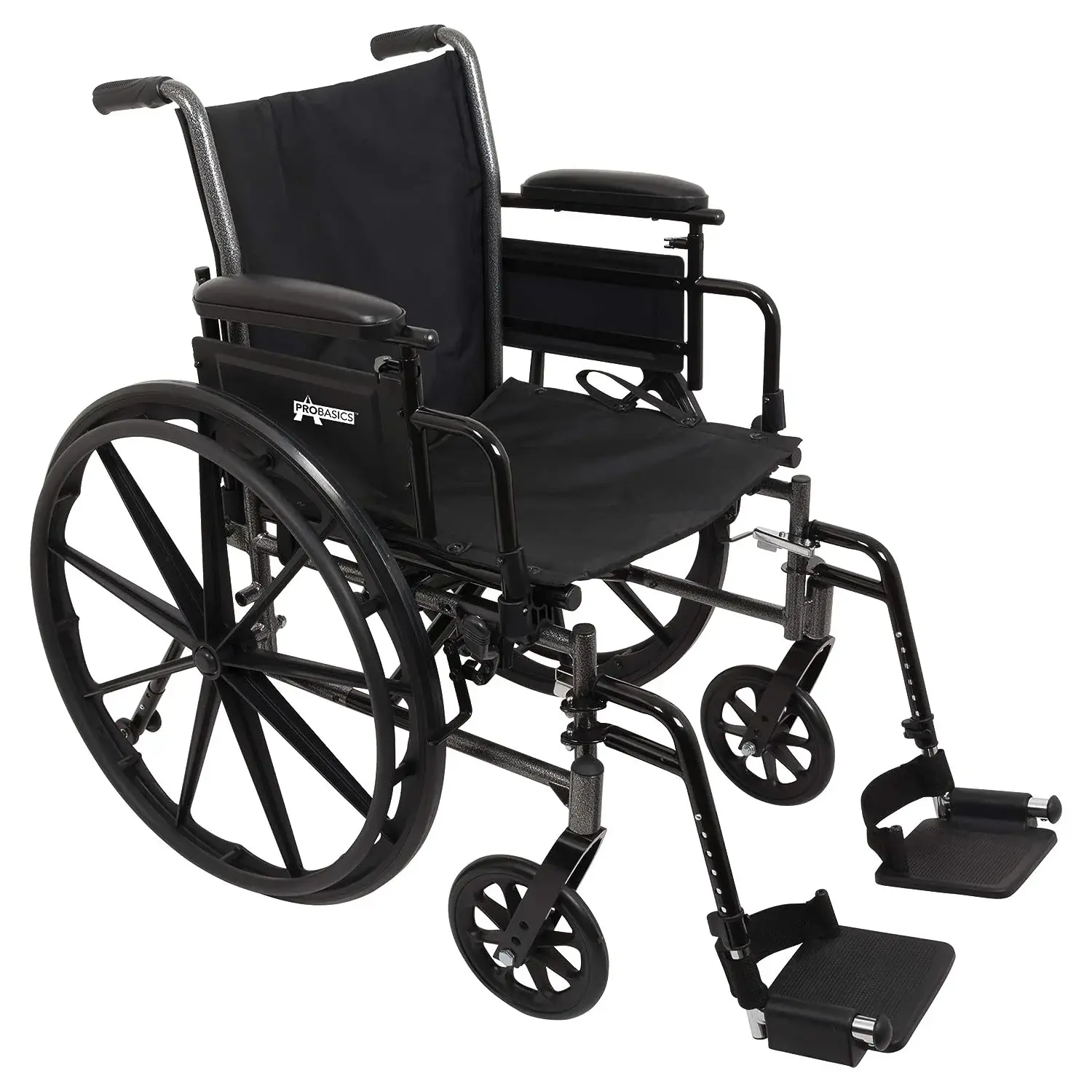
- 20-inch seat width x 16-inch seat depth (wide adult sizing)
- Flip-back armrests for unobstructed lateral transfer access
- Height-adjustable arms accommodate varying desk and table heights
- Removable 2-inch seat extension for customizable 18-inch depth option
- Tool-free swing-away footrests with heel loops for transfer clearance
- Optional elevating legrests available for lower extremity positioning
- Powder-coated steel frame with reinforced construction
- 300-lb weight capacity supports wide range of adult users
- Lightweight 35-38 lb frame weight for easier vehicle loading
- Dual-position seat-to-floor height (17" hemi or 20" adult)
- 18-inch fixed backrest height with padded vinyl upholstery
- Quick-release rear wheels for compact storage and transport
- Folding cross-brace frame collapses to approximately 11-13 inches wide
Benefits
- Proper Fit: 20" width eliminates hip compression for users with 17-20 inch hip measurements, reducing pressure ulcer risk
- Postural Stability: Wider base improves lateral stability and prevents pelvic obliquity (lateral tilt)
- Transfer Safety: Flip-back arms enable unobstructed sliding board access, reducing caregiver strain and user fall risk
- Doorway Navigation: 29" overall width maintains standard doorway clearance unlike full bariatric models (34-36" wide)
- Desk Accessibility: Height-adjustable arms slide wheelchair under tables for proper ergonomic positioning
- Seating Customization: Removable 2-inch extension adapts depth from 16" to 18" for taller users
- Transport Ease: 35-38 lb weight manageable for most caregivers loading into vehicles
- Clinical Versatility: Serves users who exceed standard 18" chairs but don't require full bariatric equipment
- Cost Efficiency: Single wheelchair accommodates wider size range, reducing need for multiple specialized chairs
- Pressure Management: Proper width prevents tissue compression at lateral hip prominences
Clinical Applications
✓ Users with 17-20 inch hip width requiring proper seating without bariatric equipment
✓ Post-stroke rehabilitation with body composition changes (edema, muscle atrophy)
✓ Hip replacement recovery requiring wider seating for surgical precautions
✓ Nursing home residents with weight fluctuations or clothing bulk
✓ Larger-framed users under 300 lbs not requiring bariatric wheelchairs
✓ Physical therapy clinics serving diverse body types
✓ Assisted living facilities with varied resident sizes
✓ Home care patients transitioning between weight categories
✓ Temporary mobility needs during healing (edema management)
✓ Users requiring extra space for adaptive cushioning or positioning devices
✓ Patients with lateral trunk instability requiring wider base of support
✓ Medical appointment transportation for broader-bodied individuals
Usage & Application
Determining Correct Seat Width:
- Hip Measurement: Measure user's hip width at widest point while seated—measure from lateral hip prominence to lateral hip prominence across buttocks
- Add Clearance: Add 2 inches to hip measurement for proper fit (e.g., 18" hips = 20" seat width needed)
- Clothing Consideration: Account for winter clothing, incontinence products, or bulky garments that add 1-2 inches
- Positioning Device Space: If using lateral supports, gel cushions, or positioning wedges, add their combined thickness to required width
- Rule of Thumb: Proper fit allows 1 inch clearance on each side between hips and armrest supports—too narrow compresses tissue, too wide allows pelvic obliquity
When to Choose 20-Inch vs. Other Widths:
- 16-18" seats: Hip width 13-16 inches (petite to average adults)
- 20" seats: Hip width 17-20 inches (larger average to stocky builds) ← THIS WHEELCHAIR
- 22-28" seats: Hip width 21+ inches (bariatric sizing, requires full bariatric frame)
Initial Setup & Customization:
- Frame Assembly: Unfold wheelchair by pulling up on seat rails until frame locks into fully extended position
- Width Verification: Measure overall width with armrests attached—should be approximately 29 inches for 20" seat
- Armrest Height Adjustment: Position armrests at height where user's shoulders remain relaxed when forearms rest on pads
- Seat Extension Decision: For users with thigh length exceeding 16 inches from back of knee to buttocks, install 2-inch extension
- Footrest Setup: Attach swing-away footrests ensuring footplates position feet with knees at 90° angle
- Seat Height Selection: Use adult setting (20" seat-to-floor) for standard users; hemi setting (17") for foot-propulsion users
- Doorway Clearance Test: Verify wheelchair fits through narrowest doorways in user's environment with 1.5-2 inch clearance on each side
Transfer Protocol for Wider Wheelchairs:
- Positioning: Wider wheelchairs require slightly different angle approach—position at 20-30° to transfer surface (vs. 30-45° for standard widths)
- Armrest Management: Flip back armrest on transfer side; wider seat means transfer distance may be 2-4 inches longer than standard chairs
- Sliding Board Placement: For 20" seats, ensure board spans full width of wheelchair seat plus transfer surface—typically need 24-30 inch boards
- Weight Distribution: Wider base provides more stable platform during transfers but requires user to shift weight more deliberately across broader surface
- Caregiver Body Mechanics: Wider wheelchair means caregiver stands slightly further from user during assisted transfers—adjust stance accordingly
Navigating Doorways with 20-Inch Width:
- Standard Residential Doorways (32-36"): 29" wheelchair width provides 3-7 inch clearance—adequate for straight approach
- Narrow Doorways (30-32"): May require slight angle approach; practice in user's home environment before discharge
- Commercial ADA Doorways (36"+): Ample clearance for easy navigation
- Bathroom Doorways (28-30"): Tight fit—may require door widening or removal for full accessibility
- Technique: Approach doorways straight-on when possible; if angling required, lead with front casters at 15-20° angle
Armrest Height Optimization for 20-Inch Seats:
- Dining Tables: Raise armrests to slide wheelchair under table; wider seat may require table with deeper knee clearance underneath
- Desk Work: Adjust armrests so they align 1-2 inches below desk surface; wider chair may not fit under narrower desks (verify 30" minimum desk width)
- Transfers: Lower armrests slightly for wider chairs to reduce lateral transfer distance between surfaces
- Propulsion: For self-propelling users, armrest height should allow comfortable push rim access without shoulder elevation
Managing Wider Wheelchair in Vehicles:
- Trunk Loading: 29" width fits most sedan trunks (typically 40-50" wide) but leaves less side clearance than 16-18" chairs
- Van Storage: Full-size vans accommodate 20" chairs easily; minivans should be tested for specific vehicle model
- Wheelchair Accessible Vehicles: Track width in WAVs must accommodate 29" chair width plus tie-down hardware (verify 36" minimum track spacing)
- Folded Dimensions: Collapses to 11-13" width; slightly wider than standard chairs due to seat upholstery bulk
Weight Distribution & Stability:
- Wider wheelchairs have lower center of gravity, providing enhanced lateral stability
- Users less likely to tip sideways during reaching or leaning compared to narrow chairs
- May feel "more stable" for users with trunk weakness or balance impairments
- Wider base requires slightly more effort to propel due to increased rolling resistance from wider track
Maintenance Specific to Wider Models:
- Weekly: Inspect seat upholstery for stretching or tearing—20" width creates more lateral tension on fabric
- Monthly: Check armrest adjustment mechanisms—wider seats create longer moment arms, potentially loosening hardware faster
- Quarterly: Verify wheel alignment—wider wheelchairs may track slightly less straight if casters become misaligned
- Cleaning: Wider seat upholstery accumulates more debris—vacuum seams and crevices thoroughly
Common Fit Issues & Solutions:
- Hip Compression Despite 20" Width: User may need 22" bariatric model; verify hip measurement and add 2" clearance
- Excessive Side-to-Side Movement: Seat may be too wide; consider adding lateral positioning pads or cushions to reduce width
- Armrests Won't Fit Under Tables: Wider overall width combined with armrest projection may exceed table knee clearance; try removing armrests for dining
- Difficulty Navigating Tight Spaces: 29" width requires more clearance than standard chairs; consider fold-up or swing-away accessories to reduce width temporarily
Clinical Documentation for Justification:
- Document hip width measurements showing 17-20 inch requirement
- Note tissue compression or pressure marks from narrower wheelchairs
- Photograph pelvic obliquity in improperly fitted chair vs. neutral alignment in 20" width
- Record functional improvements: reduced pain, better posture, easier transfers
- Insurance often covers 20" chairs under standard manual wheelchair codes (K0001-K0009) without bariatric justification
Technical Specifications
- Model Type: Manual Wheelchair with Flip-Back Arms, Wide Seat Configuration
- Seat Dimensions: 20 inches width x 16 inches depth
- Seat Depth with Extension: 18 inches (with optional 2-inch extension installed)
- Seat-to-Floor Height: 17 inches (hemi setting) or 20 inches (adult setting)
- Backrest Height: 18 inches (fixed backrest)
- Overall Width: Approximately 29 inches (with armrests in place)
- Overall Length: Approximately 42 inches (with footrests)
- Folded Width: Approximately 11-13 inches (wider upholstery than standard models)
- Weight Capacity: 300 lbs (136 kg)
- Product Weight: 35-38 lbs (16-17 kg) depending on footrest configuration
- Frame Material: Powder-coated steel with reinforced cross-brace construction
- Armrest Type: Flip-back, height-adjustable desk arms
- Armrest Adjustment Range: Typically 8-11 inches from seat surface
- Footrest Type: Tool-free swing-away with composite footplates and heel loops (standard)
- Optional Footrest: Elevating legrests available (specify at time of order)
- Rear Wheel Size: 24 inches diameter with quick-release axles
- Front Caster Size: 8 inches diameter semi-pneumatic tires
- Wheel Type: Pneumatic or solid tires depending on model variant
- Brake Type: Push-to-lock wheel locks on both sides
- Upholstery Material: Padded vinyl seat and back (black or gray standard)
- Frame Finish: Powder-coated steel (silver-vein or black)
- Cross-Brace: Heavy-duty double cross-brace for enhanced frame stability under wider loads
- Seat Extension Material: Padded vinyl matching main seat upholstery (2 inches deep)
- Seat Extension Attachment: Hook-on design, tool-free installation and removal
- Hip Width Accommodation: Suitable for users with 17-20 inch hip width (measured at widest point)
- Thigh Length Accommodation: 16-18 inches (with extension) from back of knee to buttocks
- User Height Range: 5'2" to 6'2" (hemi setting accommodates 4'10" to 5'8")
- Doorway Clearance Required: Minimum 30 inches (recommend 32+ inches for comfortable navigation)
- Standards Compliance: RESNA wheelchair safety standards; HCPCS codes K0001-K0009 eligible
- Warranty: Typically limited lifetime on frame, 1 year on components (verify with supplier)
- Intended Use: Manual wheelchair for users requiring wider seating than standard 18" chairs
- Recommended Environments: Home care, nursing facilities, rehabilitation centers, assisted living

 780 409-1509
 Get directions