
Slideshow Items

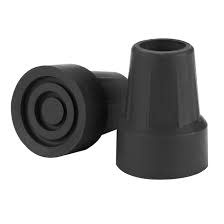
Drive Crutch Tips Pair are durable replacement rubber ferrules for crutch tube ends, restoring floor traction, shock absorption, and slip resistance at the contact point when original tips wear through, compress, or lose their surface grip.
Loading…
Crutch tips are retained on the crutch tube by an interference fit — the tip’s inner bore diameter is slightly smaller than the tube’s outer diameter, so the tip must be pressed onto the tube with firm force and is held in place by the compression of the rubber bore against the tube wall. This interference fit is the entire retention mechanism: there is no secondary fastener, clamp, or adhesive. The consequence of selecting a tip with the wrong bore diameter is not aesthetic — it is structural. A tip with a bore diameter that is too large for the tube slides onto the tube without resistance and cannot generate the compression contact that produces retention. Under the lateral loading of normal crutch use — a user placing the crutch tip at an angle to the floor during stride — an improperly retained tip will displace laterally off the tube end, removing traction from the crutch at the moment the user’s weight is committed through it. A tip with a bore diameter that is too small cannot be fully seated on the tube, leaving the metal tube end partially exposed below the tip rim where it makes floor contact before the rubber does. The standard 7/8″ inner bore matches the outer diameter of most standard aluminum axillary and forearm crutch tubes — but measure rather than assume, because crutch tube diameters vary across manufacturers and models. Confirming tube diameter before ordering is the single most important step in crutch tip selection.
The black rubber finish of Drive crutch tips is the clinical standard color for a functional reason that is not always recognized. Black rubber compound wears to a characteristic gray or silver appearance at the wear-through point — when the carbon-black pigment has abraded away and the exposed lighter-colored substrate becomes visible at the leading contact edge. This color transition is the visual indicator that the tip has worn through its protective rubber layer and the underlying ferrule or hard backing is making floor contact. On a non-black tip, this wear-through transition is less visually distinct, and the user or caregiver may not recognize the degraded state until the crutch slips on a polished surface. The black compound’s color transition from black to gray/silver at the contact edge provides a clear, unambiguous wear indicator that is visible during a routine inspection of the contact surface, supporting the replace-when-worn-through protocol rather than the guess-based replacement schedule that non-indicating tip colors require.
The pair replacement principle matters because crutch gait is not symmetric in the load it applies to each crutch tip. Most users with a lower limb injury or post-surgical weight-bearing restriction load the crutch on their stronger or unaffected side more heavily than the crutch on the affected side — the unaffected side crutch provides the primary propulsion support while the affected side crutch provides a lighter balance assist. This asymmetric loading means the dominant-side tip wears faster than the non-dominant-side tip, and if only the visibly worn dominant-side tip is replaced, the two crutches are now carrying tips at different stages of wear and compression. The worn tip has been replaced at original thickness; the non-dominant tip has compressed permanently to a reduced height. A height differential of even a few millimetres between crutch tips produces an asymmetry in the user’s supported posture — the shoulder on the shorter-tip side is slightly lower, and the crutch handle height on that side is not at the configured setting. Replacing tips as a matched pair each time eliminates this compounding height and wear differential.
The mixed floor environment of homecare and clinical use is the context for which the rubber compound’s traction coefficient must be specified. Standard crutch users in homecare settings encounter hardwood, vinyl plank, linoleum, tile, low-pile carpet, outdoor concrete, and — in Alberta’s climate — snow-tracked entry floors and salt-contaminated thresholds within a single trip from the bedroom to the front door. Traction on each of these surfaces depends on the rubber compound’s friction coefficient against that specific material under the user’s body weight. A rubber compound formulated for traction on dry hard floors may perform poorly on wet tile; a compound optimized for carpet may not maintain traction on polished hardwood. Drive’s crutch tip rubber compound is specified to provide adequate traction across the mixed hard-surface environments of standard crutch use — not premium traction on any single surface, but consistent grip across the full range of surfaces the user encounters in a typical home and community mobility circuit.
✓ Individual user replacement — homecare or community crutch users replacing worn tips when visual inspection of the leading contact edge shows gray wear-through, rubber thinning, or surface hardening ✓ Discharge preparation — fitting new tips to axillary or forearm crutches at hospital or clinic discharge, ensuring the patient begins home ambulation on a full-traction, correctly retained contact surface ✓ Post-fall or near-miss inspection — crutch tip replacement following a slip or near-slip event where tip condition may have contributed, as part of a post-incident equipment check before returning to use ✓ Matched pair renewal — simultaneous replacement of both tips when only one appears visibly worn, maintaining equal height and traction at both ends and preventing the posture asymmetry of mismatched tip wear ✓ Clinic and homecare single-pair stocking — maintaining tip availability for individual patient needs without requiring bulk box inventory
Testimonial items
Very welcoming and informative. We went in to rent a Walker for my mom to see if she would use it. They had no rentals left so he gave us a brand new one on rental. Highly recommend this company for all your ADL needs.
Tara Maye
The rating of this product is 5 out of 5
Fantastic service and experience, from delivery to pickup we could not have asked for anything more! We rented a hospital bed, and I do not believe you would get better service anywhere. Highly recommended!
Shawn Dillon
The rating of this product is 5 out of 5
Super friendly and very helpful! Delivered the wheelchair for me, special ordered other parts and took the time to show me how to install. I recommend!
Fiona Haines
The rating of this product is 5 out of 5
Can not thank the team at Med Supplies enough for their amazing service. We were in a tough spot till we got their help. Amazing service. Kind and respectful delivery. First class all the way. Thank you again.
Jon Beatty
The rating of this product is 5 out of 5
Ordered the chair on Sunday and it arrived Monday morning. Spoke to customer service to follow up on delivery times. It was already on my front door. Excellent and helpful staff. The product is sturdy and of good quality. Thank you for your help.
H D
The rating of this product is 5 out of 5
Excellent experience - website faithfully represented what was in stock (which hasn't always been my experience with other vendors sadly), and local shipping was really fast - ordered on the weekend, received it on Monday in my case. Thank you for being
Jason Hudson
The rating of this product is 5 out of 5
0/0
You cart is currently empty
780 409-1509
Get directions