Slideshow Items

  • Mobility Accessories
  • mobility/mobility-accessories
  • Mobility
  • mobility
ESC-Escape

  |  

Escape Rollator Slow Down Brake

C$96.00
In stock online
In store: Check availability

Available in store

SKU: 500-4000

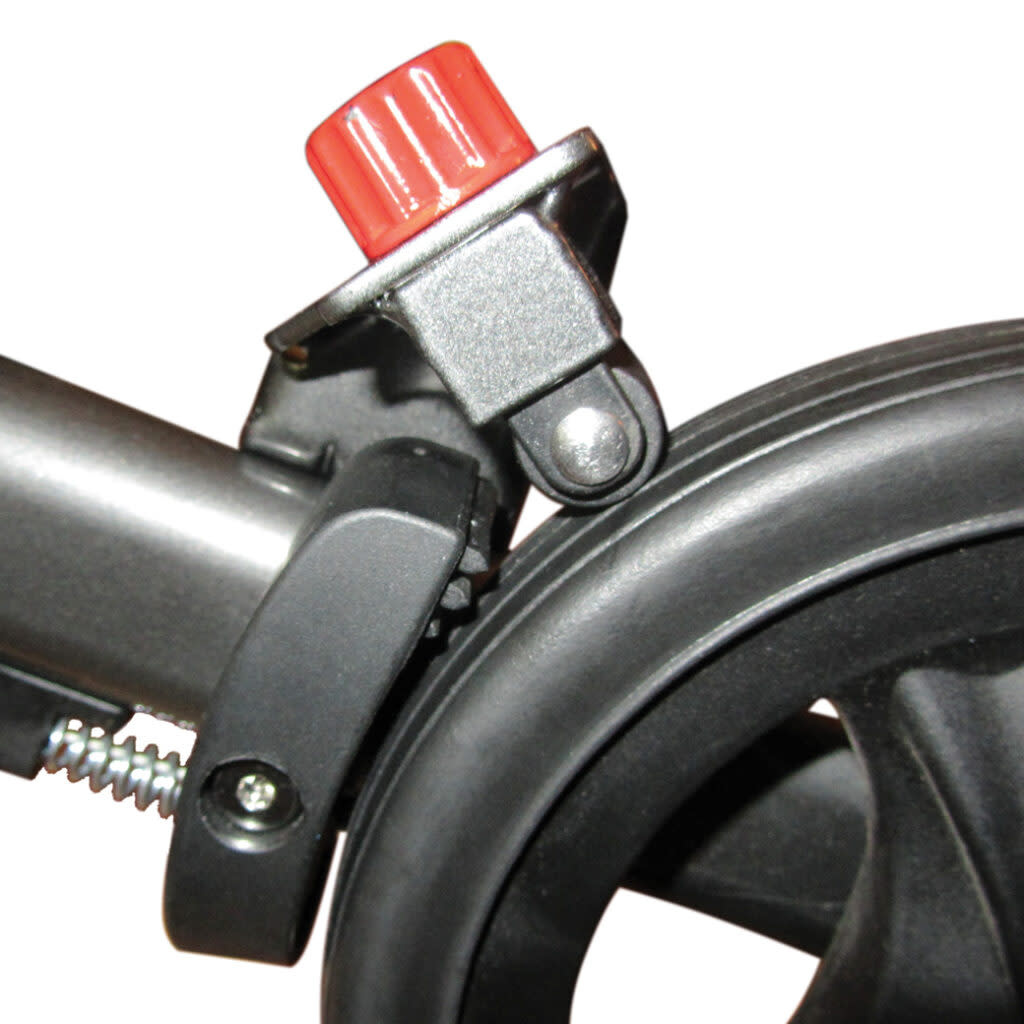
The adjustable drag brake modules deliver speed control on slopes while tension adjustment, Escape-specific mounting and preserved hand-brake function provide rolling resistance moderation for safer ambulation on inclines and smooth floors.

    • Why Adjustable Drag Brakes?

      Adjustable drag brakes address a critical safety gap in standard rollator braking systems that many users and clinicians encounter but conventional equipment designs fail to resolve: the inherent difficulty of maintaining controlled rolling speeds on declining surfaces, smooth flooring, or during momentum-building ambulation when users have compromised hand strength, reaction time, or brake modulation capability. Standard rollator brake systems operate on an all-or-nothing principle—hand-loop brakes provide zero resistance when fully released (enabling free rolling) or maximum resistance when fully engaged (locking wheels for stationary positioning), with limited intermediate modulation available through partial brake lever engagement that requires continuous precise hand pressure control. This binary system works adequately for users with normal hand strength, fine motor control, and cognitive processing speed who can continuously adjust brake lever pressure responding to changing terrain, but creates significant safety challenges for several vulnerable user populations. Users with arthritis affecting hand joints experience difficulty maintaining consistent brake lever pressure—the sustained grip force required for partial brake engagement throughout descent of long ramps or slopes causes pain and fatigue, leading users to release brakes completely and accept dangerous acceleration. Parkinson's disease patients with resting tremor and reduced fine motor control cannot achieve smooth graduated brake modulation, instead applying brakes in jerky all-or-nothing fashion that creates unstable stopping and starting patterns. Stroke survivors with hemiparesis may have adequate hand strength in their unaffected hand but cannot safely modulate brakes while simultaneously managing cane or concentrating on affected-side leg placement. Cognitive impairments affecting processing speed or judgment reduce users' ability to anticipate terrain changes and adjust braking preemptively rather than reactively. For all these populations, standard brake systems create a dangerous mismatch: users either maintain excessive brake pressure causing arm fatigue and jerky movement, or release brakes completely accepting uncontrolled acceleration that can exceed safe ambulation speeds. The Triumph Mobility Escape Adjustable Drag Brake system solves this problem by adding constant baseline rolling resistance independent of user brake lever manipulation. The drag brake modules mount to the rear wheel hubs creating adjustable friction against wheel rotation—users or therapists set the friction level via tension adjustment screws to create just enough rolling resistance to limit maximum rolling speed on typical declined surfaces encountered in daily environments. With drag brakes properly adjusted, the rollator never accelerates beyond the preset maximum speed even if users release hand-loop brakes completely, effectively establishing a mechanical speed governor that prevents dangerous runaway situations. The drag creates constant resistance rather than variable resistance, eliminating the need for continuous hand strength and fine motor control to moderate speed. Users can still engage hand-loop brakes for complete stopping when needed (drag brakes don't interfere with standard brake function), but during ambulation the baseline drag maintains controlled speeds without active user modulation. The Escape-specific design ensures proper geometric fit with the rollator's rear wheel assembly, folding mechanism, and frame structure without compromising standard functions or requiring frame modification.

      Key Features

      • Pair of Adjustable Drag Brake Modules: Complete left and right wheel system providing symmetric rolling resistance for balanced ambulation
      • Manual Tension Adjustment: Screw-type tension mechanism enables graduated resistance settings from minimal to substantial drag based on user needs
      • Escape-Specific Compatibility: Engineered exclusively for Triumph Mobility Escape rollator (standard models); NOT compatible with Escape Mini
      • Preserved Hand-Brake Function: Drag brakes operate independently from standard loop brakes enabling both systems to function simultaneously without interference
      • Maintained Folding Capability: Module design accommodates Escape's side-folding mechanism without binding or requiring removal during folding
      • Tool-Free Installation: Mounting system attaches to rear wheel hubs using hand-tightened hardware without requiring power tools or specialized equipment
      • Speed Governor Function: Establishes maximum rolling speed limit preventing dangerous acceleration on slopes regardless of hand-brake engagement
      • Symmetric Dual-Wheel System: Both rear wheels receive equal drag ensuring straight-line tracking without pulling to one side
      • Adjustable Resistance Range: Tension screws provide broad adjustment spectrum accommodating varied user weights, terrain conditions, and safety preferences
      • Durable Construction: Materials and design withstand daily use over typical 2-3 year service life without requiring frequent adjustment or replacement
      • Part Number 500-4000: Standard manufacturer designation for ordering, warranty claims, and technical support reference

      Benefits

      • Prevented Runaway Acceleration: Constant rolling resistance limits maximum speed on declined surfaces eliminating dangerous uncontrolled acceleration
      • Reduced Hand Strength Requirements: Baseline drag eliminates need for continuous precise brake lever pressure modulation during slopes or smooth floors
      • Enhanced Safety for Arthritis: Users with hand joint pain can ambulate on slopes without maintaining painful sustained grip force for brake control
      • Improved Parkinson's Safety: Compensates for tremor and reduced fine motor control that impair smooth brake modulation capability
      • Supported Hemiparesis Ambulation: Stroke survivors can focus on affected-side coordination without simultaneously managing continuous brake adjustment
      • Accommodated Cognitive Limitations: Reduced need for anticipatory brake adjustment supports users with processing speed or judgment impairments
      • Increased Caregiver Confidence: Family members feel more secure allowing independent rollator use knowing speed is mechanically limited
      • Maintained Independence: Users who might otherwise require restrictive supervised-only ambulation can safely continue independent mobility
      • Smooth Consistent Speed: Constant drag creates more predictable rolling characteristics improving user confidence and gait quality
      • Preserved Standard Functions: Normal hand-brake operation for complete stops and parking remains fully functional alongside drag brake system
      • Customizable Safety Margin: Adjustable tension enables personalized speed limits based on individual capability, environment, and risk tolerance

      Clinical Applications

      ✓ Parkinson's disease with tremor and reduced fine motor control impairing brake modulation capability
      ✓ Arthritis affecting hand joints limiting sustained grip strength for continuous partial brake engagement
      ✓ Post-stroke hemiparesis with unilateral weakness affecting brake control coordination
      ✓ Multiple sclerosis with upper extremity weakness reducing brake lever force capability
      ✓ Progressive supranuclear palsy with balance and coordination deficits
      ✓ Cognitive impairment affecting anticipatory brake adjustment and terrain assessment
      ✓ Reaction time delays from aging, medication, or neurological conditions
      ✓ Fear of falling with anxiety about speed control on slopes creating mobility restriction
      ✓ Assisted living facility use where residents have varied capabilities requiring added safety margins
      ✓ Memory care units where users require simplified equipment operation with passive safety features
      ✓ Rehabilitation settings during progressive training from restricted to independent outdoor mobility
      ✓ Home environments with challenging terrain (long driveways, sloped approaches, smooth floors)
      ✓ Community ambulation training where therapists need adjustable safety controls during skill development
      ✓ Seasonal conditions (rain, ice) temporarily requiring enhanced safety margins
      ✓ Users transitioning from walkers to rollators needing intermediate support during adaptation period

      Usage & Application

      Pre-Installation Assessment and Compatibility Verification: Before ordering or installing drag brakes, confirm absolute compatibility with the specific rollator model. The Triumph Mobility Escape Adjustable Drag Brake system (Part 500-4000) fits ONLY the standard Triumph Mobility Escape rollator—it is NOT compatible with Escape Mini models due to different wheel hub geometry, axle dimensions, and frame structure. To verify compatibility, locate the model identification on the rollator's frame label or documentation. If labels are unclear, measure the rear wheel diameter (standard Escape typically has 8-inch wheels; Mini has smaller wheels) and contact Triumph Mobility or authorized dealers for confirmation. Using drag brakes on incompatible models creates serious safety hazards including wheel binding, frame damage, or brake system failure. Beyond model compatibility, assess whether drag brakes address the user's specific needs: users requiring speed moderation due to hand strength limitations, balance concerns, or cognitive factors benefit significantly; users with adequate brake control seeking primarily parking brake function gain limited benefit from drag brake addition. Consider whether the user's typical environment includes frequent declined surfaces, smooth floors, or long-distance ambulation where speed control becomes critical—users primarily navigating flat carpeted indoor environments may not require drag brake enhancement. Evaluate user hand strength and dexterity to ensure they can still operate standard loop brakes for complete stops even with drag brakes installed—drag brakes reduce but don't eliminate the need for hand-brake engagement during active stopping.

      Installation Procedure and Mounting Verification: The drag brake modules mount to the rear wheel hubs of the Escape rollator using clamp-style or bracket-style attachment hardware depending on specific model design. Begin installation with the rollator on stable level surface with brakes engaged preventing movement. Locate the installation instruction video or manual provided by Triumph Mobility—visual demonstration significantly simplifies installation compared to written instructions alone. Each drag brake module consists of a mounting bracket that attaches to the wheel hub, a friction pad or disc that contacts the wheel or hub surface, and a tension adjustment screw that controls friction force. Position the left drag brake module on the left rear wheel hub, aligning mounting hardware with hub attachment points. Hand-tighten mounting fasteners initially (typically hex bolts or wing nuts) ensuring the friction pad positions correctly against the intended contact surface without binding the wheel or interfering with brake cable routing. Repeat the process for the right wheel drag brake module, maintaining symmetry with left-side installation. After both modules are loosely mounted, spin each wheel manually to verify free rotation with minimal drag—at this stage with tension screws backed off completely, wheels should spin freely similar to stock configuration. Tighten mounting fasteners firmly but avoid excessive torque that could crack plastic components or strip threads. Verify that drag brake modules don't interfere with the rollator's side-folding mechanism by folding and unfolding completely—modules should clear all frame members and cables during folding without binding or requiring removal.

      Tension Adjustment and Speed Calibration: After installation verification, adjust the tension screws on each drag brake module to establish desired rolling resistance. The tension adjustment process requires iterative testing and refinement rather than single-setting finalization. Begin with both tension screws backed off (turned counterclockwise) to minimum tension position—at this setting, drag brakes provide minimal resistance, essentially functioning like stock configuration. Have the user (or a person of similar weight) stand behind the rollator on level ground and attempt to push it forward with standard walking force. The rollator should move easily with very little resistance. Now turn both tension screws clockwise 1-2 full rotations, increasing friction force. Test rolling again—resistance should be noticeably increased but rollator should still move forward with reasonable pushing effort. Continue increasing tension incrementally (1-2 turns at a time) while testing rolling until reaching desired resistance level. The optimal setting varies by user: users with significant strength limitations need minimal drag (just enough to prevent acceleration on moderate slopes); users with good strength but poor modulation control can tolerate higher drag providing maximum speed limitation. The ideal resistance creates slight noticeable drag during level-ground pushing but doesn't require excessive force that causes arm fatigue. To test slope performance, position the rollator at the top of a gentle slope representative of typical environment (driveway, building entrance ramp). With user positioned behind rollator maintaining light hand grip but NOT engaging brakes, allow rollator to descend the slope. Properly adjusted drag brakes limit maximum rolling speed to comfortable walking pace even without active brake engagement. If rollator accelerates beyond comfortable speed, increase tension further; if resistance makes pushing difficult, decrease tension. Both left and right tension screws should be adjusted symmetrically to equal settings preventing the rollator from pulling to one side during ambulation.

      Integration with Standard Hand-Brake Operation: The drag brake system operates independently from and in addition to the Escape's standard hand-loop brake system—both systems function simultaneously providing layered safety control. Users must understand that drag brakes provide baseline constant resistance reducing maximum rolling speed, but hand-loop brakes remain necessary for active stopping, stationary parking, and navigating particularly steep slopes exceeding drag brake capability. During typical ambulation on level or gently declined surfaces, users can walk normally with drag brakes providing passive speed moderation without conscious brake lever engagement. When approaching complete stops (reaching destinations, entering doorways, transferring to seats), users must actively engage hand-loop brakes by squeezing brake levers as they would with stock configuration—drag brakes alone don't provide stopping capability, only speed reduction. For stationary parking (while seated on rollator or standing with rollator stationary), users must engage hand-loop brake parking locks as usual—drag brakes maintain resistance during rolling but don't lock wheels for stationary holding. On particularly steep declines exceeding drag brake capability (steep driveways, building ramps steeper than standard codes), users should engage partial hand-brake pressure in addition to drag brake resistance, creating combined control that's still easier than hand-brake-only modulation. The layered system philosophy provides redundancy: if user fails to engage hand brakes appropriately, drag brakes prevent dangerous high speeds; if drag brake tension reduces over time, hand brakes maintain full stopping capability; if hands are briefly occupied (adjusting clothing, retrieving items), drag brakes maintain safe speeds during momentary distraction.

      Periodic Inspection and Maintenance: Drag brake systems require minimal maintenance but benefit from periodic inspection ensuring continued safe function. Weekly during initial use and monthly thereafter, check tension screw settings by attempting to turn them—if tension screws turn freely without requiring force, they've loosened and require re-tightening to restore original resistance setting. Test rolling resistance regularly on familiar level surface—increased ease of rolling compared to initial setup indicates tension loss requiring adjustment. Inspect friction pad surfaces monthly for wear—pads contacting wheels or hubs gradually wear down reducing effectiveness. Excessive wear (pad material thickness reduced more than 50% from original) indicates replacement need. Check mounting fasteners quarterly for tightness—vibration during use can gradually loosen hardware creating instability or complete detachment. Verify clearances during folding/unfolding monthly—any new contact between drag brake modules and frame members suggests hardware loosening or component shift requiring attention. After outdoor use in wet conditions, inspect drag brake components for moisture accumulation or corrosion—wipe dry and consider light lubricant on metallic components (but avoid lubricating friction pads which would reduce effectiveness). Tension adjustment screws may require occasional lubrication if they become difficult to turn—apply small amount of lubricant to screw threads but wipe away excess preventing contamination of friction surfaces. Expected drag brake service life is typically 2-3 years with daily use, though friction pads may require earlier replacement (annually) depending on usage intensity and environmental conditions. Complete drag brake module replacement becomes necessary when mounting hardware fails, friction pads wear beyond functionality, or adjustment mechanisms no longer maintain tension.

      User Training and Caregiver Education: Effective drag brake utilization requires proper training ensuring users and caregivers understand system capabilities, limitations, and correct operation. Physical therapy or occupational therapy sessions should include specific drag brake instruction covering: recognizing when to engage hand brakes versus relying on drag brake resistance alone, understanding that drag brakes don't eliminate need for hand-brake operation, knowing how to test and adjust tension settings, and recognizing signs of system malfunction requiring service. Users transitioning from standard rollators to drag-brake-equipped models need adaptation period (typically 3-5 days) learning to trust passive speed control rather than constant active brake modulation—therapists should provide supervised practice on varied terrain building confidence in the drag brake system. Caregivers should understand tension adjustment procedures enabling them to increase resistance if users demonstrate unsafe speeds or decrease resistance if users struggle with excessive drag during pushing. Family members should learn inspection protocols identifying when professional service is needed. For users with cognitive limitations, simplified instruction focusing on core concepts (hand brakes still needed for stops, rollator won't run away even if hands come off brakes briefly) rather than technical system details. Create written or pictorial quick-reference cards showing optimal tension screw positions for different environments (minimal drag for indoor flat surfaces, moderate drag for mixed terrain, maximum drag for hilly outdoor environments)—these references support users adjusting settings independently as needs change.

      Environmental Adaptation and Setting Changes: Drag brake optimal tension varies by environment and seasonal conditions, requiring adjustment when usage patterns change. Indoor-primarily users benefit from minimal drag settings—indoor floors (tile, vinyl, carpet) provide inherent friction that limits acceleration even without drag brake assistance; excessive drag makes indoor maneuvering needlessly difficult. Outdoor-primarily users require higher drag settings—concrete, asphalt, and paved surfaces provide less inherent friction enabling higher speeds without mechanical limitation. Users alternating between indoor and outdoor environments face dilemma: optimal indoor settings provide insufficient outdoor control, while optimal outdoor settings create excessive indoor resistance. Solutions include: accepting moderate compromise settings providing adequate outdoor safety while tolerating slightly increased indoor resistance; adjusting tension before major environment transitions (tighten before outdoor excursions, loosen upon returning indoors); or maintaining two identical rollators with different drag brake settings for dedicated indoor versus outdoor use (practical mainly for institutional settings with equipment budgets). Seasonal considerations affect optimal settings: winter conditions with ice, snow, or rain may warrant temporarily increased drag providing extra safety margins during hazardous periods, while summer dry conditions enable reduced drag settings. Sloped driveway approaches at home create specific challenges—users may need higher drag specifically for driveway navigation even if other environments tolerate lower settings; in such cases, adjust to the highest-requirement environment accepting minor over-control in less demanding settings.

      Technical Specifications

      Product Identification
      Part Number: 500-4000
      Description: Adjustable Drag Brake System for Triumph Mobility Escape Rollator
      Manufacturer: Triumph Mobility
      Quantity: Pair (left and right wheel modules)
      Category: Rollator safety enhancement accessory

      Compatibility
      Compatible Model: Triumph Mobility Escape Rollator (standard model)
      Incompatible Models: Escape Mini (different wheel hub geometry)
      Wheel Position: Rear wheels only (front wheels unaffected)
      Installation Location: Mounts to rear wheel hubs or axle assemblies

      Adjustment Specifications
      Adjustment Method: Manual tension screws (typically one per module)
      Adjustment Range: Minimal resistance to substantial drag (specific values proprietary)
      Adjustment Tool: Hand-adjustable (no tools required) or basic hex wrench depending on design
      Tension Mechanism: Screw-type friction adjustment creating graduated resistance settings
      Setting Retention: Tension maintained through vibration-resistant hardware and lock mechanisms

      Functional Specifications
      Primary Function: Constant rolling resistance limiting maximum rollator speed on declined surfaces
      Speed Governor: Establishes mechanical speed limit independent of user brake engagement
      Hand-Brake Compatibility: Drag brakes operate independently without interfering with standard loop brake function
      Folding Compatibility: Modules designed to clear frame during side-folding operation
      Symmetric Operation: Both wheels receive equal drag ensuring straight tracking

      Materials and Construction
      Mounting Hardware: Corrosion-resistant metal (steel or aluminum with protective coating)
      Friction Components: Wear-resistant pad material (rubber compound or composite)
      Adjustment Hardware: Threaded steel or stainless steel screws with lockwasher retention
      Durability: 2-3 year typical service life with daily use
      Maintenance: Friction pads may require annual replacement depending on usage intensity

      Installation Specifications
      Installation Method: Clamp or bracket attachment to wheel hub assemblies
      Tools Required: Typically hand-tightened or basic hex wrench (size varies by model)
      Installation Time: Approximately 20-30 minutes for pair with instruction video guidance
      Reversibility: Fully removable without permanent modification to rollator frame
      Professional Installation: Optional but not required (user-installable design)

      Performance Parameters
      Resistance Type: Continuous constant drag during rolling (not intermittent)
      Maximum Speed Reduction: Adjustable based on tension settings (manufacturer specifications proprietary)
      User Weight Range: Accommodates varied user weights through tension adjustment
      Terrain Effectiveness: Most effective on smooth declined surfaces (ramps, slopes, smooth floors)
      Weather Resistance: Outdoor use capable; performance may vary in wet conditions

      Maintenance Requirements
      Inspection Frequency: Weekly initially, monthly thereafter for tension retention
      Adjustment Frequency: As needed when resistance decreases or user needs change
      Friction Pad Replacement: Annually or when wear exceeds 50% of original thickness
      Fastener Inspection: Quarterly verification of mounting hardware tightness
      Cleaning: Periodic wiping to remove debris from friction surfaces

      Safety Considerations
      Intended Use: Speed moderation supplement to (not replacement for) standard hand brakes
      User Requirements: Must maintain ability to operate standard loop brakes for complete stops
      Supervision: Initial use should be supervised to verify appropriate tension settings
      Terrain Limitations: Not substitute for active brake engagement on extremely steep slopes
      Cognitive Requirements: Users must understand hand brakes still necessary for stopping

      Warranty and Support
      Warranty: Manufacturer warranty against defects (duration varies by retailer)
      Technical Support: Triumph Mobility customer service for installation and adjustment guidance
      Replacement Parts: Friction pads and mounting hardware available separately
      Return Policy: Verify with retailer; typically returnable if unused

      Packaging and Documentation
      Package Contents: Two drag brake modules (left and right), mounting hardware, adjustment tools (if required)
      Documentation: Installation instructions, adjustment guide, safety warnings
      Video Support: Installation demonstration video typically available online
      Language Options: Multi-language instructions depending on market

    • No reviews yet

      Add yours

    Testimonials from Google

    See all reviews

    Recently viewed

    Your cart — 0

    You cart is currently empty

    Login