Slideshow Items

  • Premium Knee Walkers & Mobility Scooters: Explore Med Supplies' Best Selection
  • mobility/premium-knee-walkers-mobility-scooters-explore-med
  • Mobility
  • mobility
NHK-Nighthawk

  |  

Nighthawk Deluxe Knee Scooter 7" Casters 300lbs Capacity

C$338.75
In stock online
In store: Check availability

Available in store

SKU: 410

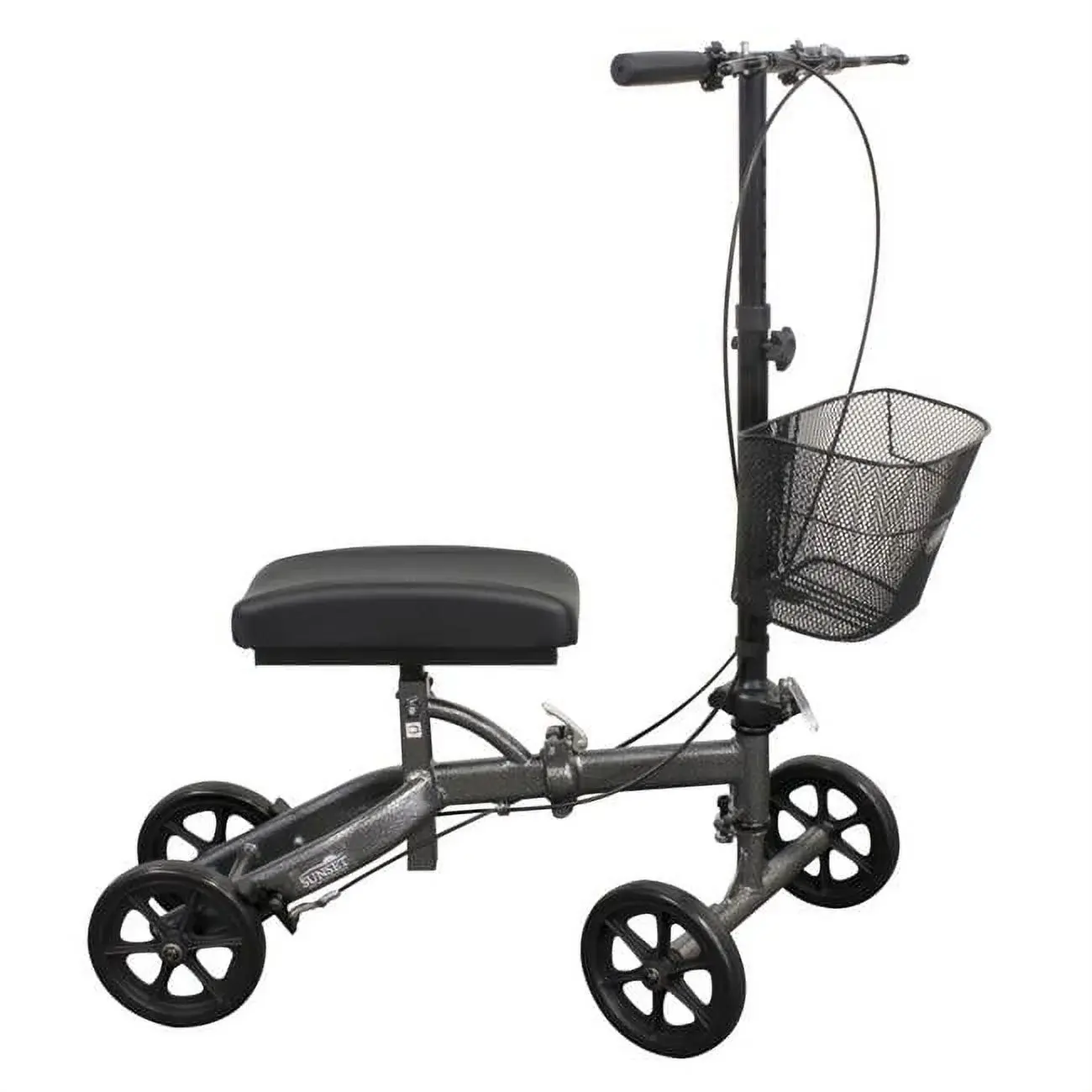
The 7-inch casters with dual hand brakes plus folding frame deliver stable indoor and outdoor mobility for 300-pound capacity while contoured adjustable knee pad enables comfortable weight-free recovery from foot, ankle or lower-leg injury.

    • Why 7-Inch Casters with Dual Brake System

      The Nighthawk Deluxe's oversized 7-inch caster wheels provide fundamental advantages over budget knee walkers equipped with undersized 5-6 inch wheels that struggle with common obstacles encountered during daily mobility. Larger diameter wheels roll smoothly over door thresholds, sidewalk cracks, carpet transitions, and minor surface irregularities that cause smaller wheels to catch or jolt, reducing user confidence and creating fall risk. The increased wheel diameter also improves rolling efficiency, requiring less push effort to maintain forward momentum—critical for users with limited upper body strength or endurance during post-surgical recovery. The dual hand brake system with parking lock function delivers reliable stopping power on slopes and enables secure stationary positioning during transfers, dressing, or rest periods. This combination of large-diameter smooth-rolling capability with comprehensive braking control addresses the primary user complaints about budget knee scooters: difficulty navigating common household obstacles and inadequate braking leading to unsafe runaway situations. The folding frame design maintains mobility device portability without compromising structural rigidity during use, enabling vehicle transport to medical appointments while supporting full 300-pound capacity without frame flex or instability.

      Key Features

      • 7-Inch Diameter Casters: Oversized wheels navigate thresholds, carpet edges, and sidewalk cracks smoothly
      • Dual Hand Brakes: Independent left and right brake levers with parking lock function for secure stopping
      • Contoured Knee Pad: Thick cushioning with ergonomic shaping distributes pressure evenly during extended use
      • Adjustable Knee Platform Height: Accommodates varied leg lengths and injury locations (foot, ankle, lower leg)
      • Adjustable Handlebar Height: Customizable handle position for different user heights and postures
      • Folding Frame Design: Collapses quickly for vehicle transport and compact home storage
      • 300-Pound Weight Capacity: Heavy-duty construction supports most adult users without frame flex
      • Durable Metal Construction: Steel or aluminum frame (model-dependent) provides long-term structural integrity
      • Indoor/Outdoor Capability: Smooth casters perform on tile, wood, carpet, concrete, and asphalt surfaces
      • Tool-Free Adjustments: Height modifications accomplished without tools for quick customization
      • Parking Brake Lock: Keeps scooter stationary during transfers and prevents rollaway on slopes
      • Stable Four-Point Base: Wide wheelbase provides lateral stability preventing tipping during turns

      Benefits

      • Complete Weight Relief: Eliminates all pressure on injured foot, ankle, or lower leg enabling proper healing
      • Superior Comfort: Padded knee platform reduces discomfort versus crutches causing underarm pain and hand blisters
      • Maintains Independence: Enables continued daily activities, work, and social engagement during recovery
      • Reduces Upper Body Strain: No arm strength required unlike crutches demanding sustained upper body effort
      • Improves Recovery Compliance: Comfortable mobility increases adherence to non-weight-bearing protocols
      • Navigates Tight Spaces: Maneuverable design fits through standard doorways and navigates home environments
      • Prevents Secondary Injuries: Reduces crutch-related falls, shoulder injuries, and wrist strain common during recovery
      • Portable for Appointments: Folding capability enables medical appointment attendance without mobility compromise
      • Speeds Daily Tasks: Completes household activities faster than crutch ambulation or hopping
      • Supports Bilateral Hand Use: Frees hands for carrying items, opening doors, and maintaining balance
      • Cost-Effective Recovery: Rental or purchase cost lower than complications from improper weight-bearing

      Clinical Applications

      ✓ Foot fractures requiring non-weight-bearing protocols (Jones fracture, metatarsal fractures, calcaneus fractures)
      ✓ Ankle fractures and post-surgical ankle reconstruction (ORIF, arthrodesis)
      ✓ Achilles tendon rupture and post-surgical repair
      ✓ Severe ankle sprains with complete non-weight-bearing recommendation
      ✓ Foot surgery recovery (bunionectomy, hammertoe correction, plantar fascia release)
      ✓ Lower leg fractures (tibia, fibula) during cast immobilization
      ✓ Diabetic foot wounds requiring complete pressure offloading
      ✓ Post-amputation healing (below-knee amputation) before prosthetic fitting
      ✓ Chronic foot conditions exacerbated by weight-bearing (Charcot foot, severe arthritis)
      ✓ Plantar fasciitis requiring temporary non-weight-bearing
      ✓ Heel surgery recovery (Haglund's deformity, heel spur removal)
      ✓ Ligament reconstruction (ankle, foot) with extended non-weight-bearing phase
      ✓ Complex regional pain syndrome (CRPS) requiring weight reduction
      ✓ Post-operative recovery from any lower extremity surgery requiring 4-12 weeks non-weight-bearing

      Usage & Application

      Injury Assessment & Suitability Determination: Verify user has medical clearance for knee walker use—some conditions contraindicate knee scooter use including bilateral lower extremity injuries, balance disorders, upper extremity weakness preventing steering control, cognitive impairment affecting safe operation. Confirm injury location compatible with knee platform positioning: injuries below knee (foot, ankle, lower leg) ideal; knee and thigh injuries generally incompatible as affected leg cannot rest on platform. Assess user's living environment: knee walkers require relatively smooth surfaces and adequate turning radius—homes with thick carpet, narrow hallways, or excessive stairs may limit usability. Verify weight under 300-pound capacity limit. Evaluate user's upper body strength and coordination—must be able to steer, brake, and maintain balance.

      Initial Height Adjustment Protocol: Position knee walker on flat, stable surface. Adjust knee platform height first: User should stand beside scooter with injured leg slightly bent (approximately 20-30 degrees knee flexion). Knee platform should align with bottom of kneecap (patella) or slightly below. This height enables comfortable kneeling position with thigh approximately parallel to ground. Loosen knee platform adjustment mechanism (typically quick-release lever or knob), slide platform to target height, and securely tighten adjustment. Test by having user kneel on platform—knee should rest comfortably without excessive pressure on patella, and foot should clear ground by 4-6 inches. Adjust handlebar height next: With user kneeling on platform in natural upright posture, handles should position at waist to lower chest height enabling relaxed arm position with slight elbow bend. Handles too high cause shoulder strain; too low forces uncomfortable hunched posture. After adjustments, verify all quick-release mechanisms and adjustment collars are fully tightened—loose adjustments create serious safety hazards.

      First-Use Training & Safety Protocol: Before allowing independent use, conduct supervised training session covering: (1) Mounting technique—approach scooter from side, place hands on handles, lift injured leg, and gently lower knee onto pad while stabilizing with good leg; (2) Dismounting—reverse process, shifting weight to good leg before lifting knee from platform; (3) Propulsion—push with good leg using smooth skating motion while maintaining light grip on handles for steering; (4) Braking—squeeze both brake levers simultaneously for controlled stopping, never just one brake; (5) Parking brake engagement—flip parking brake lock after stopping to prevent rollaway. Practice these skills in safe, open area under supervision before independent use. Emphasize: never lean or reach beyond scooter wheelbase (causes tipping), always engage parking brake when stationary, avoid wet surfaces (reduced traction), navigate slopes cautiously.

      Indoor Navigation Techniques: For door thresholds: approach straight-on at moderate speed (2-3 mph), maintain forward momentum through threshold—do not stop mid-crossing as wheels may catch. For carpet transitions: increase speed slightly before transition for momentum to carry over carpet edge. For tight turns: reduce speed, make wider arcs rather than sharp pivots (reduces tipping risk). For doorways: approach centered, verify adequate clearance (standard doorway 32-36 inches accommodates most knee walkers), reduce speed through doorway. For furniture navigation: maintain 6-12 inch clearance from obstacles, avoid sharp corners that could catch scooter frame. Practice backing up: push handles forward gently to reverse, use sparingly as backward steering is counterintuitive.

      Outdoor Use Guidelines: Verify outdoor surface suitability before attempting—smooth concrete, asphalt, and firm packed surfaces appropriate; gravel, grass, sand, and uneven terrain inappropriate and dangerous. On sidewalks: maintain straight-line path, watch for cracks and heaves, reduce speed over any irregularity. On slopes: descend slowly using continuous gentle braking (both brakes evenly), never attempt steep slopes exceeding 5-degree incline. Crossing streets: use curb cuts where available, never attempt to jump or hop curbs with scooter. Weather considerations: avoid wet surfaces (slippery, reduced brake effectiveness), avoid use in rain or snow (vision impairment and surface hazards). Temperature extremes: metal components may be uncomfortably cold in winter—consider grip covers; sun exposure may heat metal and pad surfaces—allow cooling before use.

      Knee Pad Comfort Optimization: Position injured leg so knee rests centered on pad with kneecap (patella) on thickest padding—avoid positioning leg too far forward (pressure on patellar tendon) or too far back (pressure on tibial tuberosity). If prolonged use causes knee discomfort despite proper positioning, consider: (1) Additional padding—gel pad overlay or sheepskin cover distributes pressure better; (2) Frequent position shifts—periodically extend leg or adjust knee angle slightly; (3) Rest breaks—dismount every 30-60 minutes initially to prevent knee stiffness. For users with larger calves, ensure shin does not contact steering column—if rubbing occurs, pad steering column with foam pipe insulation. Some users benefit from wearing long pants or knee sleeve for additional padding interface.

      Daily Activity Adaptations: Carrying items: use backpack, cross-body bag, or apron with pockets—never carry items in hands as both hands needed for steering and braking. Opening doors: approach parallel to door, shift weight to stabilize scooter with hip contact, use one hand to open door while other maintains steering control. Kitchen tasks: height-adjustable knee platform enables working at counter height; consider adjusting platform higher to bring user to standing counter level. Bathroom use: fold scooter and prop outside shower/tub area; transfer to shower chair using crutches or hopping for short distance. Dressing: sit on bed edge for lower body dressing before mounting scooter, or remain on scooter and use long-handled dressing aids. Stairs: knee walkers cannot navigate stairs—users must either hop, use crutches, or use stair chair lift.

      Folding for Transport & Storage: Engage parking brake to prevent rolling during folding process. Remove any accessories or bags attached to scooter. Locate folding mechanism (typically lever or latch on frame near steering column base). Pull/lift folding release while simultaneously pulling handles upward—frame should collapse vertically bringing wheels closer together. Some models require two-step folding (release, then push/pull to complete collapse). Folded dimensions typically 36-40 inches tall × 16-20 inches wide × 36-40 inches long—fits in most car trunks, SUV cargo areas, minivans. To unfold: reverse process, ensure folding mechanism clicks/locks into extended position before use. After folding/unfolding, always verify height adjustments remained secure—folding stress can loosen adjustment mechanisms.

      Maintenance & Safety Inspection Schedule: Weekly inspection (during active use phase): Check brake function by testing both levers—should provide firm resistance and hold scooter stationary on slight slope. Inspect wheels for wear, cracks, or flat spots—replace if significant damage visible. Verify all adjustment mechanisms tight (knee platform, handlebars). Check knee pad for tears or compression loss—replace if padding degraded. Monthly maintenance: Clean wheels removing hair, dirt, or debris wrapped around axles. Wipe frame and pad with disinfectant cleaning solution. Lubricate moving parts (folding mechanism, brake pivots) with light machine oil. Inspect frame for cracks, bends, or loose components. Before each use (especially after storage or transport): Verify folding mechanism locked, verify height adjustments tight, test brakes, verify wheels spin freely.

      Troubleshooting Common Issues: Problem: Scooter pulls to one side. Solution: Check wheel inflation if pneumatic tires; verify all wheels spin freely; adjust brake cable tension if one brake dragging. Problem: Brakes don't hold on slopes. Solution: Tighten brake cables; replace worn brake pads; verify parking brake mechanism engaging fully. Problem: Knee discomfort during use. Solution: Recheck platform height; add supplemental padding; ensure knee centered on pad; take more frequent breaks. Problem: Difficulty steering. Solution: Verify handlebar height appropriate (should be waist to lower chest); ensure wheels not binding; practice in open area to improve technique. Problem: Scooter feels unstable. Solution: Verify user weight under 300 lb capacity; check wheel condition; ensure proper knee positioning (not leaning too far forward or back); reduce speed during turns. Problem: Folding mechanism won't lock. Solution: Inspect locking mechanism for debris or damage; ensure proper folding sequence followed; apply light lubricant to mechanism; contact supplier if persistent.

      Skin Care & Pressure Prevention: Monitor knee skin condition daily for pressure areas, redness, or breakdown—prolonged pressure can cause skin damage even with padded platform. Apply barrier cream or use knee sleeve to reduce friction. If redness develops, increase rest breaks and verify platform height correct. Users with diabetes, peripheral vascular disease, or decreased sensation should inspect knee hourly during use and limit continuous use to 30-minute periods. For users with thin skin or on blood thinners (increased bruising risk), consider gel pad overlay for additional pressure distribution.

      Return to Weight-Bearing Protocol: As recovery progresses and physician authorizes partial weight-bearing, transition strategy varies: Some users reduce knee walker use while introducing crutches for short distances; others use knee walker for longer trips while weight-bearing short distances; gradual reduction in knee walker dependence as weight-bearing tolerance increases. Never discontinue knee walker use without physician clearance—premature weight-bearing causes re-injury requiring extended recovery. Maintain knee walker access for several weeks after full weight-bearing achieved in case of setbacks or fatigue requiring temporary mobility assistance.

      Technical Specifications

      • Model: Nighthawk Deluxe Knee Walker (verify specific model designation with supplier)
      • Weight Capacity: 300 lb (136 kg) maximum user weight
      • Caster Wheel Size: 7 inches diameter (significantly larger than budget 5-6 inch models)
      • Wheel Configuration: Four wheels (dual front steering casters, dual rear drive wheels)
      • Brake System: Dual hand-operated brakes (left and right levers) with parking lock mechanism
      • Knee Platform: Contoured, padded design with height adjustment
      • Knee Platform Height Range: Typically 16-22 inches adjustable (verify specific model range)
      • Handlebar Height Range: Typically 32-42 inches adjustable (verify specific model range)
      • Overall Width: Approximately 24-26 inches (verify fits doorways in user's environment)
      • Overall Length: Approximately 40-44 inches unfolded
      • Folded Dimensions: Approximately 36-40" H × 16-20" W × 36-40" L (model-dependent)
      • Frame Material: Durable steel or aluminum construction (material varies by specific model/supplier)
      • Frame Type: Folding design with secure locking mechanism
      • Knee Pad Material: High-density foam padding with easy-clean vinyl or fabric cover
      • Handle Material: Rubber or foam grips for comfortable steering control
      • Adjustment Mechanism: Tool-free quick-release or adjustment knobs
      • Color: Black standard (verify color availability with supplier—may vary)
      • Weight: Approximately 25-35 lb depending on frame material (aluminum lighter than steel)
      • User Height Range: Accommodates most adults 5'0" to 6'4" (verify specific model range)
      • Indoor/Outdoor Use: Designed for both indoor smooth surfaces and outdoor paved surfaces
      • Assembly: Minimal assembly required (typically handlebars attach to frame)
      • Warranty: Manufacturer limited warranty (verify terms and duration with supplier)
      • Intended Use: Non-weight-bearing mobility assistance for lower leg injuries in home and community settings
      • Rental Availability: Many medical equipment suppliers offer rental options for short-term recovery periods
    • No reviews yet

      Add yours

    Testimonials from Google

    See all reviews

    Your cart — 0

    You cart is currently empty

    Login