
Why Single-Side Lap Trays Matter
Standard full-width lap trays create barriers for users with unilateral impairments requiring asymmetric positioning and support. Stroke survivors with hemiplegia need affected arm positioning while maintaining functional arm mobility for eating, writing, and device operation. Full-width trays restrict bilateral arm movement forcing both arms onto single surface despite only one arm requiring support. Half-width configurations address this deficit by providing affected-side positioning support and padding while preserving functional-side freedom of movement enabling natural task performance without spatial restriction.
Key Features
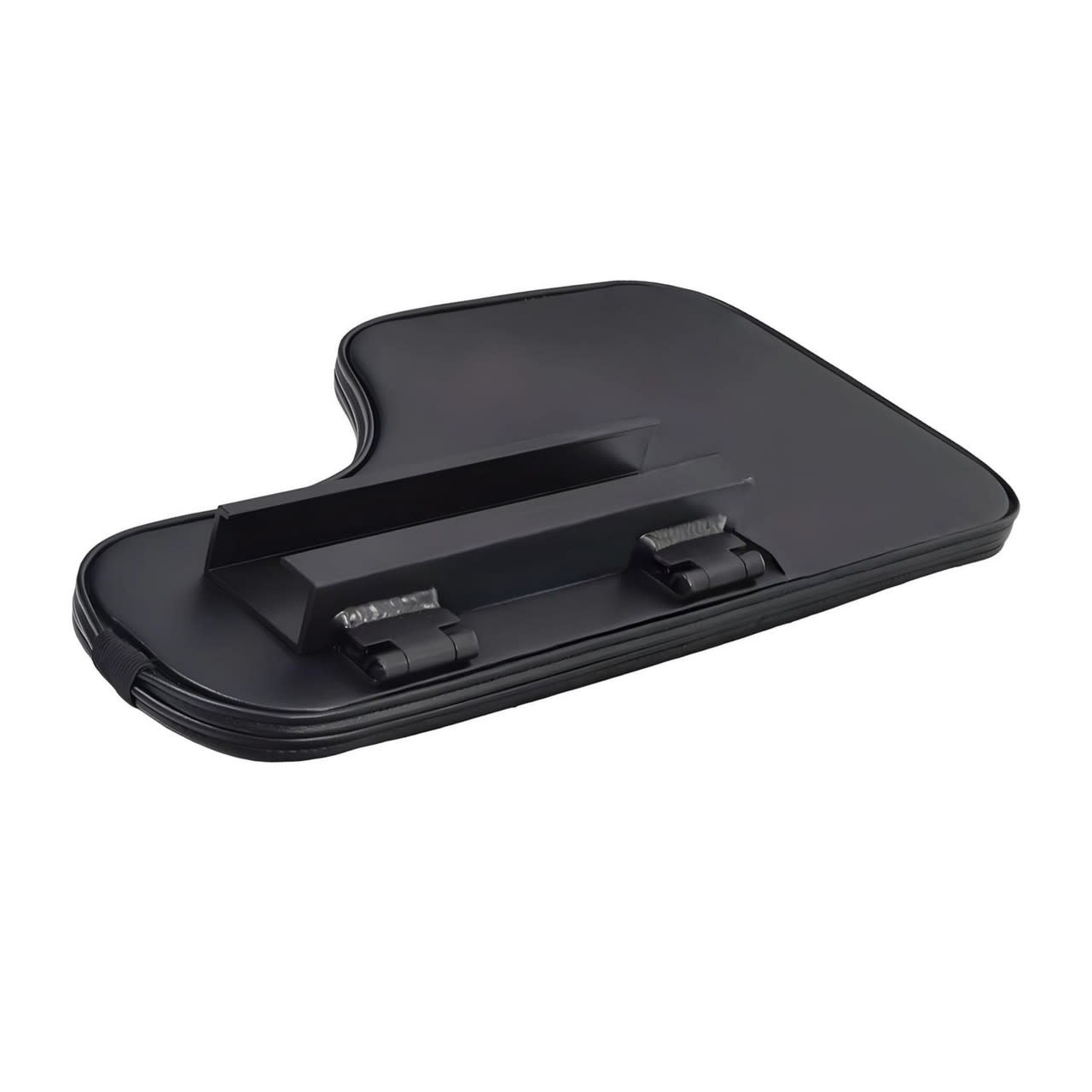
- Half-Width Design: Covers left side only preserving right arm mobility
- Padded Surface: Vinyl/foam cushioning provides comfortable forearm contact
- Flip-Up Mechanism: Swings away for transfers and wheelchair-to-table positioning
- Combo Hardware: Includes mounting brackets for direct armrest installation
- Universal Fit: Compatible with most standard padded wheelchair armrests
- Slim Profile: Low-rise design minimizes bulk while providing adequate support
- Left-Side Specific: Engineered for right-side weakness/hemiplegia positioning
- Slide-On Attachment: Tool-free installation and removal for flexibility
Benefits
- Asymmetric Support: Positions affected arm while freeing functional arm
- Eating Independence: Stable surface for meal self-feeding with functional hand
- Writing Capability: Secure platform enables written communication and signatures
- Device Access: Accommodates tablets, phones, communication aids with stability
- Forearm Comfort: Padded contact prevents pressure ulcers during extended use
- Positioning Maintenance: Supports affected arm reducing subluxation and edema
- Transfer Safety: Flip-up function clears path for safe wheelchair transfers
- Social Integration: Enables wheelchair users to pull up to standard tables
Clinical Applications
✓ Stroke with Hemiplegia: Affected arm positioning while preserving functional arm mobility
✓ Traumatic Brain Injury: Unilateral upper extremity weakness requiring asymmetric support
✓ Brachial Plexus Injury: Complete arm impairment needing continuous positioning
✓ Upper Extremity Amputation: Single-arm users requiring work surface and body support
✓ Cerebral Palsy: Asymmetric involvement with one functional and one affected upper extremity
✓ Spinal Cord Injury: Incomplete injuries with unilateral arm weakness
✓ Multiple Sclerosis: Progressive unilateral upper extremity impairment
✓ Peripheral Neuropathy: Single-side sensation loss requiring protective positioning
✓ Post-Surgical Recovery: Temporary arm immobilization requiring positioning support
✓ Shoulder Subluxation: Affected arm support preventing glenohumeral separation
✓ Long-Term Care Residents: Elderly with unilateral weakness needing meal/activity support
✓ Rehabilitation Patients: Recovering stroke/TBI patients during therapy progression
Usage & Application
Initial Installation & Fitting
Assessing Wheelchair Compatibility:
- Verify wheelchair has padded desk-style or full-length armrests (required for mounting)
- Measure armrest width ensuring sufficient surface for mounting bracket attachment
- Check armrest height relative to user's torso—tray should position at comfortable working height
- Confirm armrest padding intact (worn padding may compromise mounting security)
- Test armrest stability—loose armrests require tightening before tray installation
Installing Mounting Hardware:
- Position mounting bracket on left armrest with flip-up hinge toward wheelchair front
- Align bracket under armrest padding or against armrest frame per design specifications
- Slide mounting bracket onto armrest ensuring secure fit without excessive play
- Tighten retention mechanism (clamp, screw, or clip system) per manufacturer instructions
- Test flip-up function—bracket should pivot smoothly through 90° arc
- Verify bracket security by attempting to slide/rotate—should remain fixed during normal use
Attaching Tray to Mounting Hardware:
- Align tray's mounting slots with bracket's attachment points
- Slide tray onto bracket following directional indicators (usually front-to-back or side-slide)
- Ensure tray fully seated on bracket with audible click or visible alignment confirmation
- Test tray stability by pressing downward and side-to-side—should not rock or detach
- Flip tray up and down several times verifying smooth operation without binding
Positioning for Optimal Function
User-Specific Height Adjustment:
- With user seated in wheelchair, measure from armrest to mid-torso (approximately waist level)
- Tray should position 2-3" below elbows when arms relaxed at sides
- If tray too high (above elbow level), user cannot comfortably rest forearm—seek lower armrest wheelchair
- If tray too low (mid-thigh), provides inadequate support—add armrest height extenders if available
- Optimal position: User's left forearm rests comfortably on padded surface with elbow bent 90-110°
Affected Arm Positioning Protocol:
- Place affected/weak left arm on tray with forearm fully supported from elbow to wrist
- Hand should rest naturally on tray surface without dangling over edge (prevents edema)
- Shoulder in neutral position—avoid excessive forward reach creating shoulder protraction
- Elbow positioned at approximately 90° flexion (comfortable resting angle)
- Wrist in neutral alignment—not hyperextended or excessively flexed
Functional Arm Freedom Assessment:
- With left arm positioned on tray, user should freely move right arm through full range
- Right arm should reach mouth for eating without obstruction from tray
- Right arm should access writing surface in front of body without tray interference
- Confirm tray doesn't restrict right arm movement laterally (reaching to right side)
- If right arm movement restricted, tray may be too wide—verify "half" tray specification
Activities of Daily Living Support
Meal Setup & Self-Feeding:
- Flip tray down into working position before meal service
- Place plate/bowl on stable surface in front of user (on table or overbed tray)
- Position left arm on tray providing trunk stability during eating
- User feeds self with right hand while left arm remains supported reducing trunk sway
- Padded tray surface prevents left forearm pressure ulcers during 20-30 minute meals
Benefits During Eating:
- Trunk stability: Supported left arm provides counterbalance preventing leftward lean
- Reduced energy expenditure: Less core muscle activation needed to maintain upright posture
- Improved swallowing safety: Better trunk alignment reduces aspiration risk
- Independence: Enables self-feeding without caregiver physical support
Writing & Communication Activities:
- Position paper/communication book on stable surface in front of user
- Left arm supported on tray maintains trunk stability during writing
- Right hand writes/types while supported posture prevents fatigue
- Especially beneficial for signatures, forms, written correspondence
Device Usage (Tablets, Phones, Communication Aids):
- Some users place device directly on tray surface for viewing
- Others hold device with functional right hand while left arm support provides postural stability
- Padded surface prevents device sliding during use
- Tray acts as safety barrier preventing device falling to floor if grip released
Therapeutic Positioning Between Activities:
- Even when not actively used for tasks, tray provides continuous affected arm support
- Prevents shoulder subluxation by maintaining glenohumeral joint alignment
- Reduces dependent edema by elevating forearm above heart level
- Protects arm from wheelchair wheel contact or getting caught during propulsion
Transfer Safety Procedures
Preparing for Transfers:
- Remove any items from tray (plates, devices, papers) before initiating transfer
- Grasp tray at front edge with functional hand
- Lift and flip tray upward rotating approximately 90° to vertical position
- Tray should lock or rest in up position clearing transfer path
- Verify tray secure in up position—should not fall down during transfer
Transfer Techniques with Half Tray:
- Standing pivot transfer: Flip tray up, user stands with assistance, pivots to target surface
- Sliding board transfer: Tray up, board placed from wheelchair to bed/chair, user slides across
- Mechanical lift transfer: Tray up, sling positioned, lift raises user for transfer
- Two-person assist: Tray up, caregivers support user under arms/legs for transfer
Table Positioning for Meals:
- Wheel chair up to dining table or overbed table
- Flip tray up allowing wheelchair to fit under table edge
- User's trunk moves close to table with left arm resting on tray in up position or removed
- Alternative: Some users prefer keeping tray down with left arm supported while right arm reaches to table surface
Caregiver Support & Assistance
Meal Service Protocol:
- Caregiver flips tray down into position before delivering meal
- Place plate/cup on stable surface accessible to user's functional right hand
- Monitor for trunk stability—if user leaning excessively left, reposition affected arm on tray
- After meal, remove dishes, clean tray surface, flip up if not immediately needed
Preventing Skin Breakdown:
- Inspect left forearm and elbow daily for redness, pressure marks, or skin breakdown
- Ensure tray padding intact—replace if foam compressed or vinyl torn
- Reposition affected arm every 30-60 minutes during extended tray use
- Use sleeve or arm cushion for additional protection if skin fragile
Activity Facilitation:
- Set up activities on tray or nearby surface (puzzles, crafts, reading materials)
- Position items within reach of functional right hand
- Encourage use of supported posture for longer activity participation
- Provide cues for repositioning if user sliding/slouching during activity
Maintenance & Care
Daily Cleaning:
- Wipe tray surface with damp cloth after each meal removing food debris
- Use mild soap solution for sticky residues or spills
- Dry thoroughly preventing moisture accumulation under padding
- Inspect vinyl covering for tears or punctures requiring repair
Weekly Maintenance:
- Check mounting hardware tightness—tighten if loosening detected
- Lubricate flip-up hinge if squeaking or stiffness develops
- Inspect padding compression—replace if foam significantly compressed
- Clean mounting brackets removing accumulated dust and debris
Monthly Inspection:
- Examine vinyl covering integrity—small tears expand requiring replacement
- Test flip-up mechanism security—should hold in up position reliably
- Check armrest attachment points for wear or loosening
- Assess overall tray stability during simulated use (press down, side-to-side force)
Replacement Indicators:
- Vinyl covering torn exposing foam (moisture penetration causes bacterial growth)
- Foam padding compressed to <50% original thickness (inadequate cushioning)
- Mounting hardware cracked or broken (safety hazard)
- Flip-up mechanism fails to hold tray in up position (transfer safety risk)
- Tray warping or bending under normal use loads (structural failure)
Troubleshooting Common Issues
Tray Won't Stay in Flipped-Up Position:
- Cause: Flip-up mechanism worn or tension adjustment loosened
- Solution: Tighten tension adjustment screw; replace mechanism if worn beyond adjustment
Affected Arm Slides Off Tray:
- Cause: Tray too narrow for user's arm, insufficient edge support, vinyl too slippery
- Solution: Add foam bolster along tray edge creating raised barrier; apply non-slip pad to surface
User Leans Heavily onto Tray (Excessive Weight Bearing):
- Cause: Poor trunk strength requiring more support than tray designed to provide
- Solution: Assess for full-width tray with bilateral support; improve wheelchair back support; consider chest strap for trunk stability
Tray Interferes with Self-Propulsion:
- Cause: Tray positioned too far forward blocking hand rim access
- Solution: Reposition mounting bracket farther back on armrest; verify half-width design not obstructing functional arm
Skin Breakdown Under Forearm:
- Cause: Prolonged pressure, inadequate padding, moisture accumulation, shear forces
- Solution: Add gel pad over tray surface; reposition arm every 30 minutes; use long sleeves for friction reduction; increase inspection frequency
Tray Detaches from Mounting Bracket During Use:
- Cause: Bracket loosened, tray mounting slots worn, improper initial installation
- Solution: Tighten bracket to armrest; verify tray fully seated on bracket; replace worn components
Professional Assessment Indicators
When to Consult OT/PT:
- User demonstrates unsafe trunk positioning despite tray use (excessive leaning, sliding)
- Affected arm develops increased edema, contracture, or skin breakdown
- User unable to perform ADLs with tray suggesting improper setup or inappropriate equipment
- Functional arm demonstrates reduced range of motion suggesting tray interference
- User's condition changed (increased weakness, improved function) requiring equipment reassessment
When to Consider Full-Width Tray:
- Bilateral upper extremity weakness requiring both arms supported
- Severe trunk instability needing anterior stability surface
- User at risk for forward falls from wheelchair
- Both arms require positioning support (not hemiplegia pattern)
When to Discontinue Tray Use:
- Affected arm function improves sufficiently to eliminate support need
- Tray creates more barriers than benefits (excessive transfer difficulty, social isolation from table meals)
- User transitioning to more independent mobility not requiring positioning support
- Alternative positioning solutions more appropriate (arm sling, lapboard, cushioned armrest alone)
Technical Specifications
Product Identification:
- Model: Padded Slim Half Lap Tray Combo – Left Side
- Configuration: Left armrest mounting (for right-side weakness/hemiplegia)
- Compatibility: Standard padded wheelchair armrests (desk or full-length style)
Dimensions:
- Tray Width: Approximately 8-12" (half-width, covers left side only)
- Tray Depth: Approximately 10-14" (front-to-back coverage)
- Surface Area: ~80-170 square inches working surface
- Profile Height: 1-2" rise above armrest (slim profile minimizing bulk)
- Weight: ~2-4 lbs (lightweight for easy flipping/removal)
Coverage Area:
- Extends from wheelchair frame to midline (approximately user's torso center)
- Does NOT extend across full wheelchair width
- Preserves right-side open for functional arm movement
Materials:
- Surface Covering: Vinyl upholstery (medical-grade, easy-clean)
- Padding: High-density foam (1/2" to 1" thickness typical)
- Tray Base: Rigid plastic or composite board (provides structural support)
- Mounting Hardware: Steel or aluminum brackets (durable metal construction)
- Hinge Mechanism: Metal pivot with tension adjustment
Weight Capacity:
- Supported Load: Typically 10-20 lbs (adequate for forearm weight plus light objects)
- Not Designed For: Heavy lifting, transferring body weight, standing support
- Usage Limitation: Positioning and light work surface only
Mounting System:
- Attachment Method: Slide-on clamp or clip system to armrest
- Tool Requirements: Usually tool-free installation (hand-tightened clamps)
- Adjustment Range: Limited horizontal positioning (few inches front/back adjustment)
- Flip-Up Angle: ~90° rotation from horizontal to vertical
Flip-Up Mechanism:
- Type: Single-axis hinge with tension control
- Operation: Manual lift-and-flip (user or caregiver operated)
- Lock Position: May include detent holding tray in up position
- Release: Lift slightly then lower to return to working position
Color Options:
- Typically available in neutral medical equipment colors (black, gray, beige)
- Vinyl surface may be available in multiple colors depending on manufacturer
Installation Requirements:
- Armrest Type: Padded armrests required (mounting bracket attaches to padding or frame)
- Armrest Width: Minimum ~2-3" wide surface for bracket attachment
- Armrest Height: User-specific (tray height determined by existing armrest position)
- Modifications: No permanent wheelchair modifications required (reversible installation)
Maintenance Requirements:
- Cleaning: Daily wipe-down with damp cloth, weekly deep cleaning
- Inspection: Monthly hardware check, padding assessment
- Replacement Schedule: Padding typically 1-2 years; hardware 3-5 years with normal use
Regulatory & Quality:
- Standards Compliance: Medical device accessory standards (FDA classification if applicable)
- Manufacturer: Various DME manufacturers produce half-tray accessories
- Warranty: Typically 90 days to 1 year limited warranty on defects
Packaging:
- Contents: Tray with padding, mounting bracket with hardware, installation instructions
- Shipping Weight: ~3-5 lbs packaged
Ordering Considerations:
- Left Side Only: This product mounts on left armrest (for right-side weakness)
- Right Side Available: Separate product for left-side weakness users
- Universal Fit Note: Verify wheelchair armrest compatibility before ordering (some wheelchairs have non-standard armrests incompatible with aftermarket accessories)