
Slideshow Items

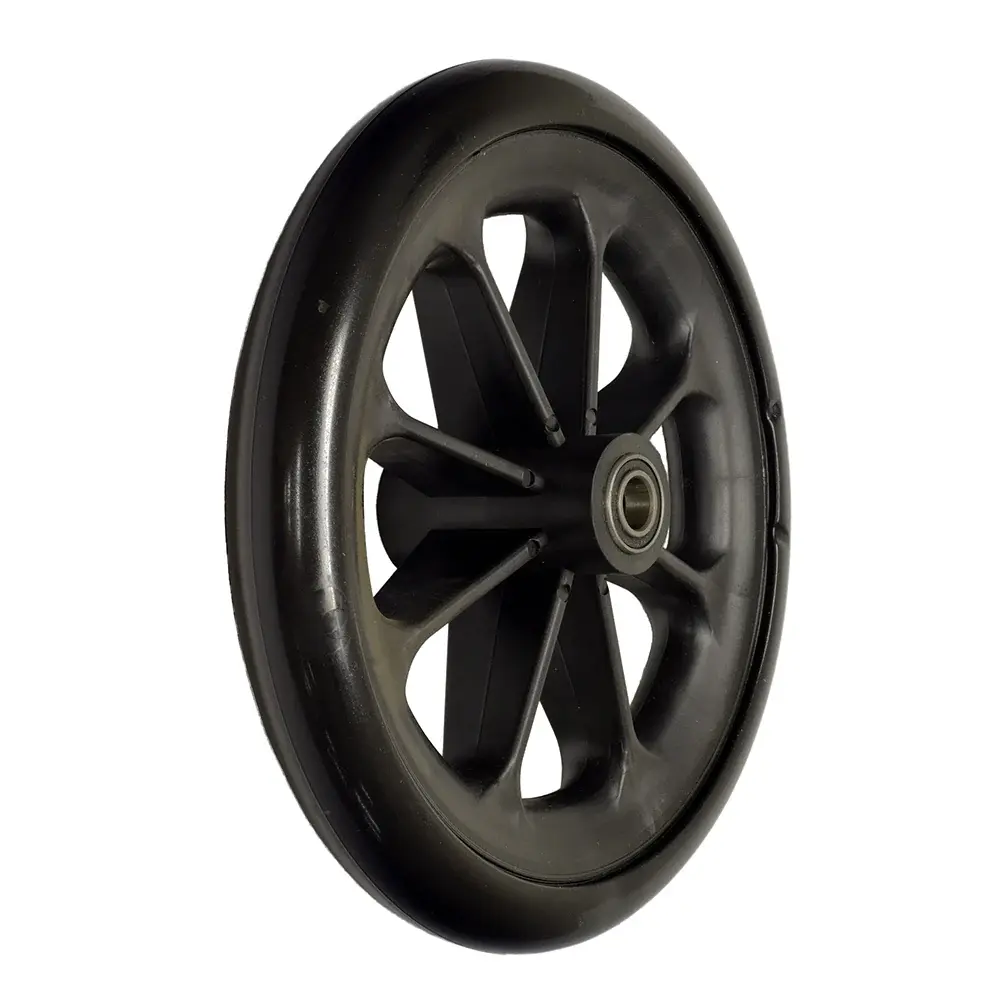
Replacement Drive Front wheel Caster with 11mm Bearings

C$19.99
In stock online
In store: Check availability

Available in store

UPC Code: 822383504155
SKU: STDS4S2432

The Drive Front Wheel Caster with 11 mm Bearings is a full replacement front caster assembly for compatible Drive Medical wheelchairs, restoring smooth swivel steering and low-friction rotation when original casters wear, flatten, or seize.

    • Why Front Caster Condition Determines the Steering Responsiveness and Push Effort of the Entire Wheelchair

      The front casters are the wheelchair’s steering mechanism — in a manual wheelchair, there is no active steering system; directional control is produced entirely by differential push force on the rear wheels, and the front casters respond to that differential by swiveling to the new direction of travel. The quality of the caster’s swivel response determines how precisely and effortlessly the wheelchair tracks the intended direction. A caster with a new, correctly loaded bearing assembly swivels with near-zero resistance — the trailing-castor geometry means the wheel naturally aligns behind the direction of push without requiring any steering effort from the user or caregiver. As the bearing deteriorates — through the progressive corrosion and spalling of the bearing race surfaces under the combined load of the user’s weight and the floor surface’s lateral reactions — the swivel resistance increases. The first perceptible effect is a slight increase in the push force required to steer, which is typically attributed to floor surface or fatigue rather than equipment condition. The progressive effect is caster shimmy and flutter during straight-line travel — the caster oscillates between swivel positions rather than tracking cleanly, producing the characteristic vibration and noise of worn front casters. By the time shimmy is noticeable, the bearing races have accumulated significant damage, and the caster is in the terminal phase of its service life.

      The 11 mm inner bearing diameter is not an interchangeable specification across wheelchair caster replacements — it is the dimension that determines whether the bearing correctly fits the axle bolt that passes through the caster hub. Bearing inner diameter must match axle bolt outer diameter within the tolerance for a correct running fit: typically a clearance of a few hundredths of a millimetre that allows the axle to seat through the bearing with light hand pressure while maintaining the concentricity that distributes bearing load evenly around the race. An 11 mm bearing installed on a 10 mm or 12 mm axle produces either an interference fit that prevents correct installation or a running clearance so large that the bearing inner race can cock relative to the axle, concentrating load on one side of the bearing and producing rapid wear at the load concentration point. The bearing specification pairing — 11 mm inner, 23 mm outer, 10 mm thickness — also determines the fork assembly’s bearing housing fit: the 23 mm outer diameter must correctly match the caster hub bore for correct radial load distribution in the outer race. Confirming all three bearing dimensions against the wheelchair’s axle and hub specifications is the prerequisite for correct installation.

      The front caster is the component most vulnerable to flat-spotting — the permanent deformation of the caster tire’s contact surface that occurs when the wheelchair is stored or left stationary in one position for an extended period with the user’s full weight on the front casters. Flat-spotting is more common than users expect in homecare settings, where a wheelchair may sit in the same position for hours or overnight between uses. A flat-spotted caster produces a rhythmic bump with each revolution of the wheel — a tactile and audible impulse that is transmitted through the front fork, the frame, and the armrests to the user with every front-wheel rotation during travel. For users with pressure sensitivity, spinal conditions, or post-surgical tenderness, the repetitive impact of a flat-spotted front caster is not merely uncomfortable — it is a meaningful aggravation of their clinical condition during every use of the wheelchair. Replacing flat-spotted casters eliminates this impulse entirely and restores the smooth rolling that the wheelchair’s pneumatic-equivalent solid tire was designed to provide.

      The compatibility range of this caster — Cirrus IV, Cruiser II, Cruiser III, Cruiser X4, Silver Sport 2, and similar Drive Medical frames — reflects a shared front fork axle specification across these models that accepts the 11 mm bearing inner diameter. However, compatibility across a product family does not mean all models use identical caster wheel dimensions: overall wheel diameter, hub width, and fork width may vary between the listed models, and a caster with the correct bearing specification but incorrect wheel diameter changes the wheelchair’s front-end height and therefore the seat-to-floor dimension. The seat-to-floor dimension is a clinically significant measurement for wheelchair users — it determines the user’s foot position during seated use and the transfer height for standing and sitting transfers. Confirming that the replacement caster’s wheel diameter matches the original before installation preserves the seat-to-floor measurement the wheelchair was configured to at prescription.


      Key Features

      • Complete front caster assembly including wheel, tire, and 11 mm inner diameter bearings — the full replacement unit for worn, flat-spotted, or bearing-failed front casters
      • 11 mm inner / 23 mm outer / 10 mm thick bearing specification — confirm against wheelchair axle diameter and hub bore dimensions before ordering to ensure correct running fit
      • Compatible with Drive Medical Cirrus IV, Cruiser II, Cruiser III, Cruiser X4, Silver Sport 2, and compatible frames using the 11 mm axle specification
      • Swivel caster design with trailing-axis self-alignment — the caster naturally follows the push direction without steering effort when the bearing is in correct low-friction condition
      • Durable wheel construction rated for daily indoor and outdoor surface use across the mixed floor environments of homecare and community wheelchair use
      • Sold individually — single-caster replacement for unilateral wear, flat-spotting, or bearing failure; pair replacement recommended when both front casters have comparable service history

      Benefits

      • Restores near-zero swivel resistance — eliminating the progressive increase in steering push force and the caster shimmy that worn bearing races produce during straight-line travel
      • Correct 11 mm bearing inner diameter ensures the bearing runs concentrically on the axle — preventing the off-axis race loading and accelerated wear that mismatched bearing diameters produce
      • Eliminates flat-spot impact impulse — replacing the rhythmic bump transmitted through the frame to the user with each front-wheel revolution on a deformed caster tire
      • Preserves seat-to-floor height when wheel diameter matches the original — maintaining the transfer height and foot position that the wheelchair was configured to at prescription
      • Component-level caster replacement restores front-end steering performance without replacing the fork assembly or frame

      Typical Applications

      ✓ Bearing wear replacement — front casters exhibiting shimmy, flutter, vibration, or progressive increase in steering resistance that indicates bearing race deterioration in the terminal service phase ✓ Flat-spot replacement — casters producing a rhythmic bump or impact impulse during travel, indicating permanent tire deformation from extended stationary loading in a fixed position ✓ Physical damage replacement — cracked, chipped, or deformed caster wheels following impact with a kerb, threshold, or floor obstacle ✓ Bearing seizure replacement — front casters that no longer rotate freely under hand spin, indicating full bearing race spalling or corrosion seizure ✓ Post-service recommissioning — front caster replacement on second-hand or reconditioned Drive Medical wheelchairs being returned to service, confirming smooth swivel and rotation before patient use ✓ Pair replacement on high-use chairs — simultaneous replacement of both front casters on wheelchairs where both casters have accumulated comparable service history, eliminating the handling asymmetry of mismatched caster wear

    • No reviews yet

      Add yours

    Testimonials from Google

    See all reviews

    Recently viewed

    Your cart — 0

    You cart is currently empty

    Login