
Slideshow Items

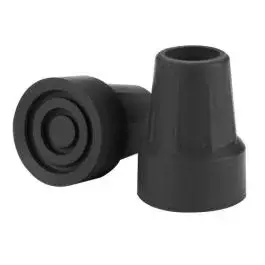
Drive Crutch Tips Pair 8 Pairs/Bx

C$54.99
In stock online
In store: Check availability

Available in store

SKU: 10439-8

Drive Crutch Tips Pair (8 Pairs/Box) are the bulk replacement rubber ferrules for standard crutch tubes, restoring floor traction, impact absorption, and slip resistance when original tips wear through, compress, or lose their grip surface.

    • Why Crutch Tip Condition Is the Most Safety-Critical Variable in Crutch-Assisted Ambulation

      The crutch tip is the only contact point between the crutch and the floor — it is the interface at which every load the user applies through the crutch is transferred to the walking surface, and at which the traction that prevents crutch slip is entirely generated. Unlike a shoe sole, which distributes load across a large contact area and benefits from the ankle's adaptive response to surface variations, a crutch tip presents a small, fixed contact patch at a single point on each crutch. The user's ability to bear weight confidently through the crutch depends entirely on that contact patch maintaining traction — a crutch that slips laterally or forward during weight bearing produces a sudden lateral shift of the user's supported weight, with no ankle response possible because the crutch is a rigid mechanical link. For users ambulating on crutches because of a lower limb injury, post-surgical weight-bearing restriction, or neurological condition, a crutch slip is not merely a balance challenge — it is a fall event occurring at the moment of maximum mechanical vulnerability, when the user's weight is committed forward onto the crutch. Crutch tip traction is therefore the single most consequential variable in crutch fall prevention, and worn tip condition is the most common equipment factor in crutch-related fall events.

      Crutch tip wear follows a pattern that is not evenly distributed across the tip's contact surface. During normal crutch gait, the tip contacts the floor at a consistent forward angle as the user swings the body through — the tip's leading edge takes disproportionate abrasive load during each contact cycle, wearing faster than the trailing and lateral edges. The result is a progressively beveled wear pattern on the leading edge that the user cannot see during normal use, because the worn surface faces the floor and the tip appears intact from above. A tip that looks acceptable from the caregiver's or user's visual check may have worn through to the crutch tube ferrule on the leading edge — the exact surface that contacts the floor first and bears the greatest load during weight transfer. When the rubber wears through to the ferrule, the exposed metal or hard plastic makes direct floor contact, and the traction coefficient drops dramatically on smooth, polished, or wet floors. This asymmetric invisible wear mechanism is why crutch tip replacement should be based on scheduled intervals and tactile inspection of the contact surface, not visual appearance from above.

      The shock absorption function of the crutch tip is a secondary mechanical benefit that becomes clinically relevant for users ambulating on crutches for extended durations. Each crutch contact event transmits a brief impulse force through the crutch tip into the crutch shaft, through the axillary or forearm support, and into the user's upper limb. A new rubber tip with full compound thickness attenuates the floor-contact impulse through elastic deformation of the rubber — the tip compresses slightly on contact and rebounds, converting the hard impact event into a distributed force ramp. A tip that has worn thin or compressed permanently — the hardening that occurs in aged rubber from oxidative cross-linking — transmits the floor-contact impulse with reduced attenuation, increasing the peak force delivered to the user's wrist, forearm, and shoulder with each contact event. For users ambulating on crutches through a full rehabilitation protocol — potentially hundreds of contact events per day over weeks — the cumulative difference in upper limb loading between new and worn tips becomes a meaningful factor in wrist and shoulder strain, particularly in elderly users or those with pre-existing upper limb vulnerability.

      The 8-pair bulk pack format serves a specific clinical and operational need that single-pair replacement does not. In a rehabilitation clinic, physiotherapy department, or homecare equipment depot, crutch tips are a high-turnover consumable — multiple patients cycle through crutch use at different stages of recovery, and crutch tip condition should be assessed and replaced at each patient transition, not amortized across multiple users. A per-patient replacement approach ensures each patient begins ambulation on a new tip regardless of the previous user's wear pattern — eliminating the compounding risk of a patient inheriting a crutch with tips at the midpoint of another patient's wear cycle. The 8-pair bulk format supplies a full resupply quantity for a typical clinic patient turnover interval, reducing the reorder frequency that individual pair purchasing requires and ensuring tip availability does not become a workflow bottleneck during high patient-volume periods.


      Key Features

      • Bulk supply of 8 pairs (16 individual tips) per box — designed for clinic, rehabilitation department, and homecare equipment inventory that cycles crutch tips across multiple patients
      • Durable rubber construction maintains traction coefficient and elastic deformation across the tip's service life — resisting the surface wear and oxidative hardening that reduce traction and shock absorption in lower-grade tip materials
      • Fits standard crutch tube diameters — confirm tube outer diameter before ordering, as crutch tubes vary across axillary and forearm crutch models
      • Contact surface geometry provides traction on hard floors, polished surfaces, and low-pile carpet — the mixed floor environments of homecare, clinic, and healthcare facility settings
      • Replacement tips eliminate the exposed ferrule contact that occurs when worn rubber wears through on the leading edge — restoring the rubber-to-floor contact that traction depends on
      • Cost-effective bulk pricing for facilities requiring frequent crutch tip rotation across patient transitions

      Benefits

      • Restores full rubber-to-floor traction at the crutch contact point — the single variable that determines whether the crutch holds position under load or slips at the moment of weight transfer
      • Eliminates the invisible leading-edge wear failure mode — new tips replace the entire contact surface regardless of the asymmetric wear pattern that concentrates on the forward-contact edge
      • Reduces upper limb impact loading through restored rubber shock absorption — attenuating the floor-contact impulse that worn or hardened tips transmit at increased peak force to the wrist, forearm, and shoulder
      • Bulk pack supports per-patient tip replacement protocol — each patient receives new tips at the start of ambulation rather than inheriting wear from a previous user's cycle
      • Consistent tip availability for high-volume periods — bulk stocking eliminates the reorder delay that single-pair purchasing produces when patient turnover is high

      Typical Applications

      ✓ Per-patient replacement — crutch tip replacement at each patient transition in rehabilitation clinics and physiotherapy departments, ensuring each patient begins ambulation on a new contact surface ✓ Scheduled interval replacement — routine tip replacement at defined use intervals for crutches in facility or homecare inventory, based on elapsed contact cycles rather than visual wear assessment ✓ Post-wear-through replacement — immediate tip replacement when tactile inspection of the leading-edge contact surface reveals rubber worn through to the ferrule, restoring rubber-to-floor contact before the exposed ferrule is used on a polished or wet surface ✓ Clinic and rehabilitation department bulk stocking — inventory replenishment for departments cycling crutches across high patient volumes with regular tip rotation ✓ Homecare equipment depot inventory — bulk stocking for homecare providers managing crutch equipment across multiple patient homes with periodic maintenance visits ✓ Hospital discharge preparation — fitting new tips to dispensed crutches at point of discharge to ensure the patient begins home ambulation on a full-traction contact surface

    • No reviews yet

      Add yours

    Testimonials from Google

    See all reviews

    Your cart — 0

    You cart is currently empty

    Login

    By using our website, you agree to the use of cookies. These cookies help us understand how customers arrive at and use our site and help us make improvements. Hide this message More on cookies »