Why the 8×2″ Wheel Profile and Bariatric Load Rating Define This Caster’s Role Beyond Simple Steering
The 8″ × 2″ front caster on the Sentra EC 22–24″ is not merely a larger version of the standard wheelchair front caster — the 2″ width dimension represents a fundamentally different contact geometry that serves a specific load-distribution function in the heavy-duty application. A standard 8″ × 1″ or 1.25″ caster distributes the user’s weight through a narrow contact patch, which is adequate for standard weight ranges because the pressure per unit contact area remains within the tire material’s elastic deformation capacity. At the higher user weight ranges of the Sentra EC’s bariatric application, the same narrow contact patch would concentrate load into a smaller floor-contact area, increasing the per-unit-area pressure to a level that causes tire deformation at the front of the contact patch during caster rollover — the mechanism that produces flat spots on narrow-profile casters under sustained bariatric loading. The 2″ width distributes the same user weight across a contact patch that is approximately double the area of a 1″ tire, reducing per-unit-area pressure and the rate of flat spot formation. This width-driven load distribution is the physical basis for the wider caster’s extended service life under the weight ranges the Sentra EC accommodates.
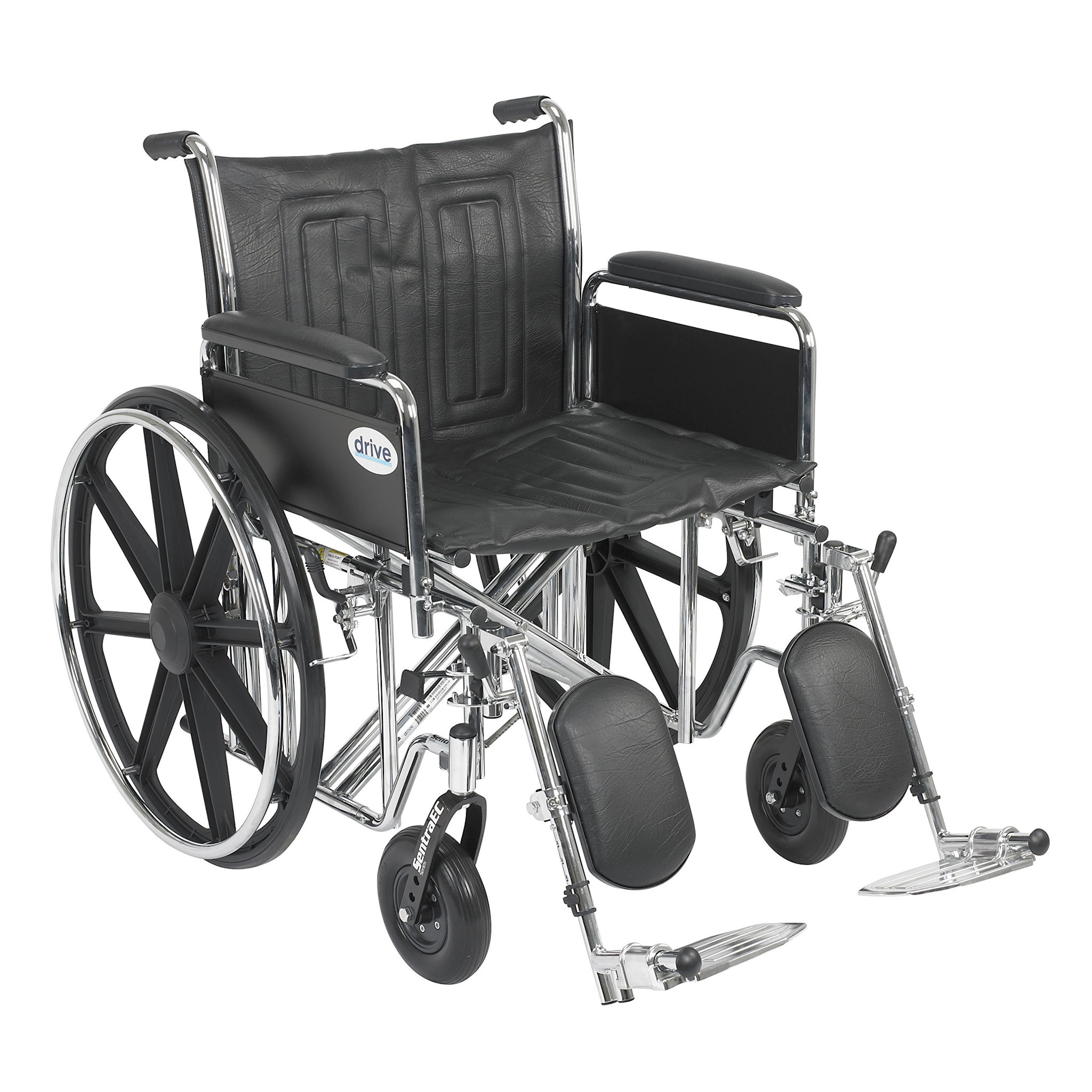
The Sentra EC is a heavy-duty wheelchair with frame geometry and component specifications scaled for users whose weight exceeds the standard wheelchair’s design parameters. The front fork on the 22–24″ Sentra EC is dimensioned to accept the 8″ × 2″ caster’s axle bolt and hub width — the axle bolt diameter and the hub width between the fork arms are both sized to the wider caster assembly. Installing a standard-width 8″ caster in a Sentra EC fork produces a hub width mismatch: the narrower hub sits in the wider fork gap with lateral play, and the axle bolt’s retention load is transmitted through washers or spacers rather than through a correctly fitted hub. Under the higher lateral loading of a heavy-duty user’s turning manoeuvres — where the caster’s swivel action produces lateral force at the axle — the spacer-filled hub interface concentrates axle bolt bending load at the washer edges rather than distributing it across the full hub bearing face. This bending load at the axle bolt increases bearing wear rate on both the inner race and the fork axle, shortening the replacement caster’s service life compared to the correctly specified hub-width caster.
The swivel bearing in the Sentra EC front caster is the component that determines steering responsiveness for the caregivers and users who push the wheelchair. In a heavy-duty application, the swivel bearing carries a higher radial load than in a standard-weight application — the user’s weight on the front casters is higher, and the inertial load during direction changes is proportionally greater. A swivel bearing in the Sentra EC caster that has worn to the point of increased friction requires the caregiver to apply meaningfully more steering force to produce the same turning response, because the force required to overcome swivel friction scales with the radial load on the bearing. For caregivers managing a heavy-duty wheelchair user in a homecare or long-term care setting, increased steering force is not merely inconvenient — it is a workplace ergonomic load that accumulates across a shift and contributes to caregiver upper limb strain. The caster’s swivel bearing condition directly affects the caregiver’s physical demand during the steering and manoeuvring tasks that constitute a significant portion of their daily workload with a wheelchair-dependent patient.
The 5/16″ bearing inner diameter specification for the Sentra EC front caster identifies the axle bolt diameter this caster is designed for — a larger axle than the 11 mm specification of standard Drive wheelchair front casters. The larger axle diameter is part of the Sentra EC’s scaling for higher load: a larger axle cross-section provides a proportionally larger moment of inertia, increasing the axle’s bending resistance under the combined weight and lateral load of a heavy-duty user. Ordering a replacement caster without confirming the 5/16″ bearing specification against the Sentra EC’s actual axle bolt diameter is the most common source of incompatible caster installation in the heavy-duty wheelchair service context — a caster with an 11 mm bearing installed on a 5/16″ (approximately 7.9 mm) axle produces an oversized bore fit, and a caster with a 5/16″ bearing installed on an 11 mm axle produces an undersized bore fit. Both mismatches produce off-axis bearing loading and accelerated wear from the first installation.
Key Features
- 8″ × 2″ (200 × 50 mm) front caster — the wider contact profile that distributes bariatric load across a larger floor contact area, reducing per-unit-area pressure and the flat-spot formation rate compared to standard-width casters at the same user weight
- 5/16″ bearing inner diameter — sized to the Sentra EC’s larger axle bolt diameter; confirm against actual axle diameter before ordering to avoid bore mismatch and the off-axis bearing loading that mismatch produces
- Hub width matched to the Sentra EC 22–24″ front fork gap — full hub-to-fork-arm contact distributes axle bolt load across the bearing face rather than through spacers
- Internal swivel bearing supports full trailing-axis self-alignment during manoeuvring — correct bearing condition is the determinant of the steering force the caregiver must apply to turn the wheelchair
- Durable construction rated for the combined weight, lateral turning load, and daily floor surface variety of heavy-duty wheelchair use in homecare and long-term care environments
- Sold individually — single caster for unilateral replacement; pair replacement recommended when both front casters have comparable service history
Benefits
- Wider 2″ contact profile extends service life under bariatric loading — distributing user weight across greater contact area to reduce the per-unit pressure that accelerates flat-spot deformation in narrower tires
- Correct hub width eliminates the spacer-fill lateral play of undersized replacement casters — preventing the concentrated axle bolt bending load that narrows the replacement caster’s service life in the Sentra EC fork
- Restores low swivel friction — reducing the caregiver steering force demand that worn swivel bearings produce under the higher radial loads of heavy-duty wheelchair operation
- Correct 5/16″ bearing bore prevents the off-axis loading that bore mismatch causes — the most common source of premature caster failure in heavy-duty wheelchair service
- Component-level caster replacement restores front-end steering performance without replacing the fork assembly or frame
Typical Applications
✓ Swivel bearing wear — Sentra EC front casters with progressive increase in steering force requirement, shimmy during straight travel, or audible bearing noise indicating race deterioration ✓ Flat-spot replacement — casters with visible or palpable flat deformation producing a rhythmic impact impulse during travel, from sustained bariatric loading in a fixed stationary position ✓ Bearing seizure — front casters that no longer rotate or swivel freely under hand force, indicating full race spalling or corrosion seizure ✓ Post-impact damage — cracked, chipped, or deformed caster wheels following a kerb impact or floor obstacle contact ✓ Bariatric equipment refurbishment — front caster replacement on second-hand or reconditioned Sentra EC 22–24″ wheelchairs, confirming swivel bearing condition and hub width fit before return to service ✓ Caregiver ergonomic intervention — front caster replacement when caregivers report increased steering effort or resistance during manoeuvring, as a proactive ergonomic measure before upper limb strain complaints develop
Installation
Axle diameter confirmation before ordering: Measure the front fork axle bolt outer diameter before ordering. Confirm it is 5/16″ (approximately 7.9 mm). A standard Drive wheelchair axle at 11 mm will not produce correct bearing fit with this caster — measure rather than assume if the wheelchair model confirmation is not available.

 780 409-1509
 Get directions