Slideshow Items

Evolution U-Bracket for Strap (Trillium)

C$6.00
In stock online
In store: Check availability

Available in store

SKU: B41IRB

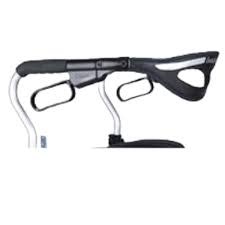
The Evolution U-Bracket for Strap (Trillium) is the OEM metal bracket and pin assembly that secures the back support strap to the Trillium rollator frame, maintaining strap tension, lateral alignment, and load capacity for safe, seated use.

    • Why the U-Bracket and Pins Are a Fall-Prevention Assembly — Not a Simple Mounting Accessory

      The back strap on a Trillium rollator is not a passive comfort feature — it is the sole posterior fall-prevention component available to a seated rollator user. Rollator users who rest seated between walking bouts rely on the back strap to resist the posterior lean that occurs naturally when a fatigued user settles into the seat during a rest break. For elderly users with limited balance recovery and delayed postural reflexes, an unexpected strap release during seated lean-back loading eliminates the only posterior support available and produces a fall directly backward off the seat — a mechanism with serious consequence for individuals with osteoporosis or fragility. The U-bracket is the structural interface between the strap and the frame, and it is therefore the component whose integrity determines whether the strap performs its fall-prevention function or fails silently until a seated user lean tests it. This makes bracket inspection and replacement a safety-critical maintenance step, not a discretionary refurbishment item, and it is the correct frame within which all other bracket specifications — geometry, material, and pin retention — should be understood.

      A flat or open attachment point allows the back strap to migrate laterally when the user leans to one side — the load vector shifts off-centre, the strap slides toward the loaded side, and tension on the opposite side drops. The U-channel geometry eliminates this failure mode by creating a captive channel that keeps the strap centred on the bracket regardless of lean direction. For rollator users who rest seated with variable posture — including those with hemiplegia, trunk weakness, or asymmetric weight-bearing habits — the strap must maintain tension in all lean positions, not only the ideal upright posture assumed at installation. This is a clinically relevant distinction because rollators are most often prescribed precisely for users who have impaired balance and trunk stability: the patients whose seated posture is most asymmetric are the same patients for whom posterior strap failure is most consequential. The U-channel achieves consistent lateral retention where a simple flat hook or open loop cannot.

      Without retaining pins, a U-bracket anchored to the frame tube resists posterior lean force primarily through friction and gravity — neither of which is adequate when a user settles back with full body weight. The retaining pins change the load geometry entirely: a force pulling the bracket away from the frame tube now acts as a shear load across the pin body rather than a pull-out load on the friction interface. Metal pins in shear are orders of magnitude stronger than a friction-fit bracket under tension. This is why the pin component is as structurally critical as the bracket itself — a bracket installed without both pins fully seated is not a functional assembly, regardless of how securely the bracket appears to fit by hand. The pins are not a secondary retention detail; they are the primary structural mechanism that makes the bracket's seated load resistance adequate. Inspecting a replacement bracket without confirming both pins are fully engaged is incomplete installation.

      Every sit-and-stand cycle loads and unloads the bracket at its frame attachment points, creating cyclical bending stress at the bracket edges. For a rollator prescribed for daily use, this accumulates to hundreds or thousands of load cycles annually. Polymer brackets accumulate micro-fatigue with each cycle, progressively losing stiffness and developing hairline fractures at stress concentration points before any visible surface damage appears — meaning polymer bracket failure tends to be sudden rather than preceded by visible warning signs. Metal construction sustains cyclical bending loads without progressive fatigue degradation. In normal rollator use the back strap textile itself rarely fails — strap fabric is designed for tensile loading across its full width and distributes force evenly. The U-bracket, by contrast, concentrates load at two specific points: the bracket edges bear against the frame tube as point loads, and the pin holes create geometric stress risers at exactly the location of highest bending moment. This makes the bracket the most likely failure interface in the strap assembly, and it is therefore the correct focus of inspection. During any service that includes back strap removal, the bracket should be inspected for deformation at the frame contact edges and for pin-hole elongation — which indicates accumulated overloading before fracture — and not simply reinstalled without assessment.


      Key Features

      • U-shaped metal bracket with retaining pins — OEM replacement component listed as B41IRB for Evolution Trillium rollators
      • U-channel geometry creates a captive strap channel that maintains lateral alignment and centred strap tension regardless of the user's lean direction
      • Retaining pin design converts posterior pull-out force into metal-in-shear loading — the mechanically appropriate geometry for a seated fall-prevention component
      • Metal construction withstands the cyclical bending fatigue of daily sit-and-stand rollator use without the progressive micro-fatigue failure mode of polymer alternatives
      • Frame-mounted configuration — not side-specific, compatible with both left and right back strap attachment positions on the Trillium frame
      • Sold as a complete assembly (bracket and pins together) for correct OEM fit at the pin-to-bracket interface

      Benefits

      • Restores the Trillium's back strap posterior fall-prevention function at the frame attachment point where structural failure is most likely to occur
      • U-channel lateral retention keeps the strap centred and tensioned under asymmetric lean loading from users with hemiplegia, trunk weakness, or variable seated posture
      • Pin-shear load geometry provides structurally appropriate resistance to the posterior lean forces applied during regular rollator rest break use
      • Metal fatigue resistance supports hundreds or thousands of daily load cycles without progressive stiffness loss or pre-fracture hairline cracking
      • OEM specification ensures correct dimensional fit at the Trillium frame attachment geometry — bracket height, channel width, and pin-hole spacing matched to the original design
      • Component-level bracket replacement restores full back strap function without replacing the rollator frame or complete strap assembly

      Typical Applications

      ✓ Bracket failure replacement — cracked, deformed, or fractured U-bracket on a Trillium rollator being returned to service after back strap failure or instability ✓ Missing pin replacement — bracket present but retaining pins lost or corroded, requiring complete assembly replacement to restore correct pin-shear retention ✓ Preventive service inspection — bracket with visible pin-hole elongation or frame-edge deformation identified during rollator refurbishment or annual maintenance ✓ Back strap replacement installation — new back strap being installed on a Trillium rollator where the existing bracket has accumulated wear and should be replaced simultaneously with the strap ✓ Long-term care and homecare equipment servicing — scheduled maintenance of resident or patient Trillium rollators where bracket integrity is assessed as part of the service checklist ✓ Rollator refurbishment — second-hand or reconditioned Trillium rollators being returned to service with full back support hardware inspection and replacement as required

    • No reviews yet

      Add yours

    Testimonials from Google

    See all reviews

    Your cart — 0

    You cart is currently empty

    Login