Slideshow Items

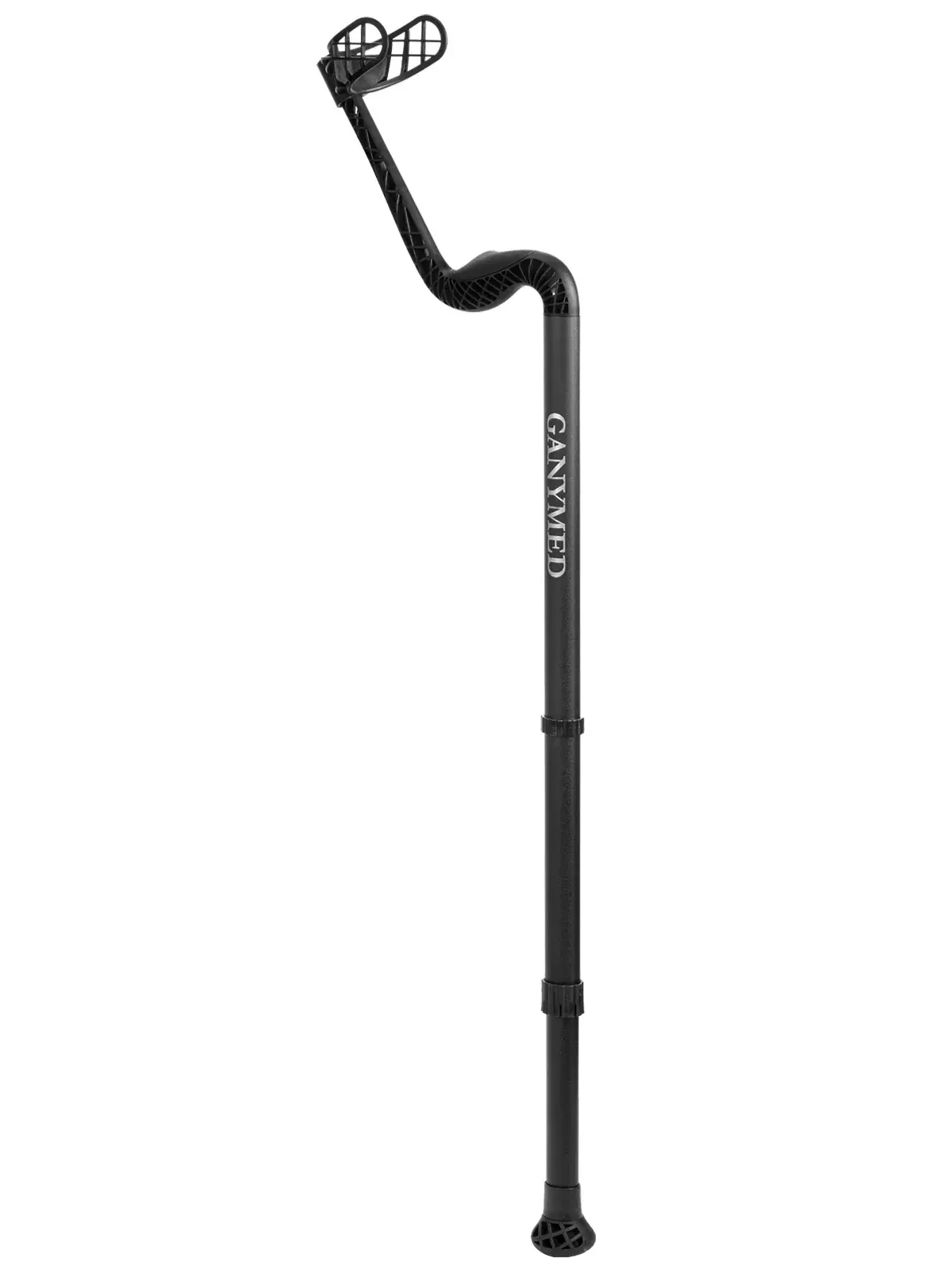
The forward-tilted design with anatomic soft grips delivers upright posture and reduced wrist strain while black structured tubes, rotatable rubber tips and 77-99cm adjustment in ten steps provides ergonomic support to 120-kg user capacity.
Loading…
The forward-tilted crutch design represents a biomechanical innovation that fundamentally reimagines the relationship between user posture and ambulatory aid geometry, addressing chronic postural compensation patterns that develop when users adapt to conventional vertical crutch designs rather than crutches adapting to natural human biomechanics. Traditional forearm crutches position the ground contact point (crutch tip) directly below the hand grip in vertical alignment, creating a straight line from grip through shaft to tip. This vertical geometry forces users to lean forward and laterally away from their body's centerline to position crutches appropriately lateral to their feet (approximately 6-8 inches or 15-20 cm lateral and 2-3 inches or 5-8 cm anterior to the foot). This forward-lateral lean creates three distinct biomechanical problems: first, forward trunk lean shifts the body's center of gravity anteriorly, requiring continuous active engagement of paraspinal muscles and cervical extensors to maintain head-up gaze position, creating chronic back and neck strain over the 6-12 week typical orthopedic recovery period. Second, the lateral lean required to position vertical crutches beside the feet creates asymmetric spinal loading with concavity toward the affected side and convexity away, essentially creating a functional scoliosis posture that becomes habituated if maintained for weeks or months. Third, the wrist positioning required to maintain grip on vertically-aligned crutches while leaning forward creates wrist extension (dorsiflexion) that concentrates loading on the posterior wrist structures, potentially causing carpal tunnel syndrome symptoms, wrist tendinitis, or chronic wrist pain that persists beyond the primary orthopedic condition's healing. The GANYMED Benchmark's forward-tilted design solves these problems through intentional geometric offset: the crutch tip positions 2-3 inches (5-8 cm) anterior (forward) of the hand grip location when the crutch stands vertically, creating approximately 12-15 degree forward angle from grip to tip. This forward offset enables users to stand in more upright posture while crutch tips still position appropriately forward and lateral to feet without requiring excessive forward trunk lean. The uprigh
t posture enabled by forward tilt reduces paraspinal muscle activation required to maintain balance, decreases cervical extension strain from looking up while leaning forward, and promotes more symmetric spinal alignment during ambulation. The wrist positioning also improves dramatically—with vertical crutches, users must extend wrists 20-30 degrees to maintain grip while leaning forward; the forward-tilted design reduces required wrist extension to near-neutral 5-10 degrees, distributing loading more evenly across the entire wrist joint rather than concentrating force on posterior structures. The anatomic soft grip component further enhances the biomechanical advantages of forward tilt by addressing pressure distribution within the hand-grip interface. Conventional cylindrical grips create concentrated loading zones at the thenar eminence (base of thumb) and hypothenar eminence (heel of hand), with relatively little contact across the central palm. During weight-bearing phases when 40-60% of body weight (80-180 lbs for typical users) transmits through each crutch alternately, this concentrated loading creates pressure points exceeding 50-80 psi in small contact areas, causing pain, calluses, and potentially median nerve compression symptoms. The GANYMED anatomic grip incorporates three-dimensional contouring that increases palm contact surface area by 60-100% compared to straight cylindrical grips, distributing identical force across larger area to reduce pressure intensity proportionally. The grip design also features left/right specificity—left and right grips mirror each other with asymmetric contouring matching the natural asymmetry of hand anatomy, particularly the thenar eminence prominence which differs between left and right hands. The black structured tube finish transforms the crutches from purely medical devices into refined mobility accessories that users feel more comfortable carrying in professional, social, and public settings. The textured black powder-coat provides both aesthetic appeal (contemporary matte finish preferred by design-conscious users) and functional benefits (textured surface reduces reflective glare, shows less scratching than smooth finishes, and provides superior corrosion resistance compared to anodized or painted surfaces).
✓ Post-operative lower extremity orthopedic procedures with 6-12 week partial or non-weight-bearing protocols
✓ Lower extremity fractures requiring protected weight-bearing during extended healing periods
✓ ACL/PCL knee reconstruction with progressive weight-bearing rehabilitation phases
✓ Hip preservation surgeries (labral repairs, FAI corrections) requiring hip precautions and protected ambulation
✓ Ankle fractures and ligament repairs necessitating prolonged non-weight-bearing or protected weight-bearing
✓ Foot and midfoot procedures (Lisfranc repairs, Jones fracture fixation) requiring extended protected ambulation
✓ Chronic conditions requiring long-term or permanent ambulatory assistance (juvenile arthritis, post-polio syndrome)
✓ Multiple sclerosis with lower extremity weakness maintaining adequate trunk control and balance
✓ Cerebral palsy diplegia requiring bilateral support for community ambulation
✓ Spina bifida ambulators using reciprocating gait orthoses requiring upper extremity support
✓ Progressive neuromuscular conditions transitioning from independent ambulation to assistive device dependence
✓ Wrist or hand conditions requiring minimized grip pressure (arthritis, carpal tunnel syndrome, tendinitis)
✓ Spinal conditions exacerbated by forward-lean postures (spondylolisthesis, spinal stenosis, disc herniations)
✓ Professional users requiring equipment compatible with business attire and formal settings
✓ Active community ambulators requiring refined equipment for shopping, dining, and social participation
✓ Long-term users (months to years) where postural compensation prevention is critical for avoiding secondary complications
Initial Height Adjustment Using Ten-Step System: The GANYMED Benchmark's ten-step height adjustment system provides 2.2 cm (approximately 0.87 inch) increments spanning 77-99 cm total range, enabling precise fitting for varied user heights. To establish correct height, the user should stand upright wearing typical daily footwear with arms hanging naturally at sides in relaxed position. The hand grip should align with the wrist crease (the flexion fold where hand meets forearm) when the crutch stands vertically beside the user. This positioning creates approximately 15-20 degrees of elbow flexion when gripping the handle, optimizing force transmission while minimizing joint stress. To adjust height, locate the push-button mechanisms on the crutch shafts positioned at each adjustment hole. Depress the spring-loaded button fully while sliding the lower tube section to the desired height—the adjustment hole should align precisely with the push-button pin. Release the button and verify full engagement by attempting to move the tube sections without pressing the button (no movement should occur if properly engaged). The ten-step system provides finer adjustment granularity than typical eight-step systems, enabling more users to achieve optimal fit without compromise. After establishing approximate height based on wrist-crease alignment, fine-tune by having the user grip handles and check forearm angle—forearms should slope gently downward from horizontal (approximately 10-15 degrees below horizontal) creating comfortable wrist positioning without excessive flexion or extension. The open cuff should position 1-2 inches (2.5-5 cm) below the elbow point, providing adequate forearm support without impeding elbow flexion during the swing phase of gait. Both crutches must be adjusted to identical heights to prevent asymmetric loading, altered gait patterns, and development of compensatory postures. Record the adjustment position (step number 1-10) for future reference if height changes become necessary due to footwear variations or posture modifications during recovery progression.
Forward-Tilted Posture Optimization: The forward-tilted design's full benefits require understanding and utilizing the geometric offset intentionally built into the crutch structure. When standing stationary with crutches positioned beside the body, users should notice that crutch tips position slightly forward (anterior) of the hand grip location—this 2-3 inch forward offset appears counterintuitive initially but becomes essential during ambulation. During the stance phase (when body weight transfers through crutches), users should maintain relatively upright trunk position rather than leaning significantly forward as required with vertical crutches. The forward tip position means the crutches naturally angle backward (from tip to grip) when properly loaded, creating a supportive structure that encourages upright posture. Users transitioning from conventional vertical crutches often initially try to maintain their habituated forward-lean posture; physical therapy guidance helps users recognize and adopt the more upright positioning enabled by forward tilt. The correct posture feels more erect with shoulders back, head up, and minimal forward trunk flexion—approximately 80-85 degree trunk angle from vertical compared to 70-75 degrees typical with vertical crutches. This 10-15 degree postural improvement significantly reduces paraspinal muscle loading and cervical strain. During ambulation, the forward-tilted design enables users to advance crutches forward without excessive reaching or trunk lean—the crutches swing naturally to proper placement positions with more neutral body mechanics. Users should practice standing and walking with focus on maintaining erect posture, allowing the crutch geometry to support this positioning rather than fighting against it through forward compensation.
Anatomic Grip Utilization for Left/Right Hands: The GANYMED Benchmark grips feature left/right specificity with asymmetric contouring matching natural hand anatomy, requiring correct grip-to-hand matching for optimal pressure distribution benefits. Each grip has markings or distinct features identifying it as left or right—typically "L" or "R" labels, though some models use color coding or asymmetric visual features. The left grip installs on the left crutch (used by left hand), right grip on right crutch (used by right hand). The anatomic contouring includes distinct zones: a prominent projection fitting into the palm's natural concavity at the base of the fingers, a valley accommodating the thenar eminence (thumb base pad), and extended surface area wrapping around the hypothenar eminence (heel of hand). To properly grip, position the palm fully onto the grip surface ensuring the thenar eminence nestles into the designated valley, central palm contacts the raised projection, and hypothenar eminence wraps around the grip's lateral edge. Fingers should curl naturally around the front of the grip without excessive flexion—over-gripping creates forearm muscle fatigue and defeats the comfort purpose. The thumb wraps around meeting fingers on the grip's front surface, creating opposition pressure that prevents forward grip slip but avoiding excessive thumb abduction (spreading) which strains the thumb web space. During weight-bearing phases, consciously engage the entire palm contact area rather than allowing weight to concentrate in habitual pressure points—proper technique involves subtle weight rolling across the full palm surface during each step cycle. The soft grip material (thermoplastic rubber or similar compound) provides compliance enabling grip material to conform to individual palm contours, but this conforming requires break-in period. During the first 2-3 days of use, the grip gradually conforms to the user's palm geometry; users may notice improved comfort after this initial adaptation period. For users experiencing persistent discomfort despite anatomic grips and proper positioning, consider supplementary interventions: padded gloves designed for crutch use, grip tape or overwraps increasing grip diameter for users with large hands, or consulting occupational therapy for hand/wrist positioning analysis.
Rotatable Rubber Capsule Tip Operation: The GANYMED Benchmark's specialized rotatable tip provides adjustable firmness settings optimizing traction and shock absorption for varied surfaces and user preferences. The tip consists of a rubber capsule that rotates within its housing, presenting different rubber compound sections to ground contact depending on rotational position. Typically, the tip offers 2-4 distinct positions ranging from softer/more compliant rubber (better shock absorption, more tactile feedback on irregular surfaces) to firmer/less compliant rubber (superior durability, better traction on smooth floors). To rotate the tip, grasp the rubber capsule firmly and twist—depending on design, rotation may be continuous or may click into defined positions. Start with mid-firmness settings and adjust based on usage feedback. For primarily indoor use on smooth tile or hardwood floors, firmer settings provide better traction and more predictable response during push-off phases. For outdoor use on concrete, asphalt, or grass, softer settings provide better shock absorption reducing impact transmission to wrists and elbows. For mixed-surface use (transitioning between indoor and outdoor frequently), mid-firmness settings provide reasonable compromise. Users with wrist or elbow pain may benefit from softer settings increasing compliance and shock absorption at the cost of slightly reduced traction. Inspect tips regularly regardless of firmness setting—even premium tips wear with use and require replacement when tread depth reduces to less than 1-2 mm. The rotatable design extends overall tip service life compared to single-compound tips because wear distributes across multiple rubber sections as users rotate for varied conditions. When one section shows wear, rotating to less-used sections provides continued service. However, once all sections show significant wear, complete tip replacement becomes necessary. Replacement tips specific to GANYMED/Ossenberg crutches should be obtained to maintain rotatable functionality—generic tips may fit the shaft diameter but lack the rotatable capsule mechanism.
Open-Cuff Entry and Forearm Positioning: The open C-shaped cuff provides tool-free forearm insertion while maintaining adequate lateral stability for most users. To enter the cuff, hold the crutch grip with the hand while simultaneously sliding the forearm through the open front of the cuff from anterior (front) direction. The forearm should slide completely through until the posterior (back) of the forearm contacts the inside curve of the cuff—the maximum forearm circumference (typically 3-4 inches or 8-10 cm below the elbow) should position within the widest part of the cuff's C-shape. Proper insertion depth is critical: insufficient depth reduces lateral stability and increases risk of inadvertent crutch separation, while excessive depth may restrict elbow flexion during the swing phase. The cuff should cradle the posterior and lateral aspects of forearm while leaving anterior forearm surface uncontacted, providing medial-lateral stability (preventing crutch from swinging away from body) while enabling instant forearm withdrawal by pulling forward. To exit cuffs for hand release, pull the forearm forward out of the cuff opening while maintaining grip on the handle—the motion requires less than 1 second with practice. For temporary hand release (opening doors, retrieving items), users can maintain crutch vertical position by pinning the crutch shaft against the torso with the upper arm while the hand performs required task. During extended use, periodically check cuff positioning—the cuff may migrate slightly up or down the forearm during ambulation, particularly for users with tapered forearms or loose-fitting long sleeves that reduce friction. Reposition as needed to maintain the 1-2 inch distance below elbow point.
Black Structured Finish Care and Maintenance: The textured black powder-coat finish provides superior durability compared to anodized or painted surfaces, but proper care extends its appearance and protective function. Clean the finish regularly (weekly during active use) using mild soap and water with soft cloth or sponge—the textured surface may accumulate dirt in texture valleys requiring gentle brushing with soft-bristle brush. Avoid abrasive cleaners, steel wool, or harsh solvents that can damage the powder-coat finish. After outdoor use in wet conditions, dry thoroughly before storage as prolonged moisture exposure can eventually degrade powder-coat adhesion at scratch or chip sites. The black color shows less superficial scratching than lighter finishes, but deep scratches exposing bare aluminum should be touched up with matching paint to prevent corrosion initiation. The textured finish naturally hides minor wear better than smooth finishes, contributing to maintained appearance throughout 3-5 year typical service life. For storage, keep crutches in climate-controlled environments avoiding temperature extremes, high humidity, or direct sunlight that can accelerate finish degradation. When transporting in vehicles, protect crutches from sliding and impacting hard surfaces—padded crutch bags or careful positioning prevents finish damage. The refined appearance of black structured tubes makes these crutches suitable for professional and formal environments, but also creates higher user expectations for maintained appearance—users report greater satisfaction maintaining crutch appearance when equipment looks refined rather than institutional, creating positive feedback loop encouraging proper care and maintenance.
Body Weight Capacity Considerations: The GANYMED Benchmark's 120-kg (264-lb) maximum user weight represents engineered structural limits based on aluminum tube specifications, cuff reinforcement, and fastener strengths under dynamic loading conditions. This capacity includes user body weight plus any carried loads (backpacks, bags, etc.). Users approaching the 120-kg limit should be particularly attentive to proper gait technique—maintaining relatively even bilateral loading between left and right crutches prevents overloading individual crutches beyond design limits. Impact loading during ambulation can create instantaneous forces 1.5-2.0 times body weight, meaning a 110-kg user creates 165-220 kg instantaneous loading during normal walking—staying below the rated capacity provides safety margins accommodating these dynamic forces. Users exceeding 120 kg should seek bariatric-rated crutches specifically engineered for heavier loads. For users in the 100-120 kg range, inspect crutches more frequently (weekly) for stress indicators: tube bending, cuff cracks, or fastener loosening suggesting excessive loading. The lightweight 0.6 kg per crutch construction optimizes portability but achieves this through precise material use without excess—proper weight capacity observation ensures safety margins remain adequate.
Professional and Social Usage Considerations: The GANYMED Benchmark's refined black structured finish and forward-tilted posture correction specifically address the social and professional challenges faced by working-age adults and style-conscious users requiring extended crutch use. The contemporary aesthetic reduces medical device stigma, enabling users to carry crutches in business meetings, professional events, social gatherings, and public spaces without the self-consciousness often associated with institutional-appearing mobility aids. The upright posture enabled by forward tilt particularly benefits professional users—maintaining relatively erect posture during business interactions projects confidence and professionalism, while forward-leaning postures required by vertical crutches can be misinterpreted as uncertainty or submission in business contexts. For social situations, the refined appearance and color-coordination capability (black crutches coordinate with most clothing colors) enables fashion integration rather than fashion disruption. Users report increased willingness to attend social events, accept business travel, and participate in community activities when using refined mobility equipment compared to basic institutional designs. This increased participation directly impacts quality of life and potentially recovery outcomes, as maintained social engagement supports psychological wellbeing during physically limiting recovery periods.
Product Identification
Model: GANYMED Benchmark
Manufacturer: Ossenberg GmbH (Germany)
Product Line: Premium ergonomic forearm crutches
Design Philosophy: Forward-tilted geometry with anatomic grip optimization
Finish: Black structured tube (textured powder-coat)
Dimensional Specifications
Height Adjustment Range: 77-99 cm (30.3-39 inches)
Adjustment Increment: 2.2 cm (approximately 0.87 inch) per step
Number of Adjustment Positions: 10 steps
User Height Accommodation: Approximately 5'0" to 6'6" (152-198 cm) with proper adjustment
Cuff-to-Grip Distance: Varies by adjustment position (typically 12-16 inches or 30-40 cm)
Cuff Positioning: 1-2 inches (2.5-5 cm) below elbow when properly adjusted
Tip Forward Offset: 2-3 inches (5-8 cm) anterior to grip centerline creating 12-15 degree forward angle
Weight Specifications
Individual Crutch Weight: 0.6 kg (1.32 lbs) per crutch
Pair Weight: 1.2 kg (2.65 lbs) total
Maximum User Weight: 120 kg (264 lbs)
Weight-to-Capacity Ratio: 1:100 (exceptional lightweight performance)
Dynamic Loading Consideration: Instantaneous forces 1.5-2.0x body weight during normal ambulation
Cuff Specifications
Cuff Design: Open C-shaped configuration
Cuff Material: Reinforced composite with padding (specific composition proprietary)
Forearm Opening: Anterior (front) opening for tool-free entry/exit
Cuff Depth: Provides 4-6 inches (10-15 cm) forearm coverage
Lateral Stability: Adequate for most users with good balance; reduced compared to closed-cuff designs
Color: Black finish matching tube structure
Grip Specifications
Grip Design: Anatomic three-dimensional contouring with left/right specificity
Grip Material: Soft thermoplastic rubber or similar compliant compound
Hand Specificity: Mirror-imaged left and right grips
Contact Surface Area: 60-100% greater than conventional cylindrical grips (approximately 4-6 square inches or 25-40 square cm)
Pressure Distribution: Reduces peak palm pressure 40-60% versus standard grips
Break-in Period: 2-3 days for grip material to conform to individual palm geometry
Color: Black finish matching tube structure
Tube Specifications
Tube Material: Aluminum alloy (specific alloy proprietary to Ossenberg)
Tube Diameter: Standard forearm crutch diameter (typically 7/8" or 22mm)
Structural Design: Forward-tilted geometry with 12-15 degree angle from grip to tip
Finish: Textured black powder-coat ("struct black")
Finish Properties: Superior scratch resistance, corrosion protection, matte appearance, reduced glare
Durability: 3-5 year typical service life with daily use
Tip Specifications
Tip Design: Rotatable rubber capsule with multiple firmness settings
Firmness Options: Typically 2-4 positions from soft (shock-absorbing) to firm (durable traction)
Rotation Mechanism: User-adjustable via manual rotation of rubber capsule
Tread Pattern: Multi-directional grooves optimized for varied surfaces
Expected Service Life: Extended versus single-compound tips due to wear distribution across multiple sections
Replacement: GANYMED/Ossenberg-specific tips required to maintain rotatable functionality
Adjustment Mechanism
Mechanism Type: Push-button spring-loaded pin-and-hole system
Operation: Tool-free height adjustment
Lock Security: Spring-loaded pins engage into precision-drilled holes
Adjustment Ease: Single-handed operation possible with adequate hand strength
Position Verification: Visual and tactile confirmation of pin engagement
Maintenance: Periodic inspection for button function and pin wear
Manufacturing Quality
Manufacturing Location: Germany (Ossenberg GmbH)
Quality Standards: German engineering precision and materials quality
Regulatory Compliance: CE marked, meets applicable European medical device standards
Weight Capacity Testing: Tested under dynamic loading conditions exceeding rated capacity
Material Quality: Premium-grade aluminum, reinforced composites, medical-grade rubbers
Finish Durability: Powder-coat exceeds 1000-hour salt spray corrosion testing
Packaging and Documentation
Packaging: Sold as matched pair (left and right crutches)
Included Components: Pre-installed cuffs, grips, and rotatable tips
Documentation: User manual with adjustment instructions, usage guidelines, maintenance recommendations
Warranty: Manufacturer warranty against defects (duration varies by region/retailer)
Language Options: Multi-language documentation typical for European markets
Maintenance Requirements
Inspection Frequency: Weekly during active use for tip wear, button function, cuff integrity
Cleaning: Mild soap and water weekly; avoid abrasive cleaners
Tip Replacement: As needed based on wear (typically 6-12 months with daily use)
Expected Service Life: 3-5 years with proper maintenance including timely component replacement
Storage: Climate-controlled indoor environment; protect from temperature extremes
Comparative Specifications
vs. Standard Open-Cuff Crutches: Forward tilt geometry, anatomic grips, rotatable tips, premium finish
vs. GANYMED Basic Models: Anatomic grips and structured finish upgrade
vs. Closed-Cuff Designs: Reduced lateral stability but enhanced daily function and comfort
Market Position: Premium forearm crutch segment emphasizing ergonomics and aesthetic refinement
Carousel items
Testimonial items
Very welcoming and informative. We went in to rent a Walker for my mom to see if she would use it. They had no rentals left so he gave us a brand new one on rental. Highly recommend this company for all your ADL needs.
Tara Maye
The rating of this product is 5 out of 5
Fantastic service and experience, from delivery to pickup we could not have asked for anything more! We rented a hospital bed, and I do not believe you would get better service anywhere. Highly recommended!
Shawn Dillon
The rating of this product is 5 out of 5
Super friendly and very helpful! Delivered the wheelchair for me, special ordered other parts and took the time to show me how to install. I recommend!
Fiona Haines
The rating of this product is 5 out of 5
Can not thank the team at Med Supplies enough for their amazing service. We were in a tough spot till we got their help. Amazing service. Kind and respectful delivery. First class all the way. Thank you again.
Jon Beatty
The rating of this product is 5 out of 5
Ordered the chair on Sunday and it arrived Monday morning. Spoke to customer service to follow up on delivery times. It was already on my front door. Excellent and helpful staff. The product is sturdy and of good quality. Thank you for your help.
H D
The rating of this product is 5 out of 5
Excellent experience - website faithfully represented what was in stock (which hasn't always been my experience with other vendors sadly), and local shipping was really fast - ordered on the weekend, received it on Monday in my case. Thank you for being
Jason Hudson
The rating of this product is 5 out of 5
0/0
Recently view items
You cart is currently empty
780 409-1509
Get directions