
Slideshow Items

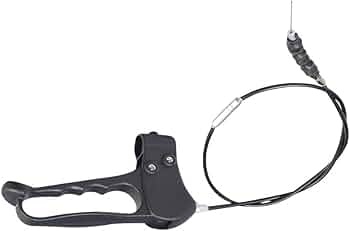
The Hand Brake Cable Replacement for EXP19LTBL is a brake lever and 23-inch steel cable assembly for the Drive Expedition Transport Chair EXP19LTBL to restore safe caregiver stopping and parking control on slopes, ramps, and uneven terrain.
Loading…
A transport wheelchair — distinguished from a self-propelling manual wheelchair by its smaller rear wheels that the occupant cannot reach to propel or brake — places the entire responsibility for stopping, slope control, and parking exclusively on the caregiver who is pushing the chair. Unlike a self-propelling wheelchair where the seated user can grab the rear wheel rim or engage a hand brake during a descent, the EXP19LTBL Expedition transport chair's occupant has no independent braking access: the rear wheels are 12-inch diameter wheels positioned behind the seat, outside the occupant's arm reach, and the braking system is entirely operated by the caregiver's hand lever at the push handle. This means the hand brake and cable assembly is not a redundant safety feature — it is the only braking mechanism for the entire wheelchair during transport, and its degradation or failure eliminates the caregiver's ability to control the chair's speed on any slope, gradient, or surface irregularity that gravity or momentum would otherwise cause it to roll away from controlled walking pace.
The 23-inch cable sleeve length of the replacement assembly reflects the specific routing geometry of the Drive Expedition EXP19LTBL frame — the distance from the brake lever at the push handle to the rear wheel brake caliper or band that the cable actuates, following the frame's push handle tube, through the seat back, and along the frame rail to the brake mechanism at the wheel hub. Cable sleeve length is not a generic or adjustable specification in a transport wheelchair brake system: a cable that is too short cannot be routed correctly through the frame's cable guides and will have insufficient slack to allow the correct brake lever range of motion; a cable that is too long creates excess cable coil at the routing points that interferes with folding, frame movement, and cable self-routing under load. The 23-inch sleeve length is the EXP19LTBL-specific dimension that allows correct installation, full lever travel, and consistent cable tension across the brake cable's full actuating range.
Steel cable construction is the material specification that determines the cable's fatigue life and braking consistency over the full replacement component's service period. A brake cable operates through a cycle of tension loading — each pull of the brake lever applies a tensile load along the full cable length — and release, and this tension-release cycling is repeated thousands of times across the cable's service life as the caregiver applies and releases the brake during every transport outing. Stainless or galvanized steel cable maintains its tensile strength and consistent cross-sectional diameter through this fatigue cycle loading without the progressive fiber breakage and core flattening that synthetic or lower-grade cable materials exhibit — ensuring that the brake's actuation force, lever feel, and cable travel remain consistent from the beginning to the end of the cable's service life rather than producing a softening or increasing lever force as cable degradation progresses. A degrading cable that requires increasing lever force to achieve the same braking effect gives the caregiver a false sense of progressive control loss rather than the consistent, predictable braking response that safe transport wheelchair use requires.
The left-or-right installation compatibility of the EXP19LTBL brake assembly is a practical feature that reflects the Drive Expedition's caregiver-adaptable design and simplifies maintenance parts stocking. The Drive Expedition EXP19LTBL is manufactured with a brake lever on one side — left or right, depending on the configuration — that the caregiver operates with their dominant hand while the other hand provides the primary steering force at the push handle. When the brake lever or cable fails on one side, the replacement assembly installs in the same position as the failed component, and the confirmed left-or-right compatibility means that the facility's parts inventory or the homecare provider's stock needs only the single part number rather than separate left and right assemblies — reducing the stocking complexity and ensuring the correct replacement is on hand regardless of which side has failed.
✓ Primary brake cable replacement — replacing a failed, frayed, or seized brake cable on the Drive Expedition EXP19LTBL when braking performance is lost or significantly degraded ✓ Brake lever replacement — replacing a cracked, broken, or mechanically failed brake lever while retaining a functional cable, or replacing both simultaneously when the lever is the primary failure point ✓ Preventive cable replacement — replacing a cable at the first sign of fraying, kinking, or reduced lever travel before complete failure occurs during transport use ✓ Long-term care facility equipment servicing — restoring brake function on EXP19LTBL transport chairs in facility fleet maintenance programs ✓ Homecare transport wheelchair maintenance — replacing worn brake components on an EXP19LTBL used for patient transport between home, medical appointments, and community outings ✓ Equipment refurbishment — brake assembly replacement on pre-owned EXP19LTBL transport chairs as part of pre-resale or donation reconditioning service ✓ Post-incident inspection — replacing the brake cable assembly after a wheelchair transport incident where brake performance was reported as inadequate or the cable may have been subjected to overload
Confirming Compatibility Confirm the wheelchair is the Drive Medical Expedition Lightweight Transport Chair model EXP19LTBL before ordering — the 23-inch cable sleeve length and lever mounting geometry are specific to the Expedition frame design. Other Drive Medical transport chairs may have different cable sleeve lengths or lever mounting configurations that the EXP19LTBL replacement will not fit correctly.
Removing the Old Brake Assembly At the lever end: release the cable from the brake lever's cable anchor — typically a barrel nipple seated in a slotted anchor groove on the lever — and remove the cable housing from the lever's cable guide ferrule. At the brake end: release the cable from the brake caliper or band's cable anchor and remove the cable housing end from the brake mechanism's cable guide. Remove the cable from any frame-mounted cable guides or cable clips along the routing path. Inspect the cable guides and routing path for corrosion, deformation, or debris accumulation before installing the replacement to ensure the new cable runs freely through the guides without binding.
Installing the Replacement Assembly Mount the new brake lever to the push handle at the same position as the removed lever — confirm the lever pivot bolt torque is adequate to prevent lever rotation during brake application but not so tight that the lever cannot be pulled through its full range of motion. Route the cable through the frame's cable guides from the lever to the brake mechanism — confirm the cable runs without kinking, abrupt bends, or contact with moving frame components such as the footrest pivot points. At the brake end, seat the cable in the brake mechanism's anchor and adjust cable tension: the brake should engage with comfortable lever pull force and fully release when the lever is at rest, without the cable being slack enough to produce delayed engagement or tight enough to prevent complete brake release.
Post-Installation Brake Function Test Before returning the wheelchair to transport use, perform a brake function test: apply the brake lever with the wheelchair on a flat surface and attempt to roll the chair — the brake should prevent rolling under the force of a gentle push. Release the lever and confirm the wheels roll freely without dragging. Then test brake engagement on a slight slope if available — apply the lever and confirm the chair holds position without rolling. If the chair rolls on a slope with the lever applied, cable tension requires additional adjustment. Document the brake replacement in the wheelchair's maintenance record and note the date of replacement for future service interval reference.
Testimonial items
Very welcoming and informative. We went in to rent a Walker for my mom to see if she would use it. They had no rentals left so he gave us a brand new one on rental. Highly recommend this company for all your ADL needs.
Tara Maye
The rating of this product is 5 out of 5
Fantastic service and experience, from delivery to pickup we could not have asked for anything more! We rented a hospital bed, and I do not believe you would get better service anywhere. Highly recommended!
Shawn Dillon
The rating of this product is 5 out of 5
Super friendly and very helpful! Delivered the wheelchair for me, special ordered other parts and took the time to show me how to install. I recommend!
Fiona Haines
The rating of this product is 5 out of 5
Can not thank the team at Med Supplies enough for their amazing service. We were in a tough spot till we got their help. Amazing service. Kind and respectful delivery. First class all the way. Thank you again.
Jon Beatty
The rating of this product is 5 out of 5
Ordered the chair on Sunday and it arrived Monday morning. Spoke to customer service to follow up on delivery times. It was already on my front door. Excellent and helpful staff. The product is sturdy and of good quality. Thank you for your help.
H D
The rating of this product is 5 out of 5
Excellent experience - website faithfully represented what was in stock (which hasn't always been my experience with other vendors sadly), and local shipping was really fast - ordered on the weekend, received it on Monday in my case. Thank you for being
Jason Hudson
The rating of this product is 5 out of 5
0/0
You cart is currently empty
780 409-1509
Get directions