Slideshow Items

|
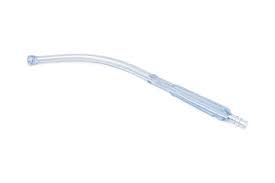
Box of 50 sterile single-use rigid Yankauer suction catheters with a bulb tip and non-vented handle for consistent suction control during oral and oropharyngeal secretion removal in respiratory care, surgery, and emergency airway management.
Loading…
The Yankauer suction catheter serves two structurally distinct functions that are both essential to effective and safe oral airway suctioning, and that a single catheter must satisfy simultaneously. The first function is secretion access: the Yankauer is the rigid oral suction instrument whose curved, semi-rigid shaft provides the geometric access to the oral cavity and oropharynx that flexible suction catheters — used for nasal or tracheal access — cannot replicate in the oral suction context. The oral and oropharyngeal space presents surfaces at multiple angles — the buccal gutters, the floor of the mouth, the base of the tongue, and the posterior oropharyngeal wall — from which secretions, blood, vomit, and other fluids must be aspirated effectively and quickly during surgery, respiratory care, and emergency airway management. The Yankauer's curved shaft maintains its geometry under the operator's handling and suction forces without the collapse that a flexible catheter would undergo in the same use, allowing the operator to direct the tip to specific areas of the oral cavity with positional control that flexible materials do not provide. The connection end of the Yankauer's handle attaches to standard suction tubing, connecting the catheter to the suction machine's vacuum source and transmitting the machine's negative pressure to the bulb tip opening, where it aspirates the secretions the tip is positioned against.
The second function the Yankauer must satisfy simultaneously is tissue trauma prevention — minimising the mucosal contact trauma that the suction catheter's tip creates at the oral and oropharyngeal surfaces it contacts during the suction procedure. Oral and oropharyngeal mucosa is delicate and highly vascular, and suction catheters with open-bore flat or bevelled tips can generate focal negative pressure events at the mucosa when the suction opening makes direct contact with the mucosal surface — the mucosa is drawn into the tip opening by the negative pressure, causing petechial haemorrhage, mucosal erosion, or suction cup trauma at the contact site. In patients who require repeated suctioning — post-operative patients with reduced swallow reflex, tracheostomy patients, or neurologically impaired patients with chronic aspiration risk — the cumulative mucosal trauma from repeated flat-tip or open-bore catheter contact over multiple daily suction events is clinically significant and can impair the mucosal integrity that serves as a barrier to secondary infection. The bulb tip of the Yankauer catheter addresses this trauma mechanism by enclosing the suction opening within a rounded, smooth-surfaced bulb that distributes the negative pressure across the curved surface of the bulb rather than concentrating it at a single opening edge — the mucosa contacts the curved bulb surface, and the suction opening is oriented away from direct forward mucosal contact, reducing the focal negative pressure event that a flat open-bore tip creates.
The non-vented handle design of the Yankauer catheter provides the consistent, operator-controlled suction characteristic that distinguishes non-vented from vented designs. A vented Yankauer handle includes an opening in the handle body that, when unobstructed, vents the suction pathway to atmosphere and reduces the suction at the tip to near zero — the operator covers the vent to apply suction and uncovers it to interrupt suction without disconnecting the catheter. The non-vented design transmits the suction machine's full vacuum directly to the tip whenever the catheter is connected to the suction tubing, without a vent port that the operator must cover and uncover. In high-acuity emergency and peri-operative contexts where the operator is managing multiple aspects of the patient's airway simultaneously, the non-vented design simplifies the suction procedure to a single-action instrument — position and suction — without the additional cognitive and motor demand of vent management. The operator controls suction application and cessation by positioning the catheter tip rather than by vent manipulation.
The sterile, individually packaged, single-use specification of the Yankauer catheter addresses the infection control requirement of an instrument that makes direct contact with the oral and oropharyngeal mucosa. The oral cavity and oropharynx are not sterile environments, but the suction catheter that contacts them is introduced from outside the patient and must not be a vector for cross-contamination between patients or between suction sessions in the same patient. A sterile, individually packaged catheter provides the contamination-free starting condition required for single-patient single-session use, and the single-use specification ensures that a used catheter — which is contaminated with the patient's secretions and the microorganisms present in them — is not reintroduced to the same patient's airway in subsequent sessions or to another patient's airway without decontamination.
✓ Peri-operative and anaesthetic oral suctioning — Yankauer catheter for removal of blood, secretions, and oral fluids during surgical procedures requiring oral airway management, with bulb tip reducing mucosal trauma in the operative field
✓ Emergency airway management — oral suction during emergency resuscitation, aspiration events, and airway emergencies where rapid clearance of vomit, blood, and secretions from the oral cavity is required for airway patency
✓ Post-operative recovery room suctioning — oral secretion management in recovery room patients with reduced swallow and gag reflex following general anaesthesia, with non-vented design supporting rapid single-action suctioning during the recovery period
✓ Chronic neurological condition oral suction — repeated oral suction sessions in patients with dysphagia, motor neuron disease, or other neurological conditions causing chronic secretion accumulation and aspiration risk, with bulb tip protecting the oral mucosa across multiple daily sessions
✓ Tracheostomy and ventilator patient oral hygiene — oral suctioning component of ventilator-associated pneumonia prevention protocols in ICU and long-term ventilator patients, removing oral secretions that are a primary aspiration source for subglottic inoculation
Carousel items
Testimonial items
Very welcoming and informative. We went in to rent a Walker for my mom to see if she would use it. They had no rentals left so he gave us a brand new one on rental. Highly recommend this company for all your ADL needs.
Tara Maye
The rating of this product is 5 out of 5
Fantastic service and experience, from delivery to pickup we could not have asked for anything more! We rented a hospital bed, and I do not believe you would get better service anywhere. Highly recommended!
Shawn Dillon
The rating of this product is 5 out of 5
Super friendly and very helpful! Delivered the wheelchair for me, special ordered other parts and took the time to show me how to install. I recommend!
Fiona Haines
The rating of this product is 5 out of 5
Can not thank the team at Med Supplies enough for their amazing service. We were in a tough spot till we got their help. Amazing service. Kind and respectful delivery. First class all the way. Thank you again.
Jon Beatty
The rating of this product is 5 out of 5
Ordered the chair on Sunday and it arrived Monday morning. Spoke to customer service to follow up on delivery times. It was already on my front door. Excellent and helpful staff. The product is sturdy and of good quality. Thank you for your help.
H D
The rating of this product is 5 out of 5
Excellent experience - website faithfully represented what was in stock (which hasn't always been my experience with other vendors sadly), and local shipping was really fast - ordered on the weekend, received it on Monday in my case. Thank you for being
Jason Hudson
The rating of this product is 5 out of 5
0/0
You cart is currently empty
780 409-1509
Get directions