Why the Axle Bolt and Screw Is the Axle Retention Boundary and the Wheel Alignment Control Component of the Evolution Rollator Simultaneously
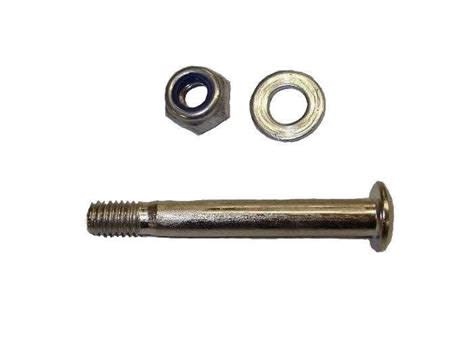
The axle bolt and screw assembly on an Evolution Xpresso or Trillium rollator serves two structurally distinct functions that are both essential to the rollator's mechanical and safety performance, and that a single hardware set must satisfy simultaneously. The first function is axle retention: the bolt and screw are the fastening elements that clamp the wheel axle at the fixed position within the fork that the rollator's wheel geometry requires. The wheel axle cannot remain in its specified position under rolling and braking loads without the clamping force that the bolt and screw assembly provides — an axle that is not retained by correctly torqued fasteners is free to shift longitudinally within the fork under the cyclic loads that walking use generates. A bolt and screw assembly that has stripped, fractured, or loosened to the point that it can no longer generate the specified clamping force at the axle must be replaced before the rollator is returned to use, because an axle that is free to shift under load introduces wheel movement at the fork that the user cannot detect until the wheel has shifted enough to alter the rollator's rolling behaviour.
The second function the axle bolt and screw must satisfy simultaneously is wheel alignment control: by clamping the axle at a fixed lateral position within the fork, the fastener assembly determines the wheel's lateral offset from the fork centreline and therefore the wheel's alignment relative to the rollator frame's travel direction. A bolt that has been installed at incorrect torque — either undertorqued, allowing axle lateral shift, or overtorqued to the point of thread damage — does not hold the axle at the correct lateral position. Axle lateral shift produces a wheel alignment error that causes the wheel to run at a small angle to the intended travel direction, generating a lateral scrubbing force on the tyre contact patch with each rotation and a progressive steering pull that the user must compensate for with asymmetric handlebar force. In a rollator user population where upper limb strength and balance may be limited, a steering pull caused by wheel misalignment from incorrect axle retention is a direct fatigue and fall risk that correctly installed axle hardware eliminates.
The metal construction specification of the Evolution Xpresso and Trillium axle bolt and screw addresses the specific failure modes that rollator axle fasteners develop in active homecare and clinical use. The bolt thread is subjected to the combined clamping preload and the cyclic bending moment that the wheel's rolling and braking loads impose on the axle at the fork mounting point. A fastener manufactured to a lower material specification than the OEM part has a reduced fatigue limit under this combined loading, and will develop thread fatigue or shank fracture at a lower cycle count than the OEM fastener — reintroducing the axle retention failure that the replacement was intended to eliminate. The OEM metal specification is therefore a functional requirement for fastener service life under rollator use loads, not simply a construction quality indicator.
The compact single-set sale configuration of the B28ABSP axle bolt and screw allows hardware replacement at the specific wheel position where the fastener has stripped, fractured, or been lost, without replacing the fork, wheel, or axle assembly. This matters in rollator maintenance practice because axle fastener wear is position-specific — the wheel position subjected to the most frequent braking or the heaviest rolling load develops fastener wear ahead of the remaining wheel positions.
KEY FEATURES
- OEM replacement axle bolt and screw set (B28ABSP) — fastener dimensions, thread specification, and material match the original Evolution hardware, restoring the manufacturer-specified axle clamping force at the wheel fork mounting point
- Axle retention clamping function — bolt and screw assembly generates the clamping force that holds the wheel axle at its fixed lateral and longitudinal position within the fork under rolling, braking, and lateral load cycles
- Wheel alignment control — correct axle lateral positioning maintained by properly torqued fasteners eliminates the wheel alignment error and steering pull that undertorqued or damaged axle hardware produces
- Durable metal construction — fastener material selected for resistance to the combined thread preload and cyclic bending fatigue that rollator axle mounting points accumulate across active daily mobility use
- Sold individually — allows targeted hardware replacement at the stripped, fractured, or missing fastener position without replacing the fork, wheel, axle, or frame assembly
BENEFITS
- Restores axle retention at the affected wheel position — replacing stripped, fractured, or missing axle hardware before the rollator is used under walking load, removing the axle shift risk that unsecured or under-clamped hardware creates
- Correct axle lateral positioning eliminates wheel alignment error — restoring straight rolling behaviour and removing the steering pull that a laterally shifted axle produces in a user population where asymmetric handlebar compensation increases fall risk
- OEM thread and material specification extends replacement fastener service life under combined preload and cyclic bending fatigue — resisting the thread fatigue and shank fracture that a lower-specification fastener would develop under the same rolling and braking load cycles
- Component-level hardware replacement extends the rollator's service life without replacing the fork, wheel, axle, or frame assembly — recovering full wheel attachment function at fastener replacement cost
- Compact individual set sale allows targeted replacement at the specific wheel position where the hardware has failed — avoiding unnecessary replacement of serviceable fasteners at the remaining wheel positions
TYPICAL APPLICATIONS
✓ Stripped thread replacement — immediate axle bolt or screw replacement when thread stripping has eliminated the fastener's ability to generate clamping force at the axle mounting point, restoring axle retention before the rollator is returned to use
✓ Fastener fracture replacement — replacement when bolt shank fracture under cyclic bending fatigue has removed the axle retention element at the affected wheel position, identified by axle lateral shift or wheel movement within the fork
✓ Missing hardware replacement — replacement when the axle bolt or screw has been lost during rollator service, transport, or wheel removal, restoring the complete axle retention assembly before the rollator is returned to active use
✓ Wheel maintenance replacement — axle hardware inspection and replacement as part of rollator wheel service, confirming thread integrity and clamping torque at all wheel positions before the rollator is returned to the user
✓ Rollator recommissioning — axle bolt and screw inspection and replacement when an Evolution Xpresso or Trillium rollator is transferred to a new user or returned from storage, confirming fastener integrity and axle retention at all wheel positions before active use

 780 409-1509
 Get directions