
Slideshow Items

  • Resuscitators, Inhalators & Airway Devices
  • resuscitators-inhalators-airway-devices
Inogen

  |  

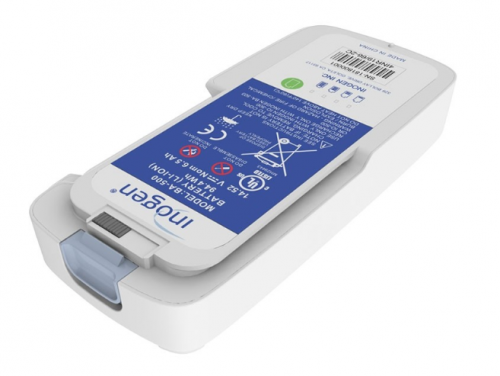
Inogen One G5 8 Cell Battery

C$499.00
3+ Day Shipping
In store: Check availability

Available in store

SKU: BA-500

Rechargeable lithium-ion 8-cell quick-release battery (BA-500) for the Inogen One G5 Portable Oxygen Concentrator, providing up to 6.5 hours of pulse-dose runtime at flow setting 1, FAA approval for flights, and full recharge in 3 hours.

    • Why the G5 Battery Is the Operational Runtime Boundary and the Mobility Independence Component of the Inogen One G5 Oxygen Therapy System Simultaneously

      The Inogen One G5 8-cell battery serves two structurally distinct functions that are both essential to effective portable oxygen therapy for G5 users, and that a single battery component must satisfy simultaneously. The first function is operational runtime: the battery is the portable power source that sustains the G5 concentrator's compressor, sieve bed, and electronic control systems through the full range of the patient's daily away-from-home activities. The G5 concentrator cannot operate without electrical power — without a charged battery, the device cannot produce oxygen, and the patient's supplemental oxygen therapy ceases entirely. The battery's operational runtime at each flow setting determines the duration of activity the patient can complete before requiring a recharge event or battery exchange. At flow setting 1, the 8-cell battery provides up to 6.5 hours of runtime — sufficient for a half-day of moderate activity, a standard outpatient appointment schedule, or a medium-duration commercial flight. At higher flow settings, runtime decreases because the concentrator's compressor operates at a higher duty cycle to produce the larger oxygen bolus volumes that higher settings require, consuming battery charge at a faster rate. Understanding the runtime at the patient's prescribed flow setting — not only at setting 1 — is therefore essential to planning the activity duration that the 8-cell battery can support without recharge.

      The second function the battery must satisfy simultaneously is mobility independence — enabling the patient to move away from mains power for the duration required by their daily activities, social participation, and travel without being tethered to an electrical outlet. Oxygen-dependent patients face a mobility constraint that non-oxygen-dependent patients do not: every activity that takes them away from a power source is constrained by the battery runtime available at the time of departure. A battery whose runtime is sufficient to cover the expected activity duration without recharge removes the oxygen supply anxiety that constrains the patient's willingness to commit to extended outings — the patient can plan activities around the activity's duration requirements rather than around the nearest power outlet. The quick-release battery design of the G5 system allows a second charged battery to be exchanged for a depleted one in seconds, enabling patients who carry a spare charged battery to effectively double the activity duration available from a single battery charge cycle without interrupting therapy.

      The 3-hour recharge time of the BA-500 battery addresses the logistics of battery recharge management in active daily use. An oxygen concentrator battery that requires 8–10 hours to fully recharge creates a dependency on overnight charging to restore the battery's full capacity before the next day's activities — a charging schedule that leaves no recovery margin if the battery is not connected to the charger immediately upon returning home. The 3-hour recharge time allows the battery to be fully recharged within a typical evening from a mid-afternoon return home, without requiring the battery to begin charging before the patient arrives home. AC and DC recharge compatibility extends this flexibility to vehicle charging during transit, allowing the battery to recharge during a long vehicle journey so that it arrives at the destination at full capacity rather than depleted from the transit period.

      The FAA approval of the BA-500 battery addresses the specific regulatory barrier that oxygen-dependent patients face when travelling by commercial aircraft. FAA approval confirms that the battery meets the safety requirements for lithium-ion battery use on commercial flights, allowing the patient to board with their G5 concentrator and battery without the device or battery being refused by airline security or cabin crew. Without FAA approval, a lithium-ion battery of this capacity may be refused on commercial aircraft regardless of its intended medical use, leaving the patient without portable oxygen therapy during air travel. FAA approval removes this barrier, enabling the patient to maintain therapy continuity throughout the flight on battery power.

      KEY FEATURES

      • Up to 6.5 hours runtime at flow setting 1 — operational duration sufficient for half-day outings, outpatient appointments, and medium-duration commercial flights at the concentrator's lowest flow setting, with reduced runtime at higher flow settings proportional to compressor duty cycle increase
      • Quick-release battery design — single-motion battery removal and installation allows a depleted battery to be exchanged for a charged spare in seconds without interrupting therapy setup, effectively doubling activity duration when a second charged battery is carried
      • 3-hour full recharge time from AC or DC power — rapid recharge cycle allows full battery restoration within a standard evening from a mid-afternoon return home, with DC vehicle charging enabling transit recharge for destination arrival at full capacity
      • FAA-approved for airline travel — regulatory approval confirms lithium-ion battery compliance with commercial flight safety requirements, removing the airline battery refusal barrier that non-approved batteries face for in-flight oxygen therapy use
      • Lightweight design at approximately 0.5 kg — battery weight matched to the G5's portable design specification, adding minimal mass to the concentrator during carry or shoulder-bag transport across daily ambulatory activities
      • BA-500 model designation — confirmed compatibility identifier for the Inogen One G5 Portable Oxygen Concentrator battery slot

      BENEFITS

      • 6.5-hour runtime at setting 1 covers half-day active use without recharge — patients can complete morning or afternoon activity schedules, appointments, and social events without locating a power outlet during the outing at the concentrator's lowest flow setting
      • Quick-release exchange enables extended runtime with spare battery — second charged battery carried alongside the concentrator doubles effective activity duration without recharge, removing the single-battery runtime as a hard activity planning constraint
      • 3-hour recharge time eliminates overnight charging dependency — battery fully restored within a short evening charge window rather than requiring connection to the charger immediately upon returning home to be ready for the next day
      • FAA approval enables air travel therapy continuity — patients can maintain G5 oxygen therapy throughout commercial flights without airline battery restrictions, enabling domestic and international travel without oxygen supply coordination
      • Lightweight battery maintains G5 portability — 0.5 kg battery addition keeps the G5 carry weight within the range that shoulder-bag or backpack transport supports across daily ambulatory activities

      TYPICAL APPLICATIONS

      Daily portable oxygen use — primary power source for G5 concentrator during daily away-from-home activities, errands, medical appointments, and social events within the 6.5-hour runtime range at the patient's prescribed flow setting

      Airline travel — FAA-approved battery enables in-flight G5 operation throughout commercial flights, with runtime sufficient for medium-duration domestic and short-haul international flights at lower flow settings

      Spare battery for extended outings — second BA-500 carried alongside the concentrator for full-day activities or long-duration travel events that exceed a single battery's runtime, with quick-release exchange enabling continuous therapy without recharge

      Battery replacement at end of service life — replacement of a capacity-degraded BA-500 when runtime at the patient's prescribed setting has fallen below the level required for the patient's daily activity duration, restoring full operational runtime

      Vehicle travel — DC recharge compatibility allows battery recharge during extended vehicle journeys, maintaining full charge availability at the destination without depleting the battery during ground transit

    • No reviews yet

      Add yours

    Testimonials from Google

    See all reviews

    Your cart — 0

    You cart is currently empty

    Login

    By using our website, you agree to the use of cookies. These cookies help us understand how customers arrive at and use our site and help us make improvements. Hide this message More on cookies »