
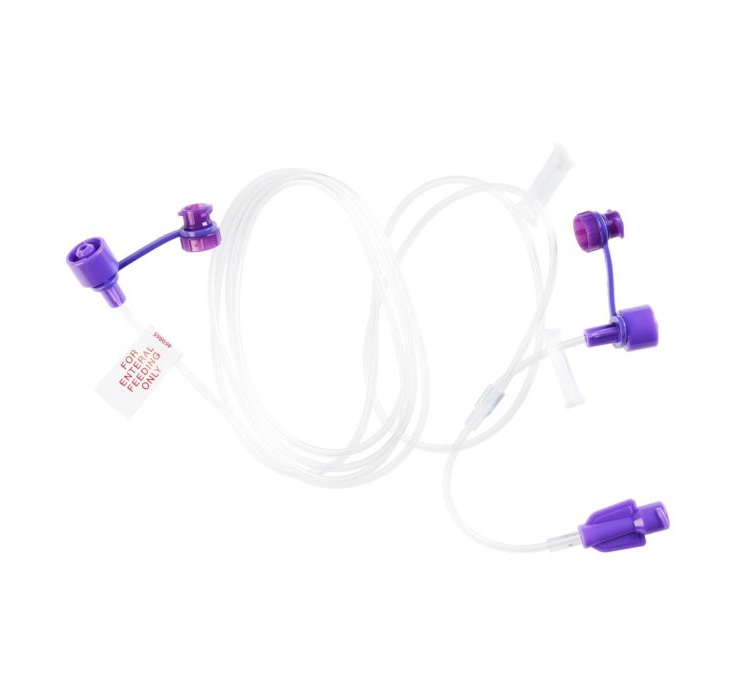
Why ENFit Connector with Direct Venting for Safe Gravity Feeding
The ENFit connector represents the international standard for enteral feeding connections—engineered with ISO 80369-3 compliant design that physically prevents misconnection with IV lines, respiratory equipment, or other medical devices through incompatible threading and dimensions, eliminating the catastrophic patient harm that occurs when feeding formula is inadvertently delivered intravenously or into airways. The direct vented design incorporates an air vent integrated into the extension set that allows atmospheric air to enter as formula flows out, preventing vacuum formation that would slow or halt gravity-fed delivery—this continuous air exchange maintains consistent flow rates without the air locks, pressure differentials, or interrupted feeding that compromise nutrition delivery and extend feeding times with non-vented systems. The compact 4-inch (10cm) tubing length provides the minimal extension needed to connect feeding bags to patient tubes while reducing dead space where formula can pool, minimizing waste of expensive nutritional products and reducing the volume of formula exposed to room temperature during prolonged feeding sessions.
Key Features & Benefits
Key Features:
- ENFit connector with ISO 80369-3 compliant design
- Prevents misconnection with IV, respiratory, or other medical lines
- Direct vented design with integrated air inlet
- 4-inch (10cm) tubing length for compact connection
- Gravity feeding design (no pump required)
- Clear transparent medical-grade tubing
- Sterile, single-use disposable
- Universal compatibility with ENFit feeding tubes
- Compatible with ENFit feeding bags and bottles
- Smooth inner lumen prevents clogging
- Drip chamber or volume indicators (product dependent)
- Roller clamp for flow rate control
- Luer-free design (enteral-specific)
- DEHP-free materials (phthalate-free)
- Latex-free construction
- Manufactured by Cardinal Health/Covidien
- Meets FDA enteral connector requirements
Benefits:
- ENFit standard prevents life-threatening misconnections
- Direct venting ensures smooth, consistent gravity flow
- Eliminates air locks that interrupt feeding
- Short length minimizes formula waste in tubing
- Reduces dead space and bacterial growth potential
- No pump needed—simple gravity operation
- Clear tubing allows visual flow monitoring
- Sterile packaging ensures patient safety
- Single-use prevents cross-contamination
- Universal ENFit compatibility simplifies inventory
- DEHP-free and latex-free for patient safety
- Flow control enables rate adjustment
- Cost-effective for gravity feeding protocols
Clinical Applications
Kangaroo Gravity Feeding Extension Sets are appropriate for:
âś“ Gastrostomy tube (G-tube) feeding via gravity âś“ Jejunostomy tube (J-tube) feeding via gravity âś“ Nasogastric tube (NG) feeding via gravity âś“ Nasojejunal tube (NJ) feeding via gravity âś“ Gastrostomy-jejunostomy tube (GJ-tube) feeding âś“ Percutaneous endoscopic gastrostomy (PEG) feeding âś“ Low intermittent tube feeding (LIF) âś“ Bolus feeding administration âś“ Continuous gravity feeding âś“ Hospital enteral nutrition programs âś“ Long-term care facility feeding âś“ Home enteral nutrition âś“ Pediatric tube feeding (with appropriate precautions) âś“ Geriatric enteral nutrition âś“ Post-operative nutrition support âś“ Neurological patient feeding (stroke, ALS, etc.) âś“ Cancer patient nutritional support âś“ Any gravity-fed enteral nutrition delivery
Usage & Application
Pre-Use Preparation:
- Verify feeding order:
- Confirm enteral nutrition prescription
- Check formula type, volume, rate
- Verify patient identity
- Review patient allergies
- Assess patient:
- Check feeding tube placement (per facility protocol)
- Verify tube type compatible with ENFit
- Check residual volume if indicated
- Assess abdomen for distention or discomfort
- Elevate head of bed 30-45 degrees (prevents aspiration)
- Gather supplies:
- Kangaroo Gravity Feeding Extension Set
- Prescribed enteral formula
- Feeding bag or bottle (ENFit compatible)
- 60 mL catheter-tip syringe for flushing
- Sterile water or saline for flushes
- IV pole or hook to elevate bag
- Clean gloves
- Towel or absorbent pad
- Hand hygiene:
- Wash hands thoroughly for at least 20 seconds
- Don clean gloves
- Prepare formula:
- Check formula name, concentration, expiration
- Bring to room temperature (if refrigerated)
- Shake formula can or bottle well
- Open formula container using aseptic technique
- Inspect extension set package:
- Check package integrity
- Verify expiration date
- Ensure sterile seal intact
- Discard if compromised
Setting Up Feeding System:
- Open extension set package:
- Peel open sterile package
- Remove extension set using aseptic technique
- Do NOT touch ENFit connector or tubing ends
- Prepare feeding bag:
- Open feeding bag package
- Close roller clamp on extension set (CRITICAL—prevents spills)
- Pour or transfer prescribed formula into bag
- Do not overfill—leave air space at top
- Secure bag closure or cap
- Prime extension set:
- Verify roller clamp closed
- Attach extension set ENFit connector to feeding bag ENFit port:
- Align connector threads
- Push and twist clockwise until secure
- Should feel resistance and hear/feel engagement
- Hang bag on IV pole or hook
- Hold distal end over sink or container
- Open roller clamp slowly
- Allow formula to fill tubing completely
- Watch for air bubbles—tap tubing to release
- Continue until formula flows steadily from distal end with no air
- Close roller clamp once primed
- Check direct vent:
- Observe air vent port on extension set
- Should be unobstructed
- Do NOT plug or cover vent
- Vent allows air in as formula flows out
Connecting to Patient Feeding Tube:
- Position patient:
- Head of bed elevated 30-45 degrees minimum
- Patient sitting upright if tolerated
- Maintain position throughout feeding and 30-60 minutes after
- Verify feeding tube placement:
- CRITICAL safety step
- Methods (per facility protocol):
- Check external marking on tube (verify at insertion mark)
- Aspirate gastric contents and check pH (pH <5 typically gastric)
- Auscultate air insufflation (least reliable—not recommended)
- Review X-ray confirmation (if recently placed)
- If ANY doubt about placement, do NOT feed
- Flush feeding tube:
- Remove cap from feeding tube ENFit connector
- Attach 60 mL syringe to feeding tube
- Flush with 30-60 mL water (per protocol)
- Ensures tube patency before feeding
- Remove syringe
- Connect extension set:
- Remove protective cap from extension set distal ENFit connector
- Align with feeding tube ENFit connector
- Push and twist clockwise until secure
- Tug gently to verify secure connection
- ENFit standard ensures proper connection
- Adjust bag height:
- Hang bag 18-24 inches above feeding tube insertion site
- Higher = faster flow rate
- Lower = slower flow rate
- Adjust as needed for desired rate
Administering Gravity Feeding:
Bolus Feeding Method:
- Open roller clamp:
- Slowly open clamp to start flow
- Formula flows by gravity
- Monitor initial tolerance:
- Watch patient for discomfort, nausea
- Check for leaking around tube site
- Verify formula flowing (observe in clear tubing)
- Control flow rate:
- Adjust roller clamp to control speed
- Typical bolus: 200-400 mL over 15-30 minutes
- Slow feeding if patient shows intolerance
- Air vent maintains consistent flow without air locks
- Observe feeding:
- Stay with patient during feeding
- Monitor for signs of intolerance:
- Nausea, vomiting
- Abdominal cramping or bloating
- Diarrhea
- Coughing (possible aspiration)
- If intolerance: Stop feeding, assess patient
- Complete bolus:
- When desired volume delivered, close roller clamp
- Disconnect extension set from feeding tube
- Flush tube with 30-60 mL water
- Cap feeding tube
Continuous Gravity Feeding:
- Set up as above:
- Prime extension set
- Connect to patient
- Hang bag
- Adjust for slow continuous rate:
- Open roller clamp partially
- Adjust to deliver prescribed hourly rate
- Example: 1000 mL over 8 hours = 125 mL/hr
- Count drops to estimate rate (product dependent)
- Refill bag as needed:
- Close clamp before bag empty
- Disconnect from feeding tube
- Add more formula to bag (per hang time limits)
- Reconnect and restart
- Monitor regularly:
- Check every 1-2 hours:
- Bag volume remaining
- Flow rate maintaining
- Patient tolerance
- Tube site condition
- No leaking or disconnection
- Maximum hang time:
- Formula should not hang >4-8 hours (manufacturer dependent)
- Bacterial growth risk at room temperature
- Replace bag and extension set per protocol
- Closed system formulas may hang longer
Post-Feeding Care:
- Flush feeding tube:
- After feeding complete, close roller clamp
- Disconnect extension set
- Attach flush syringe
- Flush with 30-60 mL water
- Prevents tube clogging
- Clears formula from tube
- Cap feeding tube:
- Replace protective cap on feeding tube ENFit connector
- Secure cap tightly
- Keep patient elevated:
- Maintain head of bed elevation 30-45 degrees
- Keep elevated for 30-60 minutes after feeding
- Prevents aspiration and reflux
- Dispose of extension set:
- Single-use only—discard after use
- Place in appropriate waste container
- Do NOT reuse
- Clean feeding bag (if reusable):
- Rinse thoroughly with warm water
- Wash with mild soap
- Rinse completely
- Air dry
- Replace per manufacturer recommendations (typically every 24 hours)
- Or use new disposable bag each feeding
- Document:
- Formula type and amount delivered
- Feeding duration
- Patient tolerance
- Residual volume if checked
- Any complications
Troubleshooting:
Formula not flowing or very slow:
- Check roller clamp open
- Bag not elevated enough (raise bag higher)
- Tube kinked or pinched (straighten tubing)
- Feeding tube clogged (flush with water)
- Air lock despite venting (disconnect, re-prime, reconnect)
- Formula too thick (may need pump feeding instead)
- Vent blocked (check vent port clear)
Air bubbles in tubing:
- Normal to see some air bubbles
- Tap tubing to move bubbles along
- Vent allows air in—this is expected
- Large air boluses: may need to re-prime
Feeding tube disconnects from extension set:
- ENFit not twisted tight enough
- Reconnect: push and twist firmly clockwise
- Check for damaged ENFit connectors
- Replace if connectors damaged
Formula leaking at connection:
- ENFit not seated properly
- Disconnect and reconnect firmly
- Check for damaged seals or threads
- Replace extension set if damaged
Patient nausea, cramping, or discomfort:
- Slow or stop feeding temporarily
- Feeding may be too fast—slow rate
- Check residual volume (may indicate poor gastric emptying)
- Elevate head of bed more
- Notify healthcare provider if persistent
Coughing or respiratory distress during feeding:
- STOP FEEDING IMMEDIATELY
- May indicate aspiration
- Assess patient airway and breathing
- Verify feeding tube placement
- Notify healthcare provider
Diarrhea:
- Feeding may be too fast
- Formula may be too concentrated
- May indicate intolerance
- Notify healthcare provider for assessment
Tube clogging:
- Flush regularly (before and after feedings, every 4 hours during continuous)
- Use warm water for flushes
- If clogged: try flushing with warm water, gentle pressure
- Never use carbonated beverages or juice (can worsen clog)
- May need pancreatic enzymes to dissolve protein clogs
- May need tube replacement if severely clogged
Special Considerations:
Pediatric patients:
- Smaller feeding volumes and slower rates
- More frequent monitoring
- Elevate infant/child appropriately
- Careful volume calculations
- Watch for signs of intolerance closely
Geriatric patients:
- May have delayed gastric emptying
- Check residuals more frequently
- Slower feeding rates often better tolerated
- Monitor for aspiration risk (swallowing issues common)
Patients with jejunostomy tubes:
- J-tubes require slower, continuous feeding
- Cannot do rapid bolus feeds (small bowel doesn't hold volume)
- May need pump rather than gravity for precise control
- Monitor for dumping syndrome
Home care patients:
- Teach patient/caregiver proper technique
- Emphasize hand hygiene
- Provide written instructions
- Demonstrate priming and connection
- Stress importance of elevation during/after feeding
- Teach troubleshooting
- Provide emergency contact information
Diabetic patients:
- Monitor blood glucose closely
- Formula contains carbohydrates
- May need insulin adjustment
- Check glucose before and after feedings
Patients with limited mobility:
- Ensure bed can be elevated adequately
- Use pillows to prop up if needed
- Position patient before starting feeding
- Have call bell within reach
Infection Prevention:
- Hand hygiene before handling feeding equipment
- Use aseptic technique
- Single-use extension sets only
- Replace feeding bags per protocol (typically 24 hours)
- Formula hang time limits (4-8 hours typical)
- Flush tubes regularly to prevent bacterial colonization
- Clean reusable bags thoroughly
- Store formula properly (refrigerate opened cans)
Safety with ENFit:
ENFit standard prevents:
- IV misconnection (enteral formula into vein—fatal)
- Respiratory misconnection (formula into airway—fatal)
- Other medical device errors
Using ENFit correctly:
- Only connects to other ENFit devices
- Cannot connect to Luer connectors (IV)
- Cannot connect to respiratory equipment
- Physical incompatibility prevents errors
Transitioning to ENFit:
- All feeding tubes should be ENFit-compatible
- Legacy devices being phased out
- Do NOT use adapters to connect ENFit to non-ENFit (defeats safety purpose)
When to Contact Healthcare Provider:
- Feeding tube displaced or external length changed
- Cannot verify tube placement
- Persistent nausea, vomiting, or abdominal pain
- Signs of aspiration (coughing, respiratory distress)
- Feeding tube clogged and cannot clear
- Excessive residual volumes
- Diarrhea or constipation
- Skin irritation or infection at tube site
- Questions about feeding technique
- Equipment malfunction
Storage:
- Store at room temperature
- Keep in original packaging until use
- Protect from direct sunlight
- Store in clean, dry area
- Check expiration dates
- Rotate stock using FIFO
Regulatory Compliance:
- Meets FDA requirements for enteral connectors
- ISO 80369-3 compliant (ENFit standard)
- Manufactured under FDA quality systems
- Meets ASTM standards for enteral feeding
- Part of GEDSA (Global Enteral Device Supplier Association) initiative
Technical Specifications
Product Details:
- Brand: Kangaroo™ (Cardinal Health/Covidien)
- Product Type: Gravity feeding extension set for enteral nutrition
- Tubing Length: 4 inches (10 cm)
- Connector Type: ENFit (ISO 80369-3 compliant)
- Connection Standard: Prevents misconnection with IV, respiratory, other systems
- Venting: Direct vented design with integrated air inlet
- Flow Type: Gravity-fed (no pump required)
- Flow Control: Roller clamp for rate adjustment
- Tubing Material: Medical-grade PVC or similar (clear transparent)
- Tubing Features: Smooth inner lumen, kink-resistant
- Sterility: Sterile, single-use only
- Sterilization Method: Ethylene oxide (EtO) or gamma radiation
- Latex Content: Latex-free (no natural rubber latex)
- DEHP Content: DEHP-free (phthalate-free)
- Packaging: Individually packaged in peel-open pouches
- Shelf Life: Typically 3-5 years (check package)
- Compatibility: Universal ENFit feeding tubes and bags
- Visual Features: Clear tubing allows flow visualization
- Drip Chamber: May include depending on product model
- Intended Use: Enteral nutrition delivery via gravity
- Patient Population: All ages receiving tube feeding
- Regulatory Status: FDA-cleared medical device
- Standards Compliance:
- ISO 80369-3 (enteral connector standard—ENFit)
- FDA enteral connector requirements
- ASTM enteral feeding standards
- Manufacturer: Cardinal Health (Covidien)