Slideshow Items

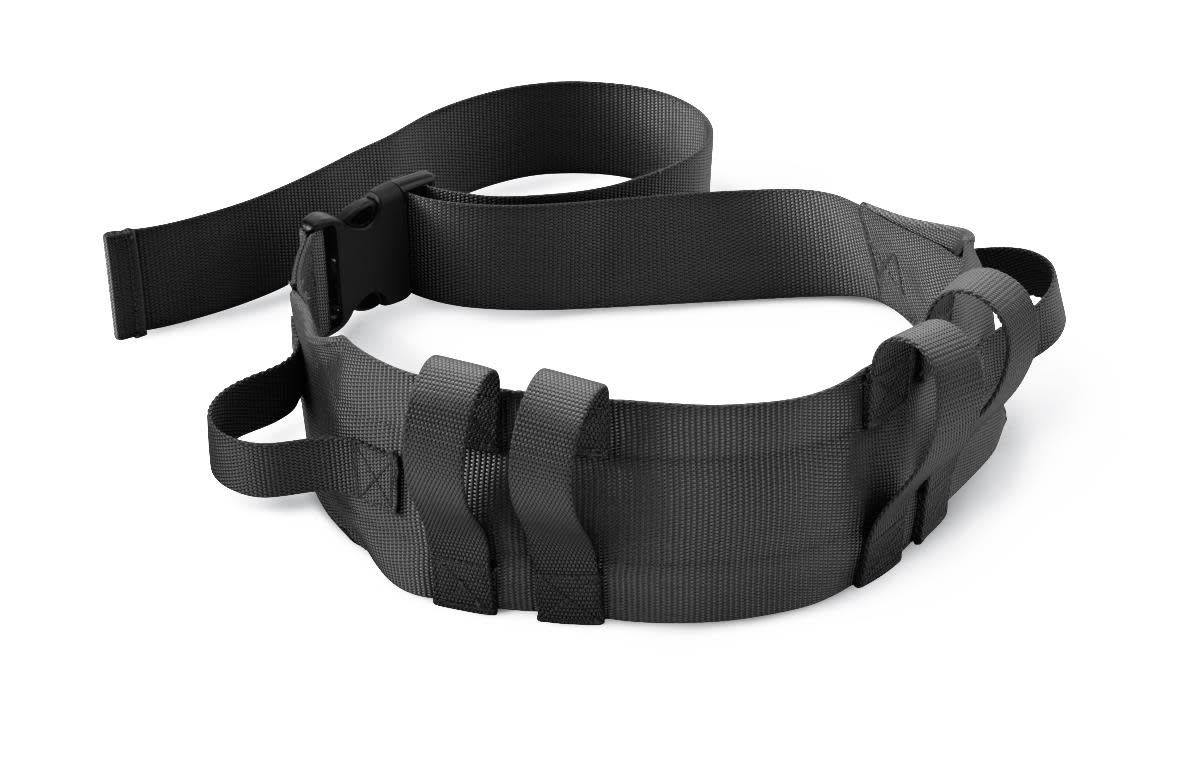
The wide reinforced nylon transfer belt with multiple positioned handles delivers secure caregiver grip and patient stability during gait training and transfers while heavy-duty buckle with adjustable length accommodates various body sizes.
Loading…
Traditional gait belts provide a single continuous loop requiring caregivers to grasp fabric fistfuls that slip, bunch, or provide inadequate control during critical transfer moments. Without proper grip points, caregivers resort to grabbing patient clothing, skin, or arms—techniques that create patient discomfort, dignity concerns, and ineffective control that increases fall risk. The strategically positioned handles along this transfer belt provide ergonomic grip options at multiple angles, enabling caregivers to redirect patient movement from front, back, or sides as needed during dynamic transfers. The wide belt design distributes pressure across a broader torso surface area compared to narrow 2-inch standard belts, reducing concentrated loading that causes patient discomfort while improving weight distribution during assisted ambulation. This combination of secure handle grips and comfortable wide contact transforms transfer assistance from uncertain clothing-grabbing into controlled, dignified patient mobility support.
✓ Post-operative patients with reduced mobility requiring transfer assistance
✓ Stroke survivors with hemiparesis during gait rehabilitation
✓ Parkinson's disease patients with balance impairment and freezing episodes
✓ Hip or knee replacement patients during early weight-bearing progression
✓ Multiple sclerosis patients with progressive weakness and balance deficits
✓ Elderly patients with generalized deconditioning and fall risk
✓ Dementia patients requiring redirectional cueing during ambulation
✓ Cardiac patients with activity restrictions during supervised exercise
✓ Orthopedic injury patients transitioning from wheelchair to walking
✓ Bariatric patients requiring mechanical advantage during transfers
✓ Physical therapy gait training programs for diverse patient populations
✓ Nursing homes managing residents with varied mobility limitations
✓ Rehabilitation hospitals facilitating intensive therapy schedules
✓ Home health agencies supporting family caregiver training
✓ Assisted living facilities maintaining resident independence with supervision
✓ Hospital medical-surgical units transferring patients for diagnostics and procedures
Patient Assessment and Sizing
Before application, assess patient's cognitive status, cooperation level, upper extremity strength, lower extremity weight-bearing capacity, and balance ability. Measure patient's waist circumference at belt application level (typically 2-4 inches above iliac crest) to verify belt length accommodates patient with 6-12 inches of overlap for secure buckling. For bariatric patients exceeding standard belt length, use extended-length transfer belts rated for appropriate weight capacity.
Proper Belt Application Technique
Position patient seated on bed edge, wheelchair, or chair with feet flat on floor. Thread belt around patient's waist at the level just above the iliac crest (hip bones)—too high restricts breathing, too low provides inadequate control. Ensure belt sits horizontally without twisting or rolling. Thread end through buckle and pull snug but not tight—proper fit allows caregiver to slip four fingers flat between belt and patient. Verify buckle is positioned at patient's front midline for visibility and access, never at back where it creates pressure point when patient leans back.
Handle Selection Strategy
For forward ambulation, grasp rear-positioned handle with dominant hand to guide from behind while non-dominant hand stabilizes patient's shoulder or upper arm. For lateral transfers (bed-to-wheelchair), use side handles to control patient rotation during pivot. For sit-to-stand assistance, grasp front or front-lateral handles to provide upward lifting assist while patient pushes from armrests. For descending stairs or ramps, position behind patient grasping rear handle to provide controlled braking. Select handle position that optimizes caregiver body mechanics—avoid reaching, twisting, or bending at waist.
Safe Gait Training Protocol
Stand slightly behind and to weaker side of patient during ambulation. Maintain firm but not rigid grip on rear or rear-lateral handle. Walk in sync with patient's pace—never rush or drag patient forward. Use handle to provide subtle directional cues: gentle pull left redirects patient left, slight upward lift encourages upright posture, minimal backward restraint slows excessive forward momentum. Keep patient within arm's length at all times for rapid response to balance loss. Scan ahead for obstacles, uneven surfaces, or hazards requiring navigation assistance.
Transfer Techniques - Sit to Stand
Ensure wheelchair brakes engaged or chair positioned against wall. Patient scoots forward to seat edge with feet flat, hip-width apart, positioned slightly behind knees. Caregiver grasps front or front-lateral handles with both hands, positioning close to patient with wide stable base. On count of three, patient pushes from armrests while caregiver provides upward lift through belt handles using leg strength, not back. As patient achieves standing, caregiver transitions grip to rear or side handles for walking or pivoting to next seated surface. Never lift patient fully using only belt—belt provides stability and guidance while patient provides primary lifting force.
Transfer Techniques - Bed to Wheelchair
Position wheelchair at 45-degree angle to bed, brakes engaged, footrests raised or removed. Assist patient to seated edge with feet flat. Apply belt and assist patient to standing using sit-to-stand technique. Once stable in standing, caregiver pivots patient using side handles to rotate toward wheelchair. As patient's legs contact wheelchair seat front, caregiver controls descent by maintaining upward tension on handles while patient lowers using armrests. Guide patient fully back into seat, then remove belt or leave in place if continuing ambulation shortly.
Toilet Transfer Considerations
For patients requiring transfer assistance to toilet, apply belt over clothing (not bare skin for dignity). Use same bed-to-wheelchair technique to transfer from wheelchair to toilet, reversing for return transfer. Belt enables controlled lowering and lifting without caregiver contact with patient's body. For patients with adequate sitting balance, belt may be loosened (not removed) while seated on toilet to allow clothing adjustment, then re-tightened for return transfer.
Weight-Bearing Progression Support
For patients advancing from non-weight-bearing to partial weight-bearing, belt provides graded assistance. Early phase: significant upward lifting support through handles as patient bears minimal weight. Middle phase: moderate support as patient increases weight acceptance. Late phase: minimal support providing primarily balance assistance and fall prevention. Belt handles enable precise calibration of assistance level matching patient's capabilities throughout recovery continuum.
Two-Caregiver Transfer Protocol
For bariatric patients, patients with complete dependence, or high fall-risk situations, employ two-caregiver technique. Caregivers position on opposite sides of patient, each grasping side handles with inside hands while outside hands stabilize patient's shoulder or upper arm. Caregivers communicate clearly—one leads count for synchronized movement. Both caregivers lift simultaneously using leg strength with wide stance. Coordination is critical—uneven lifting creates lateral instability risking fall.
Emergency Response Procedures
If patient begins to fall despite belt support, do NOT attempt to arrest fall completely—this causes caregiver injury. Instead, use belt to control descent, guiding patient to floor as gently as possible while protecting head from impact. Lower with patient rather than against them. Once patient is safely on floor, call for assistance rather than attempting single-caregiver floor-to-standing transfer. Belt can be used during multi-person floor recovery to coordinate lifting effort.
Caregiver Body Mechanics
Maintain wide base of support with feet shoulder-width apart, one foot slightly forward. Bend at knees and hips, never waist. Hold handles close to body to reduce lever arm stress on back. Use leg muscles for lifting force. Keep spine neutral—avoid twisting, which loads intervertebral discs asymmetrically. Exhale during exertion phase (lifting). If patient feels too heavy, stop and request second caregiver assistance—ego-driven solo attempts cause injury.
Belt Removal Technique
After transfer completion, remove belt promptly if patient will be seated or lying for extended period—prolonged wear causes discomfort. Release buckle and slide belt from around patient's waist. Inspect belt for wear, fraying, or buckle damage before storing. Never leave belt under patient when lying in bed—creates pressure point and skin breakdown risk. For patients with frequent transfers throughout day, belt may remain loosely applied between transfers for convenience, ensuring it's not twisted or bunched uncomfortably.
Hygiene and Infection Control
After use with each patient, inspect belt for visible soiling. Wipe clean with facility-approved disinfectant or, if machine-washable, launder per manufacturer instructions (typically cold water, mild detergent, air dry). Never share belts between patients without cleaning—this violates infection control protocols. Assign dedicated belts to individual patients in home settings or implement robust cleaning schedule for shared institutional belts. Replace belts showing embedded soiling that cannot be removed.
Staff Training Requirements
All caregivers must receive competency-based training in proper belt application, handle selection, transfer techniques, body mechanics, and emergency procedures before independent use. Training should include supervised practice with varying patient scenarios: cooperative vs. resistant, lightweight vs. bariatric, high vs. low fall risk. Annual competency reassessment identifies technique deterioration and reinforces safe practices. Document training completion for regulatory compliance.
Contraindications and Precautions
Do not use transfer belt on patients with: recent abdominal, thoracic, or spinal surgery (unless physician-approved); colostomy, gastrostomy tube, or surgical drains in belt contact area; rib fractures or severe osteoporosis; severe respiratory distress where torso compression worsens breathing; pregnancy (especially third trimester); or patient's explicit refusal. For patients with mild contraindications, consult physician and consider alternative lifting devices (sit-to-stand lifts, full mechanical lifts).
Equipment Inspection Schedule
Inspect belt before each use for: frayed stitching at handles or seams, buckle cracks or bending, torn or weakened fabric, and loose or separated handle attachments. Monthly detailed inspection examines all stress points under magnification. Quarterly load testing (if institutional policy requires) verifies belt holds rated capacity. Remove damaged belts from service immediately—never "make do" with compromised equipment. Document inspection findings and replacement actions.
Troubleshooting Common Issues
Belt slips during transfer: Likely applied too loosely—should fit snug with four-finger clearance only. Reapply with proper tension. If patient has minimal waist definition (obesity, ascites), angle belt slightly upward in front to catch under ribs preventing downward migration.
Patient complains of discomfort: Check that belt isn't twisted. Verify buckle isn't positioned at back creating pressure point. Ensure belt is at proper height (above iliac crest, below ribs). Consider padded-interior belt model for sensitive patients.
Handles seem inadequately positioned: Different belt models offer varied handle configurations. Select belt with handle spacing matching typical transfer needs—closer spacing for frequent handle changes, wider spacing for simple front-back control.
Caregiver experiences back pain: Re-evaluate body mechanics—likely bending at waist instead of knees, or reaching too far from body. Consider whether patient exceeds single-caregiver safe assistance threshold. Seek ergonomics evaluation and potential equipment upgrade to mechanical lift.
Carousel items
Testimonial items
Very welcoming and informative. We went in to rent a Walker for my mom to see if she would use it. They had no rentals left so he gave us a brand new one on rental. Highly recommend this company for all your ADL needs.
Tara Maye
The rating of this product is 5 out of 5
Fantastic service and experience, from delivery to pickup we could not have asked for anything more! We rented a hospital bed, and I do not believe you would get better service anywhere. Highly recommended!
Shawn Dillon
The rating of this product is 5 out of 5
Super friendly and very helpful! Delivered the wheelchair for me, special ordered other parts and took the time to show me how to install. I recommend!
Fiona Haines
The rating of this product is 5 out of 5
Can not thank the team at Med Supplies enough for their amazing service. We were in a tough spot till we got their help. Amazing service. Kind and respectful delivery. First class all the way. Thank you again.
Jon Beatty
The rating of this product is 5 out of 5
Ordered the chair on Sunday and it arrived Monday morning. Spoke to customer service to follow up on delivery times. It was already on my front door. Excellent and helpful staff. The product is sturdy and of good quality. Thank you for your help.
H D
The rating of this product is 5 out of 5
Excellent experience - website faithfully represented what was in stock (which hasn't always been my experience with other vendors sadly), and local shipping was really fast - ordered on the weekend, received it on Monday in my case. Thank you for being
Jason Hudson
The rating of this product is 5 out of 5
0/0
You cart is currently empty
780 409-1509
Get directions