
Slideshow Items

  • Low Air Loss/Alternating Pressure Mattress
  • mattresses/low-air-loss-alternating-pressure-mattress
  • Mattresses
  • mattresses
Roscoe Medical

  |  

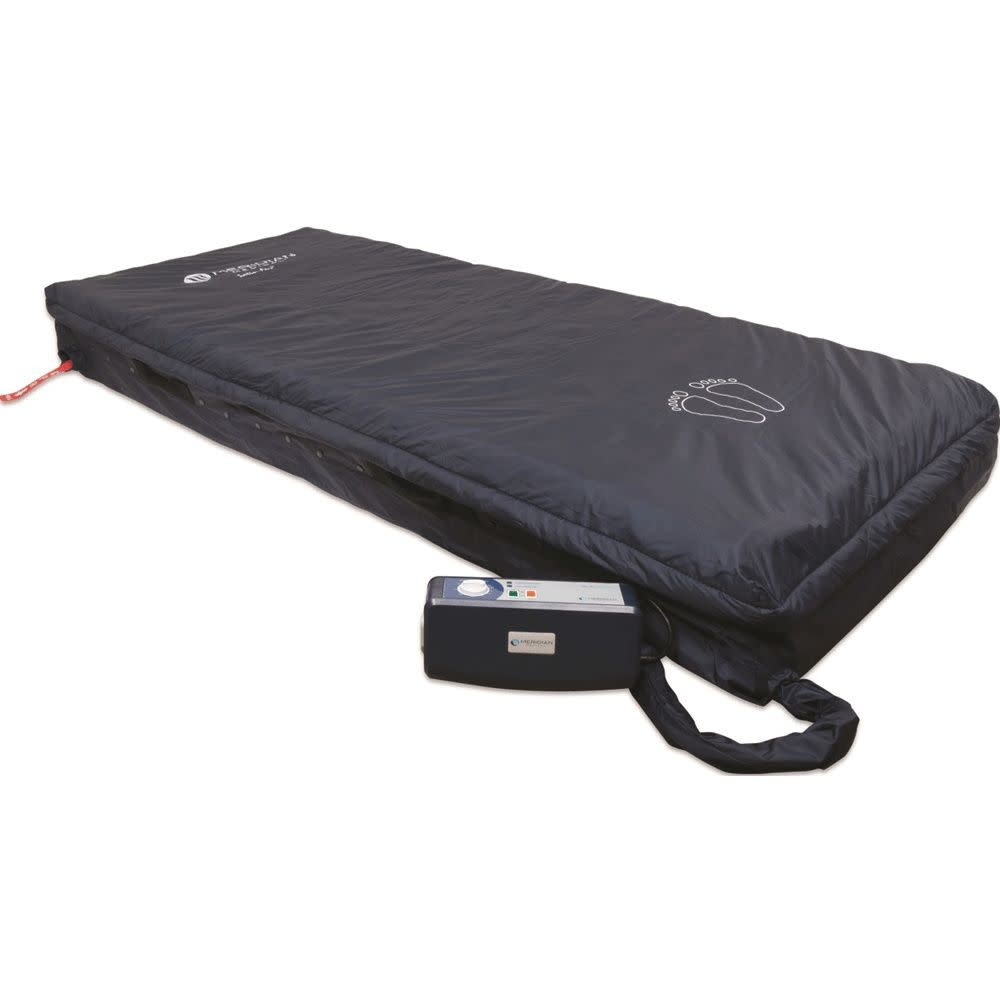
Meridian SatinAir 8” APM Alternating Pressure and Low Air Loss Mattress System

C$750.00
In stock online
In store: Check availability

Available in store

SKU: MER-SAPM2

The Meridian SatinAir 8-inch Alternating Pressure and Low Air Loss Mattress System is a 36-inch HCPCS E0277 APM therapy mattress replacement with modular removable air cells, foam base, digital pump, and low air loss for high-risk patients.

    • Why the SatinAir APM System for Standard-Width High-Risk Pressure Management?

      The clinical decision to prescribe a powered alternating pressure mattress system represents a meaningful escalation in the level of support surface therapy — from passive pressure redistribution delivered by foam or gel surfaces to active periodic tissue offloading delivered by powered air cell cycling. This escalation is clinically indicated when the patient's risk profile, existing wound status, or clinical environment exceeds what passive surfaces can adequately manage. The HCPCS code E0277 designation of the Meridian SatinAir positions it within the specific Medicare and insurance billing category for non-powered and powered pressure redistribution mattress systems that combine alternating pressure with low air loss function — a billing classification that is directly relevant for Canadian homecare programs, extended health benefit plans, and any cross-border billing environment where the HCPCS coding framework is used to categorize durable medical equipment for coverage determination. For facilities and homecare programs that document equipment selection against insurance coverage codes, the E0277 classification confirms that the SatinAir meets the functional criteria for that category.

      The modular removable air cell design of the SatinAir is a maintenance and longevity feature that distinguishes it from integrated non-modular APM systems and has direct practical significance in institutional and long-term homecare environments. In a standard integrated APM mattress, an air cell failure — a puncture, seam failure, or valve leak — affects the entire mattress system and typically requires the full mattress to be returned to service or replaced. In the SatinAir's modular design, individual air cell rows are removable and replaceable independently of the rest of the mattress system, allowing a single failed cell to be exchanged without interrupting therapy on the remaining cells or requiring full system replacement. This modularity also supports the routine maintenance of cleaning individual cells thoroughly — a process that is significantly more effective when cells can be removed from the mattress frame and cleaned on all surfaces compared to attempting to clean cells that are permanently integrated into a sealed mattress system. For long-term care facilities managing multiple SatinAir systems across a resident population, the modular design reduces both maintenance cost and therapy interruption duration when individual cell replacement is required.

      The approximately 17-row air cell configuration of the SatinAir's alternating cycle covers the full anatomical range from the head zone through the heel zone of the standard 36-inch by 80-inch mattress footprint, ensuring that alternating pressure offloading is delivered to all bony prominence zones simultaneously rather than covering only the high-risk central body zone as some narrower cell configurations do. The 10-minute alternating cycle — with each cell row cycling through inflation and deflation on a staggered interval — provides tissue relief intervals that are appropriate for the standard clinical recommendation of pressure relief at a minimum every two hours in passive management contexts, but at a per-cycle interval of 10 minutes, the SatinAir delivers pressure relief to each anatomical zone 6 times per hour rather than once every two hours. This dramatically higher relief frequency is the core haemodynamic advantage of powered alternating pressure over repositioning-only pressure management protocols, and it is the mechanism through which active APM systems can maintain tissue viability in patients who cannot be repositioned at adequate frequency by caregiving staff.

      The 30 to 60 mmHg adjustable pressure range of the digital pump — with an approximately 10 percent tolerance — is calibrated to the clinical requirements of the patient weight range up to 350 pounds. At 30 mmHg minimum inflation pressure, the system provides gentle cycling appropriate for very low body weight or highly fragile skin patients; at 60 mmHg maximum, it provides adequate support for patients at the upper end of the weight capacity. The ±10 percent pressure tolerance reflects the regulatory standard for therapeutic air mattress systems, within which the alternating pressure cycle delivers its intended interface pressure reduction. The 8 litres per minute pump output maintains both the cycling pressure and the low air loss airflow simultaneously — the same pump drives both therapeutic functions, making the pump specification the system's primary performance determinant and the component most important to maintain in optimal operating condition through regular filter cleaning and inspection.

      Key Features

      • HCPCS E0277-classified APM therapy system combining alternating pressure and low air loss for insurance-coded equipment documentation
      • Modular removable air cells allow individual cell replacement and thorough cleaning without full system removal or therapy interruption
      • Approximately 17-row air cell configuration covers the full body length for systematic pressure relief across all bony prominence zones
      • 10-minute alternating cycle provides pressure relief to each anatomical zone 6 times per hour — far exceeding manual repositioning frequency
      • 30–60 mmHg adjustable pressure range accommodates patient weights up to 350 lbs with individualized cycle pressure calibration
      • Low Air Loss airflow at approximately 8 LPM manages skin microclimate moisture and temperature simultaneously with alternating pressure cycling
      • Integrated 3-inch foam safety base maintains patient positioning during deflation cycles and passive support during power interruption
      • Static mode suspends alternating cycle for safe transfers and nursing procedures without pump shutdown
      • CPR quick-release valve enables emergency mattress deflation for resuscitation access without patient removal
      • Fluid-resistant vapor-permeable quilted nylon cover reduces shear and friction while supporting low air loss airflow to the skin surface

      Benefits

      • Active alternating pressure cycling provides systematic tissue offloading that passive foam or gel surfaces cannot achieve for high-risk patients
      • Modular cell design reduces therapy downtime and maintenance cost compared to non-modular integrated APM systems
      • Full-length 17-row cell coverage ensures no anatomical zone is excluded from the alternating pressure relief sequence
      • 6 pressure relief cycles per hour per zone dramatically exceeds the achievable manual repositioning frequency in most care environments
      • Digital adjustable pump allows individualized pressure calibration for patient weight and clinical condition
      • Low air loss moisture management complements alternating pressure cycling for comprehensive skin microclimate control
      • 3-inch foam base provides power-interruption safety and stable positioning support throughout the cycling deflation phase
      • HCPCS E0277 classification supports insurance and benefit plan documentation for funded equipment programs

      Clinical Applications

      ✓ Moderate to high-risk pressure injury prevention for patients with Braden scores below 14 where passive surfaces are clinically insufficient ✓ Active pressure injury treatment for existing Stage 2 through Stage 4 wounds requiring systematic anatomical zone offloading ✓ Long-term care residents at high risk where staffing ratios limit repositioning frequency to below the two-hour clinical interval ✓ Post-stroke and neurological patients with reduced sensation and mobility requiring continuous active surface therapy ✓ Post-operative patients with restricted repositioning during healing periods where passive surfaces cannot maintain adequate offloading ✓ Palliative and end-of-life care patients requiring maximum skin protection and comfort during extended terminal illness bed rest ✓ Homecare patients in AADL or insurance-funded APM programs where HCPCS E0277 classification is required for benefit authorization ✓ Patients with incontinence-associated dermatitis requiring concurrent moisture management alongside active pressure management ✓ Cancer patients with cachexia, fatigue, and compromised tissue tolerance requiring continuous active surface therapy ✓ Rehabilitation patients with limited mobility during intensive post-acute recovery requiring sustained active pressure management ✓ Patients with circulatory compromise where reduced tissue perfusion lowers the pressure tolerance threshold below passive surface capability ✓ Facilities implementing pressure injury prevention program audits requiring documented therapeutic surface specifications and HCPCS classification

      Usage & Application

      Initial Setup and Pump Calibration Assemble the foam safety base on the bed frame, lay the air cell mattress on the base with the cell hose connections oriented toward the pump side of the bed, and connect each air cell hose to the pump distribution manifold in the sequence indicated in the product manual. Power on the digital pump and allow the initial auto-inflation sequence to complete before adjusting settings — the system requires a full initial inflation cycle to confirm all cells are responding to pump pressure before patient placement. Once initial inflation is confirmed, adjust the pressure setting to the patient's weight range using the weight-to-pressure guide printed on the pump control panel or in the product manual. Lower the pressure setting toward the 30 mmHg range for lighter or fragile-skin patients and increase toward 60 mmHg for heavier patients approaching the 350-pound weight capacity limit.

    • No reviews yet

      Add yours

    Testimonials from Google

    See all reviews

    Your cart — 0

    You cart is currently empty

    Login

    By using our website, you agree to the use of cookies. These cookies help us understand how customers arrive at and use our site and help us make improvements. Hide this message More on cookies »