
Why 23-Gauge Ć 1-Inch with PrecisionGlide Technology for Versatile Clinical Applications
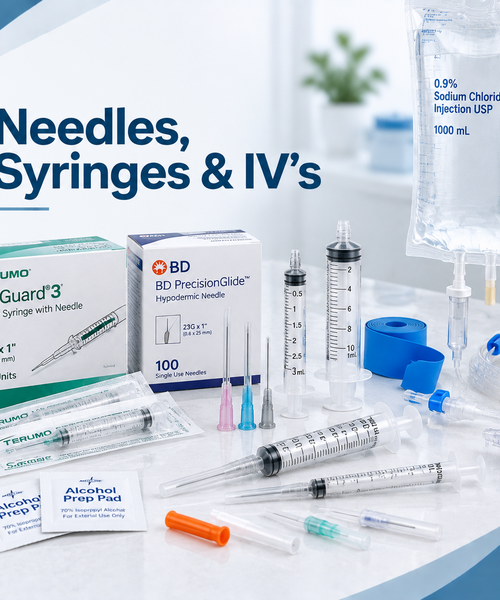
The 23-gauge (0.6mm outer diameter) needle provides the optimal balance between patient comfort and clinical functionalityāthe mid-range bore diameter enables adequate flow rates for routine medications including vaccines, antibiotics, and analgesics without the painful insertion associated with larger 21-gauge needles, while maintaining sufficient structural rigidity to penetrate skin and muscle tissue reliably unlike thinner 25-27 gauge needles that may bend during insertion or require excessive force compromising technique precision. The thin-wall PrecisionGlide design with reduced wall thickness compared to regular-wall needles increases the internal lumen diameter at the same outer gauge delivering approximately 20% greater flow rate enabling faster injection times that reduce patient discomfort duration, improved aspiration capability during blood draws preventing hemolysis from excessive vacuum, and better viscous medication delivery for suspensions or oil-based formulations that would flow too slowly through smaller-lumen needles. The 1-inch (25mm) length represents the universal standard for adult intramuscular injections accommodating deltoid, vastus lateralis, and ventrogluteal sites in average-weight patients, while remaining appropriate for subcutaneous injections in most adults when using proper technique including skin pinching to elevate subcutaneous tissueāthis versatile dimension eliminates the need to stock multiple needle lengths for routine applications while ensuring adequate depth for proper medication deposition in the majority of patients without excessive penetration risk in lean individuals. The tri-bevel PrecisionGlide tip with precision-ground cutting edge creates a three-faceted point achieving superior sharpness that requires minimal insertion force reducing tissue trauma, needle deflection during skin penetration, and the painful blunt-force pushing sensation patients experience with less precisely manufactured needles, while the proprietary silicone lubrication coating applied through BD's advanced process reduces friction during tissue penetration by up to 25% enabling the smooth gliding insertion that minimizes pain and anxiety particularly critical for pediatric patients, vaccine programs managing hundreds of daily injections where technique consistency affects patient experience, and home healthcare settings where non-professional caregivers require easy-to-use equipment.
Key Features & Benefits
Key Features:
- 23-gauge (23G) needle with 0.6mm outer diameter
- 1-inch (25mm) needle length
- PrecisionGlide⢠technology:
- Thin-wall design (increased internal lumen)
- Tri-bevel tip (precision-ground for sharpness)
- Proprietary lubrication coating
- Stainless steel construction
- Universal Luer connection (Luer Lock and Luer Slip compatible)
- Color-coded blue hub (23G per ISO 6009 standard)
- Rigid protective needle shield
- Sterile, individually packaged
- Single-use, disposable design
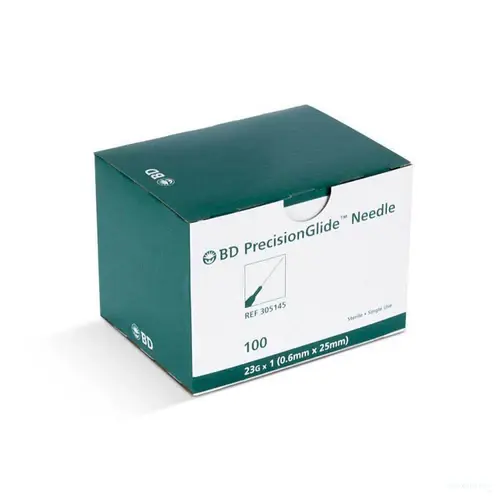
- Packaging: 5 needles per inner pack, 100 per outer box
- Latex-free construction
- Manufactured by Becton, Dickinson and Company (BD)
- Meets USP and ISO quality standards
Benefits:
- 23G balanced size:
- Less painful than larger gauges (21G, 18G)
- Adequate flow for most medications
- Good structural rigidity
- Versatile for multiple applications
- Thin-wall design increases flow rate ~20%
- Faster injections (reduced patient discomfort)
- Better aspiration (prevents hemolysis)
- Handles viscous medications
- Tri-bevel tip ensures sharp penetration
- Minimal insertion force required
- Reduced tissue trauma
- Smooth, gliding insertion
- Proprietary lubrication reduces friction
- Enhances patient comfort
- Easier for inexperienced users
- 1-inch length versatile:
- Standard for adult IM injections
- Appropriate for most SubQ injections
- Fits average-weight to slightly overweight patients
- Universal Luer fits all standard syringes
- Blue color-coding enables instant identification
- Rigid shield protects needle until use
- 5-pack inner packaging for controlled dispensing
- 100-count box ideal for high-volume settings
- Sterile packaging ensures infection control
- Single-use prevents cross-contamination
- BD quality and reliability
- Cost-effective for routine use
Clinical Applications
BD PrecisionGlide 23G Ć 1" Needles are appropriate for:
ā Intramuscular injections (primary use) ā Vaccine administration ā Antibiotic injections ā Analgesic medications ā Hormone injections ā Subcutaneous injections (with technique) ā Insulin (when prefilled syringes not used) ā Heparin, anticoagulants ā Blood collection (routine venipuncture) ā Laboratory specimen draws ā Drawing medication from vials ā Reconstituting medications ā IV line blood draws (some applications) ā Allergy testing (some protocols) ā Emergency department procedures ā Operating room medication administration ā Outpatient clinic procedures ā Home healthcare injections ā Any application requiring versatile 23G Ć 1" needle
Usage & Application
IMPORTANT: Needles should be used by trained healthcare professionals following proper technique and safety protocols.
Pre-Use Preparation:
- Verify indication and appropriateness:
- Confirm 23G Ć 1" appropriate for:
- Intramuscular injections (most common)
- Subcutaneous injections (most patients)
- Routine blood draws
- General medication administration
- Consider different size if:
- Very obese patients (may need 1.5")
- Very lean patients (may need 5/8" for SubQ)
- Pediatric (gauge/length varies by age)
- Gather supplies:
- BD PrecisionGlide 23G Ć 1" needle
- Appropriate syringe (Luer compatible)
- Alcohol swabs
- Gauze pads
- Tape or bandage
- Gloves
- Sharps container
- Hand hygiene and don gloves
- Inspect package:
- Check integrity and expiration
- Verify 23G Ć 1" specifications
- Ensure sterile seal intact
- 5-needle inner pack for convenient dispensing
Opening Package:
- Remove needle from packaging:
- Peel open sterile package
- Do NOT touch needle or hub tip
- Inspect needle:
- Check straightness
- Verify sharpness (no burrs)
- Ensure blue color-coding (23G)
Attaching to Syringe:
- Select appropriate syringe:
- Must have Luer connection
- Size appropriate for medication volume
- Attach needle:
- For Luer Lock syringe:
- Align threads
- Push and twist clockwise until secure
- Tug to verify tight
- For Luer Slip syringe:
- Push straight onto syringe tip
- Firm pressure until fully seated
- Remove needle shield:
- Pull straight off
- Do NOT touch needle
Drawing Medication:
- Prepare vial:
- Check medication, concentration, expiration
- Clean stopper with alcohol
- Draw air:
- Pull plunger to desired volume
- Insert and withdraw:
- Insert needle into vial
- Inject air
- Invert vial
- Withdraw medication
- 23G thin-wall provides good flow
- Remove air bubbles:
- Tap barrel
- Hold vertical
- Push plunger to expel air
- Verify dose
Intramuscular Injection:
Site Selection:
Deltoid (arm):
- 23G Ć 1" appropriate for most adults
- 1-inch adequate for average-weight patients
- Common for vaccines
Vastus lateralis (thigh):
- 23G Ć 1" appropriate
- Good for self-injection
- Pediatric site
Ventrogluteal (hip):
- Safest gluteal site
- 23G Ć 1" adequate for most
- Very obese may need 1.5"
Dorsogluteal (buttock):
- Use with caution (nerve risk)
- Proper landmarks critical
Procedure:
- Clean site:
- Alcohol swab in circular motion
- Allow to dry 30 seconds
- Position:
- Patient comfortable
- Muscle relaxed
- Stretch skin:
- Z-track technique (some medications)
- Or simply taut
- Insert needle:
- 90-degree angle (perpendicular to skin)
- Quick, dart-like motion
- 23G thin-wall smooth insertion
- Insert fully (or near-fully for average patients)
- Aspirate (per protocol):
- Pull back plunger slightly
- Check for blood
- CDC: No aspiration for vaccines
- For other medications: Follow facility protocol
- Inject medication:
- Slow, steady rate
- Typically 10 seconds per mL
- 23G thin-wall enables smooth flow
- Withdraw:
- Quick removal at insertion angle
- Apply pressure with gauze
- Do NOT massage (unless indicated)
- Dispose:
- Do NOT recap (needlestick risk)
- Immediately into sharps container
Subcutaneous Injection:
Site Selection:
- Abdomen (most common)
- Thigh
- Upper arm
- Back of arm
Procedure:
- Clean site
- Pinch skin:
- Create subcutaneous tissue fold
- 23G Ć 1" can be used SubQ with pinching
- Insert needle:
- 45-degree angle (typical for 1-inch SubQ)
- OR 90-degree if significant subcutaneous fat
- Insert to appropriate depth (not full length)
- Inject slowly:
- Release pinch (some protocols)
- Inject medication
- Count 5-10 after injection (ensures delivery)
- Withdraw and apply pressure
Blood Collection / Venipuncture:
- Apply tourniquet
- Select vein:
- 23G appropriate for most adults
- Good for routine draws
- Less hemolysis than smaller needles
- Clean site
- Anchor vein:
- Pull skin taut below site
- Insert needle:
- Bevel up
- 15-30 degree angle
- Smooth insertion
- Watch for flashback
- Collect blood:
- 23G provides good flow
- Less trauma than larger needles
- Release tourniquet
- Withdraw and apply pressure
Post-Use Care:
- Dispose immediately:
- Do NOT recap needle
- Place in sharps container
- Never reuse needles
- Hand hygiene
- Document:
- Procedure, medication, site, patient tolerance
Troubleshooting:
Difficult insertion:
- Ensure needle sharp (not dulled from vial access)
- 23G should insert smoothly with tri-bevel tip
- Use quick, confident motion
Needle bends:
- Should be rare with 23G (good rigidity)
- May indicate improper technique
- Use new needle
Poor medication flow:
- Thin-wall 23G should flow well
- Check for clogs
- Verify medication not too viscous
- Use steady, firm pressure
Blood on aspiration (IM injection):
- Intravascular placement
- Withdraw and discard
- Use new needle and different site
Excessive pain:
- 23G should be relatively comfortable
- Check technique
- Ensure alcohol dry
- Quick insertion reduces pain
Special Considerations:
Pediatric patients:
- 23G generally appropriate for older children/adolescents
- Younger children may need smaller gauge (25G)
- 1-inch may be long for very young
- Assess individual patient size
Geriatric patients:
- 23G appropriate
- May have fragile skin (gentle technique)
- Less subcutaneous fat (careful with depth)
Obese patients:
- 1-inch may be inadequate for deep IM in very obese
- Deltoid usually adequate (less subcutaneous fat)
- Gluteal sites may need 1.5-2 inches
- Assess individual patient
Very lean patients:
- 1-inch adequate for IM
- May be excessive for SubQ (consider shorter)
- Risk of hitting bone if inserted fully (deltoid)
Patients on anticoagulation:
- Apply pressure longer (5-10 minutes)
- Monitor for hematoma
- 23G smaller puncture than larger gauges
Home healthcare:
- Teach proper technique
- Demonstrate injection
- Practice with supervision
- Provide sharps container
- Clear disposal instructions
Vaccine administration:
- 23G Ć 1" standard for adult vaccines
- IM deltoid typical route
- No aspiration (per CDC)
- Quick injection
Infection Control:
- Aseptic technique throughout
- Never reuse needles
- Never share between patients
- Single-use only
- Dispose properly
Storage:
- Store at room temperature
- Keep in original packaging until use
- Protect from moisture and dirt
- Check expiration dates
- Rotate stock using FIFO
- Typical shelf life 5 years
Advantages:
23G vs. Other Gauges:
vs. Larger (21G, 18G):
- 23G advantages:
- Less painful
- Less tissue trauma
- More comfortable for patient
- Adequate for most medications
- Larger gauge advantages:
- Faster flow (viscous medications)
- Stronger (less bend risk)
vs. Smaller (25G, 27G):
- 23G advantages:
- Better flow rate
- More structural rigidity
- Less bend risk
- Faster injections
- Smaller gauge advantages:
- Less pain
- Better for very small volumes
When 23G optimal:
- Most routine IM injections
- Vaccines
- General medications
- Blood draws (routine)
- Balanced pain/function
PrecisionGlide vs. Regular Needles:
PrecisionGlide advantages:
- Thin-wall = increased flow (~20%)
- Tri-bevel = sharper insertion
- Lubrication = smoother entry
- Less pain
- Better patient experience
- Trusted BD quality
1-Inch vs. Other Lengths:
1-inch appropriate for:
- Most adult IM injections
- Average to slightly overweight patients
- Deltoid, vastus lateralis, ventrogluteal
- Most SubQ injections (with technique)
Consider different length:
- Very obese: 1.5-2 inches (gluteal IM)
- Very lean: 5/8-7/8 inches (SubQ)
- Pediatric: Varies by age
When to Contact Provider:
- Unable to perform procedure
- Patient complications
- Suspected nerve injury
- Hematoma formation
- Equipment concerns
Technical Specifications
Product Details:
- Brand: BD (Becton, Dickinson and Company)
- Product Line: PrecisionGlideā¢
- Product Type: Sterile hypodermic needle
- Needle Gauge: 23G (0.6mm outer diameter)
- Needle Length: 1 inch (25mm)
- Needle Tip: Tri-bevel (precision-ground)
- Wall Type: Thin-wall (increased internal lumen)
- Lubrication: Proprietary silicone coating
- Needle Material: Stainless steel
- Hub Color: Blue (23G per ISO 6009 color coding)
- Connection Type: Universal Luer (Luer Lock and Luer Slip compatible)
- Needle Shield: Rigid protective shield
- Sterility: Sterile until opened
- Sterilization Method: Ethylene oxide (EtO) or gamma radiation
- Latex Content: Latex-free (no natural rubber latex)
- Packaging:
- Inner Pack: 5 needles per pack
- Outer Box: 100 needles total (20 inner packs)
- Intended Use: Intramuscular injection, subcutaneous injection, blood collection, medication withdrawal
- Flow Rate: Enhanced by thin-wall design (~20% increase vs. regular-wall)
- Patient Population: Adults (primarily), older children/adolescents
- Shelf Life: Typically 5 years
- Storage: Room temperature, dry conditions
- Regulatory Status: FDA-cleared medical device, Class II
- Standards Compliance:
- ISO 7864 (sterile hypodermic needles)
- ISO 6009 (needle color coding)
- USP standards